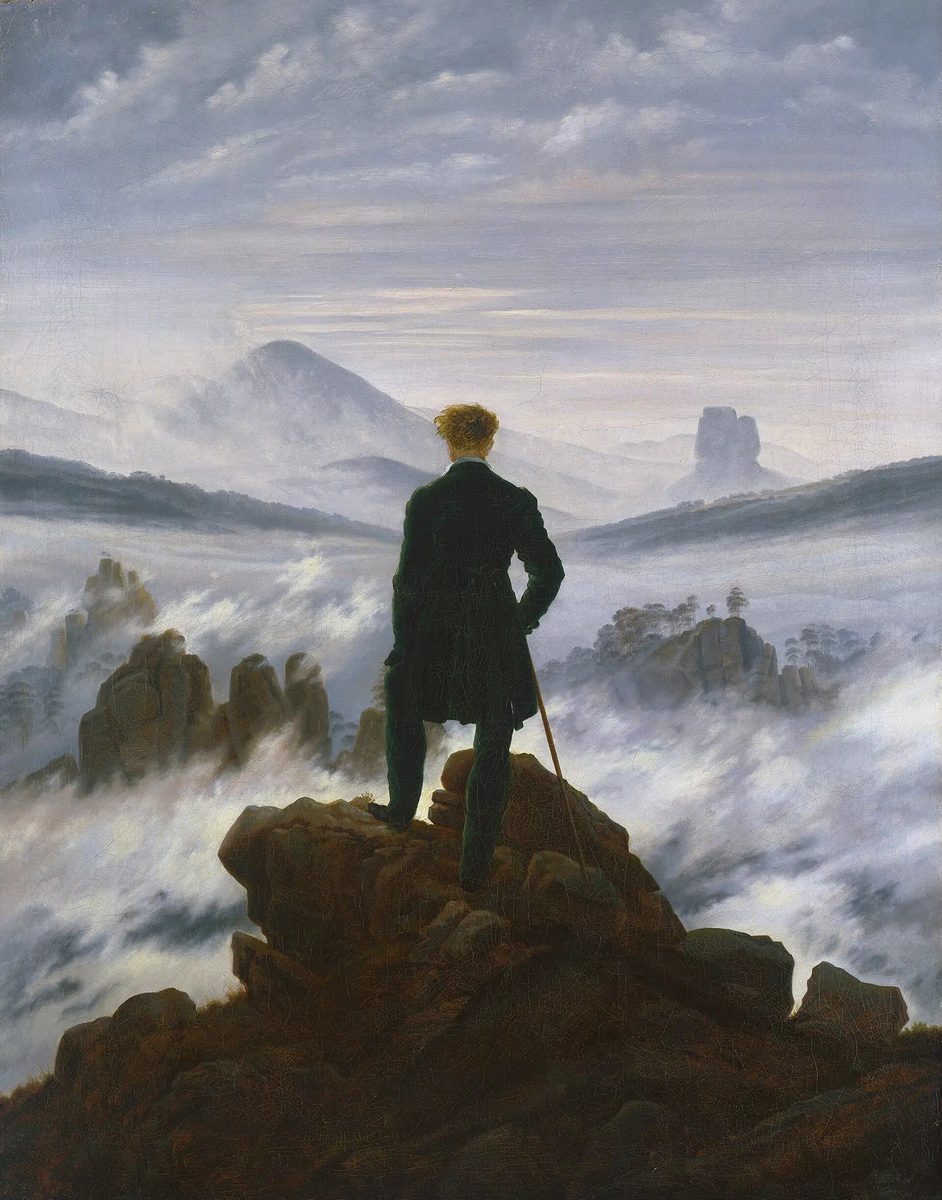
Caspar David Friedrich painted Wanderer above the Sea of Fog around 1818. The oil on canvas now hangs in the Hamburger Kunsthalle in Hamburg. Friedrich was born in Greifswald in 1774 and settled in Dresden in 1798. In this vertical picture a man in a dark coat stands on a rocky outcrop, seen from behind, above a sea of fog. Its palette is muted, built from browns, greens, grey-blue and white.
What the picture shows
A man stands on a rocky outcrop in the center of the picture, seen from behind. He wears a dark green long coat; his reddish-blond hair is blown by the wind. He leans on a walking stick in his right hand, and his left foot rests on a higher rock. Below him a sea of fog fills the valleys. Dark rock peaks with a few trees protrude from the fog. In the distance there are mountain ranges: a large mountain on the left and a tall rock pillar on the right. The sky is pale grey-blue with layered streaky clouds, lighter at the horizon. The foreground rocks are dark brown and almost black at the bottom. The composition is symmetrical, with the figure on the central axis. The muted palette includes grey, blue-white, dark green and brown. Fine craquelure is visible in the sky. The format is vertical, roughly four by five.
When and why the Wanderer above the Sea of Fog was painted
Friedrich was about forty-four when he made this picture. He had been living in Dresden since 1798 and had already developed the kind of landscape that German Romantic painters valued: a small human figure placed before wide, often misty natural scenery. By 1818 he was known for showing solitary figures before mountains, forests, or the sea. The figure seen from behind, a device later called a Rückenfigur, lets the viewer share the man's position without seeing his face. The fog and distant peaks turn the landscape into something larger than the person, an idea central to Romantic painting. Friedrich did not paint the scene from a single documented viewpoint; it is a composed landscape built from studies of rocks and mountains.
Seeing it at home
In a hand-painted copy of this picture, keep the original's vertical proportions, roughly four by five. Look for the muted palette of grey, blue-white, dark green and brown. The surface should show fine craquelure in the sky; the dark foreground rocks should stay nearly black at the bottom. A good copy keeps the figure on the central axis and preserves the soft transition from fog to pale grey-blue sky.