Famous Art, Explained Painting by Painting
This site is an online catalogue of public-domain paintings by old masters and 19th/early-20th-century painters. Each entry lists the date, medium, size, and museum, with a short explanation of what you are seeing.
Famous art in the catalogue
Browse by movement
The collection is grouped by movement as well as by painter. You can move from Renaissance panels by Botticelli to Baroque paintings by Caravaggio and Rembrandt. Later rooms include Romanticism, Impressionism, Post-Impressionism, Symbolism, Hudson River School, and Academic art. Each movement page shows painters and works from that period.
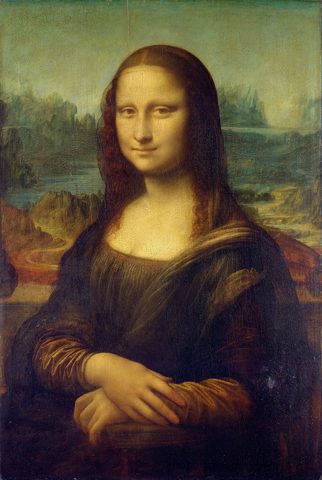
Museum visits often end in the gift shop, but the painting itself stays on the wall. A visitor to the Louvre can stand in front of Leonardo da Vinci's Mona Lisa for a few minutes before the crowd moves on. The painting, dated 1503 to 1506, is behind glass. People who want more than a memory look for a reproduction. A good print can show the composition, but it cannot show the surface. A hand-painted copy of an old master, made with oil on canvas, gets closer to the physical object.
Hand-painted copies have a practical history. When Rembrandt's The Storm on the Sea of Galilee was stolen from the Isabella Stewart Gardner Museum in 1990, it left a gap in the collection. The painting has never been recovered. A copy made from photographs gives homeowners a way to live with that dark sea and the boat tilted in wind. The painter copies the brushwork and adjusts the size to fit a wall. The same can be done with Botticelli's The Birth of Venus, c. 1478 to 1485, in the Uffizi Gallery, or with Goya's The Third of May 1808 in the Museo del Prado. A copy of that painting can be made at a smaller or larger canvas size, depending on the wall.
Prints are faster, but hand-painted copies offer a painted surface. A reproduction of Caravaggio's Judith Beheading Holofernes, c. 1598 to 1599 in the Galleria Nazionale d'Arte Antica, needs the thick highlights and deep blacks of oil paint. A digital print cannot reproduce the ridges left by a brush. For some people that difference is minor. For others, the weight of paint is the point. The catalogue pages here give size and medium for each painting so you can see what a copy would involve.
Beyond copies of old masters, there is newer hand-painted work. Artists today make abstract canvases to order. A buyer can choose a palette, a size, and an orientation. The canvas is painted by hand, not printed. It may be based on a color field, a geometric arrangement, or a loose gesture. These works do not copy a museum painting. They are made for a particular room. Because they are new, they are not in the public domain, but the process is the same as for a copy of an old master: oil or acrylic on canvas, built up in layers.
The shift from historical reproduction to commissioned abstract work is not as wide as it seems. Both start with a decision about what should hang on a wall. A hand-painted copy of Klimt's Portrait of Adele Bloch-Bauer I, 1907, Neue Galerie, brings a known image into a private home. A made-to-order abstract canvas brings a shape and color that did not exist before. The same guides explain how to measure a wall and choose a frame.
A living hand and the same process
Beyond copies of old masters there is newer work: artists today make hand-painted abstract art made to order. The canvas is painted by hand, not printed — oil or acrylic built up in layers, chosen for a particular room.