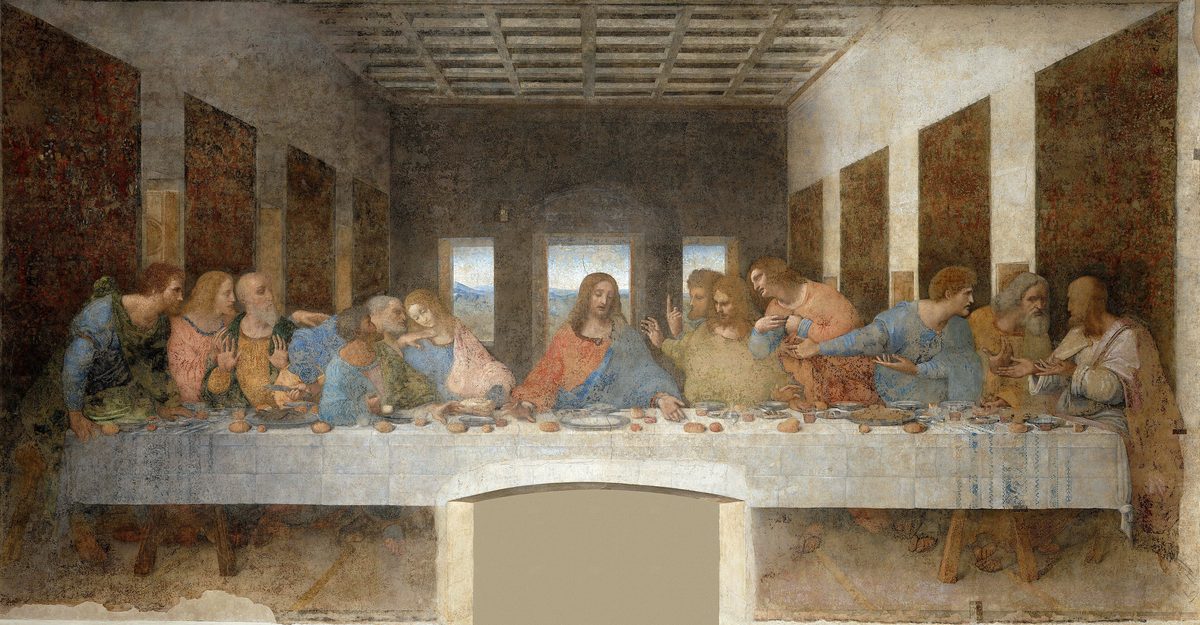
Leonardo da Vinci painted The Last Supper in the 1490s, usually dated about 1495–1498, in tempera on gesso applied to a dry wall rather than as true fresco. The mural measures about 460 by 880 centimeters and covers an end wall of the refectory at Santa Maria delle Grazie in Milan, where it remains. The subject is the meal at which Christ told the apostles one of them would betray him. It was painted for the dining hall of the Dominican friars. Today the surface is worn and flaking, but the arrangement of figures and the room still reads clearly.
What The Last Supper shows
Standing before the mural, you see a long table parallel to the picture plane, covered with a white cloth that has a blue-striped pattern at the right end. Thirteen men sit behind it facing you: Christ at the center and twelve apostles in four groups of three. Christ wears a red robe and blue mantle, arms spread on the table, head slightly bowed, framed by the middle window. The apostles lean, turn, and gesture; several raise their hands, and one points a finger upward just left of Christ. Bread rolls and dishes are scattered on the cloth. The room recedes in strong central perspective, with a coffered ceiling and dark panels on both side walls. Three openings in the back wall show a pale blue hilly landscape and sky. The paint is worn and flaking; the colors are faded to muted reds, blues, ochres, and grey. A later doorway cuts an arched gap through the lower center, removing Christ's feet. Along the lower edge, the legs of the table and benches and the feet of some figures remain partly damaged.
When and why it was painted
Leonardo painted The Last Supper in the 1490s while he was living in Milan and working for the Sforza court. The mural was commissioned for the refectory of Santa Maria delle Grazie. Leonardo chose tempera on gesso instead of the fresco technique common in Italy at the time, which allowed him to work slowly and revise details but also made the surface fragile. The painting belongs to the High Renaissance, a period when artists in Italy pursued clear spatial order, careful observation of gesture, and balanced compositions. Here Leonardo places Christ at the exact center, framed by the middle window, and sets the table and the coffered ceiling in strong central perspective. The apostles' reactions to Christ's announcement become the main subject.
Seeing it at home
A hand-painted copy of The Last Supper will rarely match the original's scale of about 460 by 880 centimeters, so look for a reduced size that keeps the horizontal format. The copyist should follow the worn, flaking surface and the muted reds, blues, ochres, and grey rather than clean, bright colors. Check that the central perspective of the coffered ceiling and the gestures of the twelve apostles remain readable.