Leonardo da Vinci Paintings
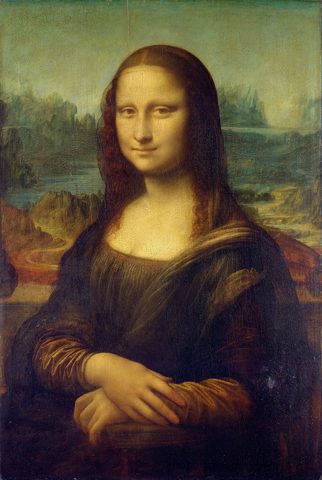
Leonardo da Vinci was an Italian High Renaissance painter, draftsman, engineer, and scientist, born in 1452 in Vinci and active until his death in 1519. He trained in Florence under Andrea del Verrocchio and produced a small number of paintings, with about fifteen generally attributed to him. This catalogue includes two: the Mona Lisa (1503-1506) and The Last Supper (1490-1499).
These da Vinci paintings matter today because they concentrate the period's study of anatomy, light, and facial expression. The originals draw millions of visitors to the Louvre in Paris and to Santa Maria delle Grazie in Milan. Conservators still examine their fragile surfaces, and art historians use imaging techniques to see how Leonardo built his layers. His method of softening outlines, called sfumato, shaped later portrait painting across Europe.
Life and training
Leonardo da Vinci was born in 1452 in Vinci, a hill town near Florence in Tuscany. He was the illegitimate son of a notary, Ser Piero da Vinci, and a local woman named Caterina. Because illegitimate sons could not become notaries, Leonardo was free to pursue manual and artistic training. Around 1466 his father placed him in the Florence workshop of Andrea del Verrocchio, one of the city's leading sculptors and painters. There he learned drawing, perspective, painting, metalwork, and the preparation of pigments. Verrocchio's workshop emphasized close observation from life, and Leonardo's early drawings already show the same attention to detail.
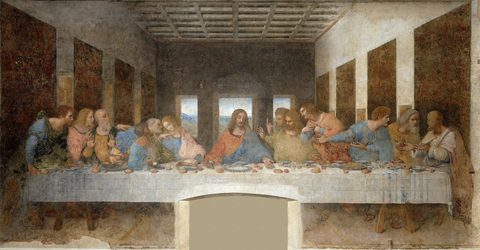
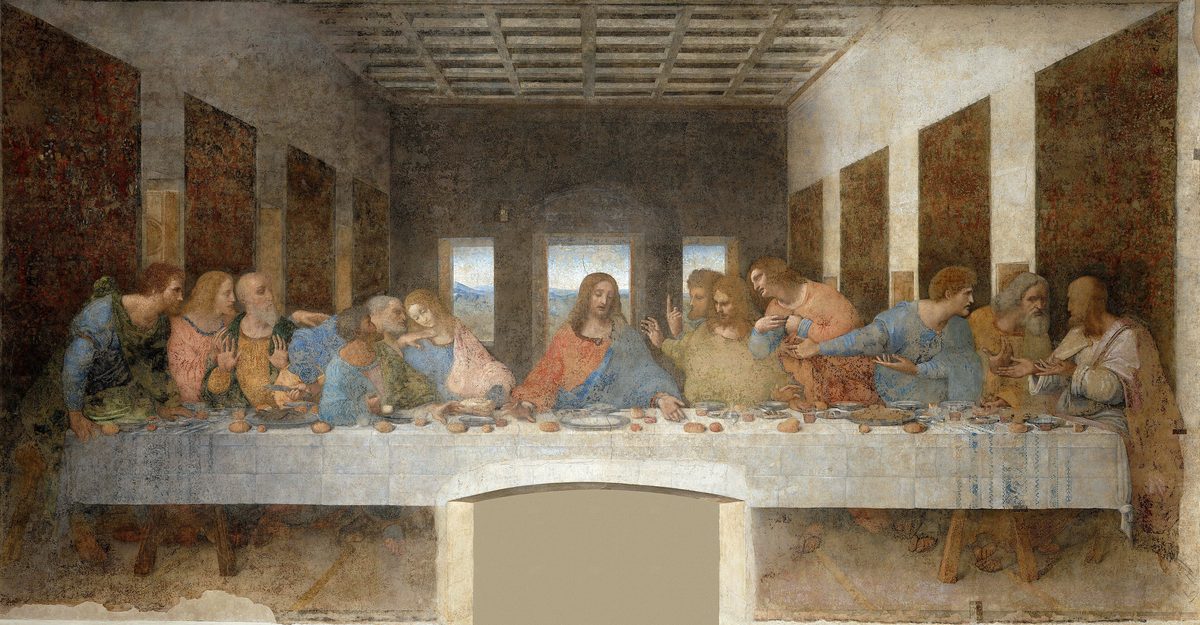
By 1472 Leonardo was enrolled in the Florentine painters' guild, the Compagnia di San Luca. He stayed in Florence until about 1482, when he moved to Milan and entered the service of Duke Ludovico Sforza. In Milan he worked on court portraits, pageant designs, hydraulic projects, and an unfinished bronze horse for a Sforza monument. The most important surviving painting from his first Milan period is The Last Supper, executed in the 1490s on a wall of the refectory at Santa Maria delle Grazie. The painting began to deteriorate soon after completion, a problem that has shaped every later restoration.
When Milan fell to French troops in 1499, Leonardo left the city and returned to Florence in 1500. He began the portrait now known as the Mona Lisa around 1503 and kept working on it for several years. In 1502 he had served briefly as a military engineer for Cesare Borgia, surveying fortifications in central Italy. He also worked on a mural of the Battle of Anghiari in Florence, which was left unfinished. From 1506 he moved between Florence and Milan, and in 1513 he traveled to Rome, where he lived in the Vatican at the invitation of Giuliano de' Medici.
Throughout these years Leonardo filled notebooks with studies of anatomy, water, flight, and mechanics. He dissected human cadavers in Florence and Milan and made drawings of muscles, bones, and organs that were not published in his lifetime. In 1516 he accepted the invitation of King Francis I of France and moved to the manor of Clos Lucé near Amboise. He brought notebooks, drawings, and several paintings with him, including the Mona Lisa. He died at Clos Lucé on May 2, 1519, at the age of sixty-seven.
Style and technique
Leonardo built his paintings in thin, translucent layers. For the Mona Lisa he used oil on a poplar panel, applying numerous glazes so that the shift from light to shadow has no visible edge. This technique, called sfumato, softens the corners of the mouth and eyes. For The Last Supper he chose tempera on a dry gesso ground rather than traditional fresco. That let him rework details over several years, but the paint did not bond well with the wall, and flakes began to fall within decades.
His palette in the two catalogued works is restrained: earth ochres, browns, deep greens, and a muted blue for the distant landscape behind the Mona Lisa. The light usually falls from the upper left, modeling the forms without harsh highlights. Leonardo also used chiaroscuro, strong contrast between light and dark, to make figures turn in space. In The Last Supper the apostles are arranged in four groups of three, and the central window behind Christ frames his head as the vanishing point. He paid special attention to hands, using them to signal mood and intent. In the Mona Lisa the sitter's right hand rests over the left, a gesture of composure.
His subjects were portraits and religious narrative. He learned precise drawing and bronze casting from Verrocchio, but he replaced the harder outlines of early Florentine painting with atmospheric perspective. Mountains and rivers in the Mona Lisa background fade into a bluish haze, matching the natural change in visibility over distance. Over time his brushwork became less visible and more blended, so that later works emphasize anatomy, gesture, and facial expression over contour. These innovations influenced Raphael and later Baroque painters.
Key da Vinci Paintings
The most famous Leonardo da Vinci paintings are the Mona Lisa (1503-1506) and The Last Supper (1490-1499), the two works catalogued on this site. The Mona Lisa is oil on poplar panel, 79.4 x 53.4 cm, and hangs in the Louvre in Paris. It shows a woman seated on a balcony before a distant, rocky landscape. Her hands are crossed, and her faint smile is produced by the blurred edges around the mouth. The painting matters because its layered glazes and pyramidal composition became a model for later portrait painters.
The Last Supper is tempera on gesso, about 880 cm wide, in the refectory of Santa Maria delle Grazie in Milan. It shows the moment after Christ says that one of the twelve apostles will betray him. The apostles react in four groups of three, while Christ sits alone in the center against a bright window. The work matters as a study of gesture and as a restorer's challenge, since the paint has flaked repeatedly since the 16th century.
Other paintings by Leonardo da Vinci include Lady with an Ermine, completed around 1491. The work shows Cecilia Gallerani, a young woman in the Milanese court, holding a white ermine against a dark background. The animal was a symbol of purity and of Duke Ludovico Sforza, who used the ermine as a personal emblem. The portrait is now in the Czartoryski Museum in Kraków.
Ginevra de' Benci, painted around 1474-1478, is one of Leonardo's earliest surviving portraits. It shows a young Florentine woman with pale skin and ringlets, set against a juniper bush. The painting is in the National Gallery of Art in Washington, D.C., and is notable for its reverse side, which carries a Latin motto and a sprig of juniper.
Where to see the originals
The Mona Lisa hangs in the Salle des États at the Louvre in Paris, behind protective glass. The Last Supper is painted on the north wall of the refectory at Santa Maria delle Grazie in Milan; visits require timed entry and are limited to small groups. Lady with an Ermine is in the Czartoryski Museum in Kraków, which is part of the National Museum. Ginevra de' Benci is in the National Gallery of Art in Washington, D.C. Check each museum's official website for current hours, temporary closures, and photography rules. Both the Louvre and the National Gallery of Art post collection pages with dimensions and provenance.