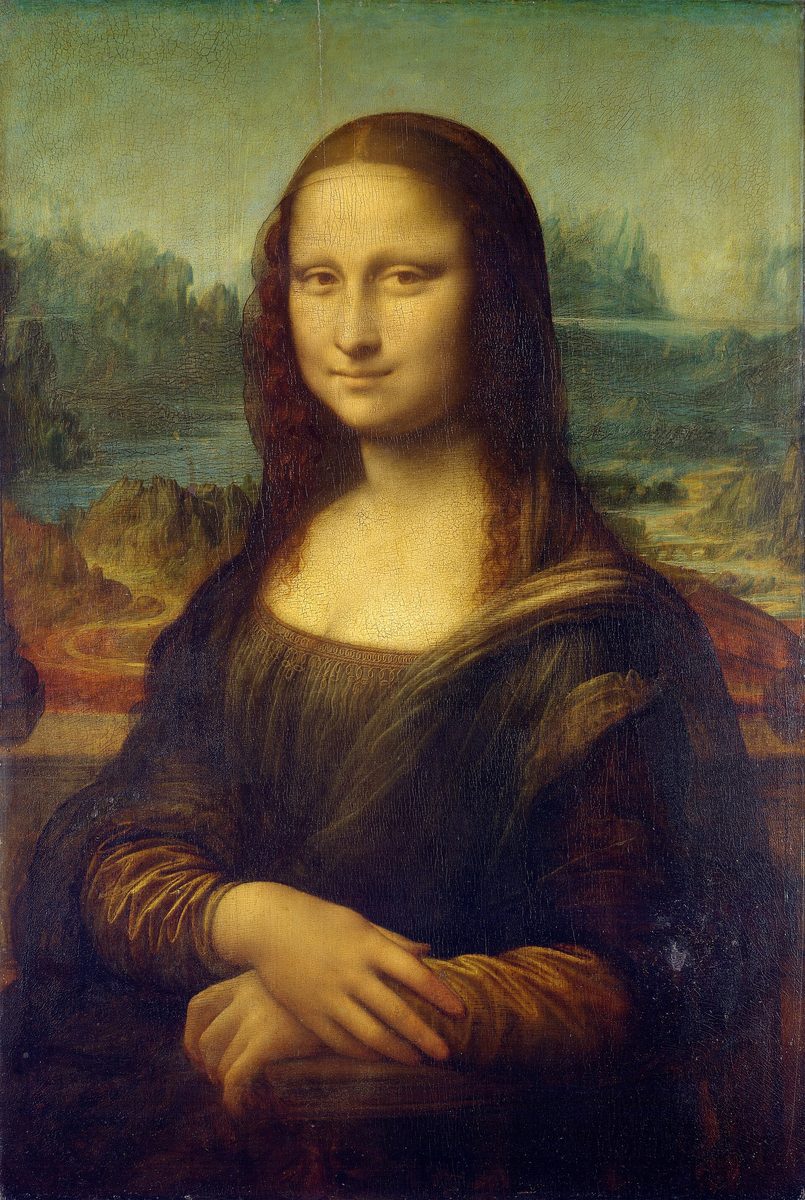
The Mona Lisa is an oil painting on poplar panel by Leonardo da Vinci, begun around 1503 and usually dated 1503–1506, though he may have kept working on it later. The panel measures 79.4 by 53.4 centimeters and hangs in the Louvre in Paris. The format is vertical, roughly 2:3. It shows a half-length seated woman against an imaginary landscape. Leonardo built the face and landscape with soft transitions of light and shade, avoiding hard outlines. The surface has fine craquelure and a yellow-green tone from the varnish.
What the picture shows
She sits half-length, turned slightly to her left, with her face and gaze directed at you. Her smile is faint and closed-lipped; she has no visible eyebrows or eyelashes. Dark hair falls in loose waves over her shoulders, partly covered by a thin transparent veil. Her dark green-brown dress has a low rounded neckline edged with fine embroidered interlacing and pleated gathers across the bodice. The sleeves are warm ochre-gold with folds, and a dark wrap is draped over her left shoulder. Her hands are folded, the right resting on the left wrist, on the arm of a chair at the bottom of the picture. Behind her a low parapet opens onto an imaginary landscape of winding paths, a river, a bridge on the right, and jagged rocky mountains. The background fades into blue-green haze toward the top; the horizon on the left sits lower than on the right. Light falls on the face and chest from the left, and the modelling is soft, without hard outlines.
When and why it was painted
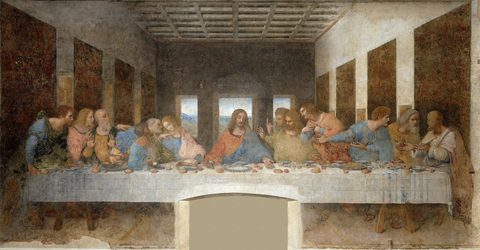
Leonardo was in his early fifties when he began the Mona Lisa, around 1503. He had already completed The Last Supper in Milan and was working in Florence on projects such as the Battle of Anghiari mural. The Mona Lisa belongs to the High Renaissance, a period when painters aimed to combine accurate observation with calm, balanced composition. Leonardo's interest in geology and atmosphere appears in the rocky peaks and blue-green haze behind the sitter. The soft modelling and the balanced triangular arrangement of the figure reflect High Renaissance ideas. Leonardo used sfumato here, the soft blending of tones without sharp edges. The picture was never handed over to a patron, and it stayed in Leonardo's possession for years after he began it.
Seeing it at home
In a hand-painted copy of the Mona Lisa, keep the original size in mind: 79.4 by 53.4 centimeters. A careful copy follows the vertical format and the same proportions. Look for the dark green-brown dress, the warm ochre-gold sleeves, and the blue-green haze in the landscape. The surface should show fine craquelure and an overall yellow-green tone from the varnish, not a bright, even finish.