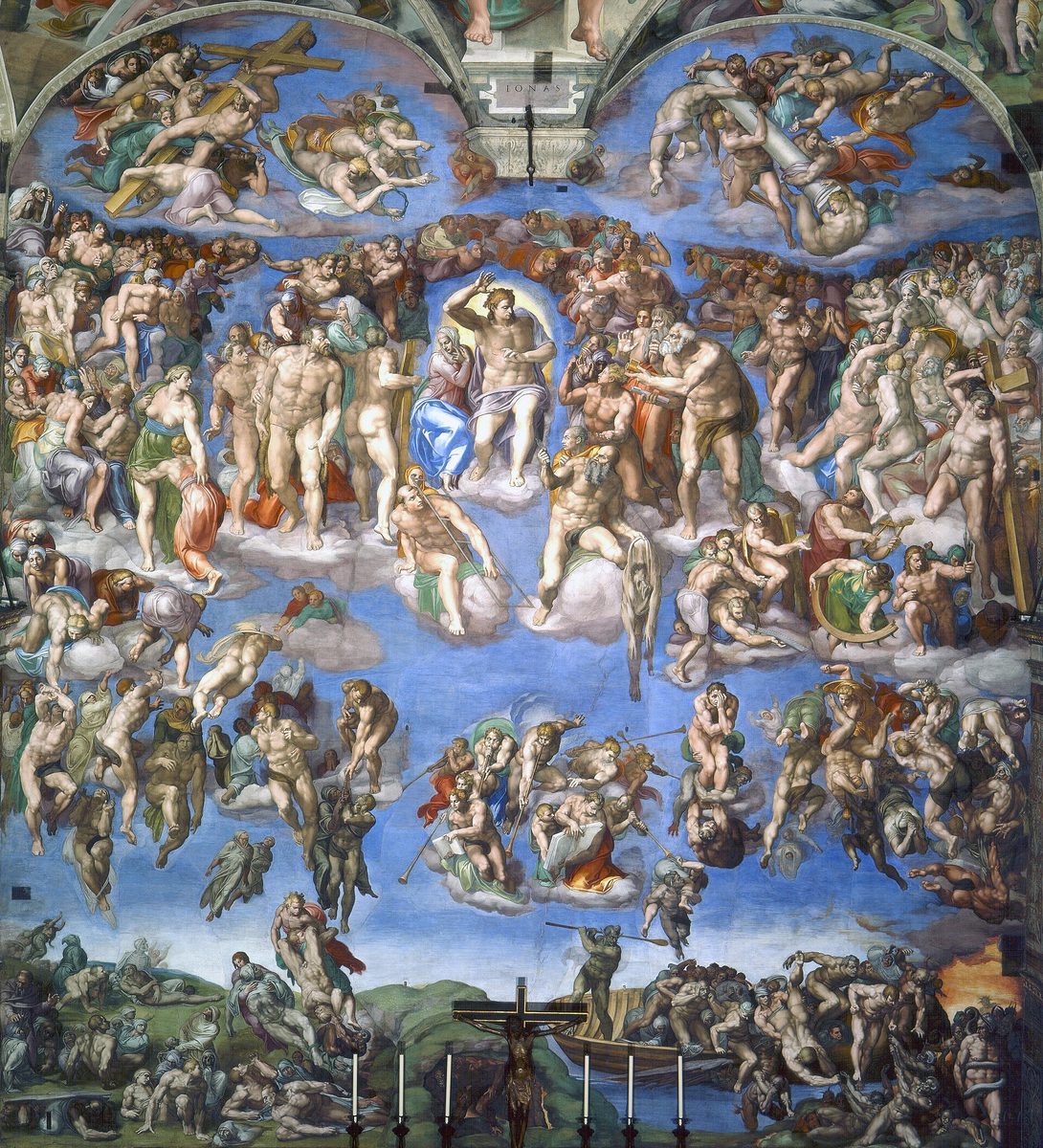
The Last Judgment by Michelangelo is a fresco painted between 1536 and 1541. It covers the altar wall of the Sistine Chapel in Vatican City and belongs to the Vatican Museums. The work measures 1370 by 1220 centimeters and fills the wall from floor to vault, following the chapel's arched top. Michelangelo, born in 1475, began this work at age 61 and completed it in 1541. The medium is fresco, painted directly on the wall plaster, not oil on canvas.
What The Last Judgment by Michelangelo shows
Several hundred mostly nude, muscular figures are arranged in tiers across a bright blue sky. At the upper center a beardless, muscular Christ stands in a pale yellow aureole with his right arm raised; the Virgin in blue sits close beside him, turned inward. Crowds of saints ring Christ. Below him, a seated saint holds a knife and a flayed human skin. In the arched lunettes, wingless figures carry a large wooden cross on the left and a column on the right. Below, a cluster of figures on a cloud blows long trumpets while two hold open books. On the left figures rise upward, some pulled by others; on the right figures fall or are dragged down. At the bottom left bodies and skeletons emerge from the earth on a green-brown ground. At the bottom right a boatman raises an oar over a crowded boat; demonic figures and a red-orange glow appear at the far right edge. Strong flesh tones, ochres and reds stand against dominant ultramarine blue; figures are sharply modelled.
When and why it was painted
Michelangelo began the fresco in 1536, when he was 61. He had painted the Sistine Chapel ceiling between 1508 and 1512 and then spent years in Florence on the Medici Chapel and the Laurentian Library. The Last Judgment brought him back to the Vatican, where he worked on wet plaster for about five years. Earlier paintings on the altar wall were removed to make room for the single large scene. The crowded, muscular figures show the High Renaissance interest in the body as a vehicle of expression, but the compressed space and anxious movement point toward mid-16th-century changes in religious art. When the fresco was unveiled in 1541, the amount of nudity drew criticism and draperies were later added to some figures.
Seeing it at home
A hand-painted copy of The Last Judgment is usually much smaller than the original 1370 by 1220 centimeter fresco, and normally painted on canvas instead of plaster. Look for the strong ultramarine blue background, the pale yellow aureole around Christ, and the warm flesh tones against ochres and reds. The figures should feel sharply modelled, with clear outlines and muscular weight, not blurred patches of color.