Michelangelo Paintings
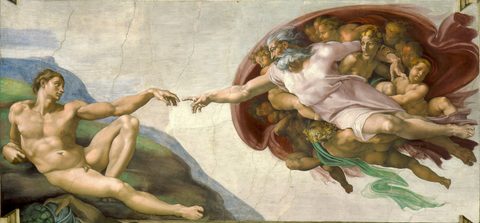
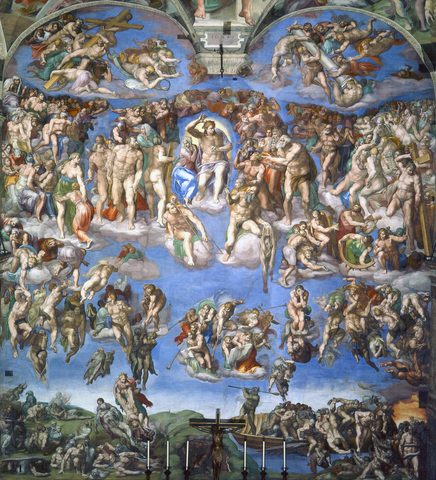
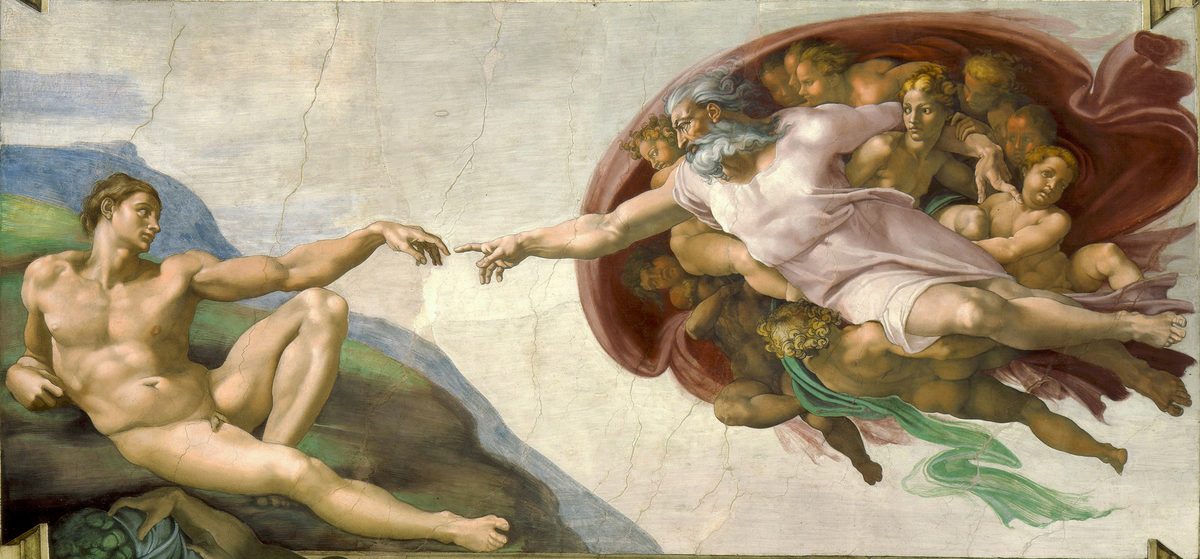
Michelangelo Buonarroti was an Italian sculptor, painter, and architect born in 1475 in Caprese, Republic of Florence, and active mainly in Florence and Rome. He trained as a painter in Domenico Ghirlandaio's workshop, but his surviving paintings are few; the frescoes in the Sistine Chapel are the best known. Michelangelo paintings matter today because they set a benchmark for how the human body can carry weight, movement, and emotion in large-scale religious art. The Creation of Adam from 1511 is one of the most reproduced images in Western art, and The Last Judgment still draws visitors to the Vatican Museums. His painted work, though less abundant than his sculpture, shows the same interest in anatomy, gesture, and tense physical energy. His few panel paintings, including the Doni Tondo, show him working in oil and tempera with a bright, sculptural palette.
Life and training
Michelangelo was born on March 6, 1475, in Caprese, a town in the Republic of Florence, and his family returned to Florence when he was an infant. He was the second of five sons. At age 13 he was apprenticed to Domenico Ghirlandaio, one of Florence's leading fresco painters, where he learned to prepare walls, grind pigments, and draw from models. By 1489 he was studying in the sculpture garden of Lorenzo de' Medici at San Marco, copying classical marble statues and meeting writers and philosophers of the Medici circle. After Lorenzo died in 1492, unrest in Florence pushed Michelangelo first to Bologna in 1494 and then to Rome in 1496. In Rome he carved the Pietà for St. Peter's Basilica, completed in 1499, which made his name as a sculptor. A rare painted work, the Doni Tondo, was made later in Florence for Agnolo Doni. The round panel shows the Holy Family with nude figures in the background, a subject that signals his continued study of antique sculpture.
Michelangelo returned to Florence in 1501 and received the commission for the marble David, unveiled in 1504. In 1505 Pope Julius II called him to Rome to design a monumental tomb, but the project was repeatedly interrupted. In 1508 Julius II asked him to paint the ceiling of the Sistine Chapel, a project Michelangelo accepted reluctantly. Between 1508 and 1512 he painted more than 300 figures illustrating scenes from the Book of Genesis, prophets, and ancestors of Christ. He moved to Rome permanently in 1534 and between 1536 and 1541 painted The Last Judgment on the altar wall of the Sistine Chapel. Later frescoes in the Pauline Chapel, The Conversion of Saul and The Crucifixion of St Peter, occupied him from 1542 to 1550. In his final decades he worked mainly as an architect, including on St. Peter's Basilica. Michelangelo died in Rome on February 18, 1564, at age 88 and was buried in Santa Croce in Florence. His body was brought back to Florence despite his long residence in Rome, fulfilling a wish to be buried in his native city.
Style and technique
Michelangelo's paintings are dominated by the human figure. He studied anatomy through dissection and drawing, and his painted bodies often look like sculpture translated into color. In the Sistine Chapel ceiling he used a fresco technique: each day he applied a patch of wet plaster, called a giornata, and painted pigments mixed with water before the plaster set. The palette of The Creation of Adam is concentrated in warm ochres, earth reds, soft greens, and pale blue. His early training with Ghirlandaio gave him a sure command of line, but his figures have more weight and torsion than those of his teacher. He studied Masaccio's frescoes in the Brancacci Chapel in Florence, where figures stand with simple drapery and solid shadows. For centuries the ceiling looked muted under dirt and old varnish, but cleaning from the 1980s revealed unexpectedly bright color, especially in the seated prophets.
Michelangelo's style changed from the balanced, classical harmony of the ceiling to the crowded, twisting composition of The Last Judgment, painted more than two decades later. In the later fresco the blue ground is filled with muscular bodies in motion, and the paint handling becomes broader and less concerned with smooth finish. The Pauline Chapel frescoes go further toward dark, compressed space and unusual color, with Christ appearing in a blaze of light. The Doni Tondo uses oil and tempera on wood and shows the same interest in the serpentine pose, bright clothing, and sculptural modeling. Throughout his career he returned to drawing as the foundation, making red and black chalk studies that record every limb before it reached the wall. This emphasis on the nude, even in religious scenes, caused later censors to add drapery over some figures in The Last Judgment.
Key Michelangelo Paintings
The Doni Tondo, painted around 1505 to 1507 for Agnolo Doni, now hangs in the Uffizi in Florence. It shows the Holy Family in a circular format, with Mary twisting toward the Christ child and Joseph while nude young men sit behind a wall in the background. It is the only finished panel painting generally accepted as entirely by Michelangelo. The Creation of Adam, a fresco from 1511, occupies a central position on the Sistine Chapel ceiling. God the Father sweeps toward the earthbound Adam, and their extended index fingers almost touch; the composition compresses the entire story of creation into one charged moment. The panel is 280 by 570 cm, large enough for the two figures to dominate the vault. Adam's reclining body rises from the earth, while God's robe billows like a sail filled with air. The Last Judgment, painted between 1536 and 1541, covers the altar wall of the Sistine Chapel. More than 300 figures crowd around Christ as judge, with the saved rising on one side and the damned falling on the other. Michelangelo included his own face in the flayed skin held by St Bartholomew. The fresco is 1370 by 1220 cm and replaced an earlier altar wall painting; its nudity led to later overpainting of draperies, some of which was removed in restoration. The Conversion of Saul, a later fresco from 1542 to 1545 in the Pauline Chapel, shows Saul thrown from his horse by a divine light while his companions scatter in confusion. These later Roman frescoes show the painter moving away from the clear, balanced space of the ceiling toward dense, dramatic scenes.
Where to see the originals
The two paintings in this catalogue, The Creation of Adam and The Last Judgment, are both in the Sistine Chapel, part of the Vatican Museums in Vatican City. Visitors need a timed ticket for the museums, and the chapel is at the end of the usual route. The Doni Tondo hangs in the Uffizi in Florence. The Pauline Chapel frescoes are in the Apostolic Palace and are generally not open to the public. For a small panel by Michelangelo, the National Gallery in London holds The Entombment, an unfinished work from around 1500. The Sistine Chapel is a chapel within the Apostolic Palace; silence is required inside, and photography is not allowed.