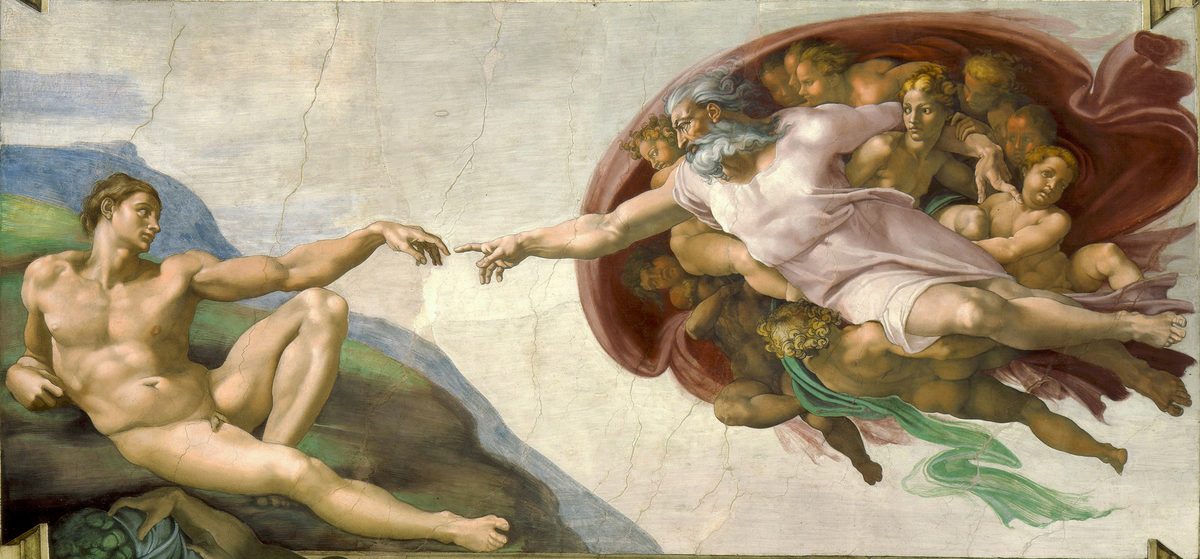
Michelangelo painted The Creation of Adam in 1511 as a section of the Sistine Chapel ceiling frescoes. The artist was 36 years old at the time. The painting measures 280 by 570 centimeters, and it is a fresco, with pigment applied to fresh plaster. It is part of the chapel within the Vatican Museums in Vatican City. Visitors see it high on the chapel ceiling, above the rows of seated prophets and sibyls that frame the central biblical scenes.
What the picture shows
On the left, Adam, a nude young man, reclines on a green and brown slope. He leans on his right elbow with his left knee raised, and his left arm extends limply toward the center, the hand and finger slightly drooping. On the right, a grey-bearded God in a light pinkish-violet tunic flies horizontally inside a large reddish-brown cloak shaped like a shell. About ten wingless children and young figures crowd the cloak with him. One young woman with wide eyes looks out from under God's left arm, which rests around her shoulders. God's right arm stretches out and his index finger points forward; the two fingers almost touch near the center, leaving a narrow gap of pale sky. Behind them the background is pale grey-white with a strip of blue-grey distant land on the left. A green drapery trails down at the bottom right. Cracks in the plaster run vertically through the sky, and the sharply modeled anatomy is lit from the left.
When and why The Creation of Adam was painted
Michelangelo was 36 in 1511 and already known for sculptures such as the Pietà and David. Pope Julius II had interrupted his work on the papal tomb to commission the Sistine Chapel ceiling, a project the artist took up in 1508 and completed in 1512. The Creation of Adam belongs to the central series of scenes from Genesis, placed between the ceiling's framing prophets and sibyls. Its treatment of the nude male body and the quiet tension between two reaching hands reflects High Renaissance interests in anatomy, balanced composition and biblical narrative. A vertical crack runs through the plaster of the sky beside God's cloak.
Seeing it at home
A hand-painted copy should keep the original's wide 2:1 horizontal format even when scaled down. Since the original is a fresco, look for a matte, slightly irregular surface rather than a glossy finish. Match the palette: the pinkish-violet tunic, reddish-brown cloak, pale grey-white sky, blue-grey land strip on the left, and the muted green drapery at lower right.