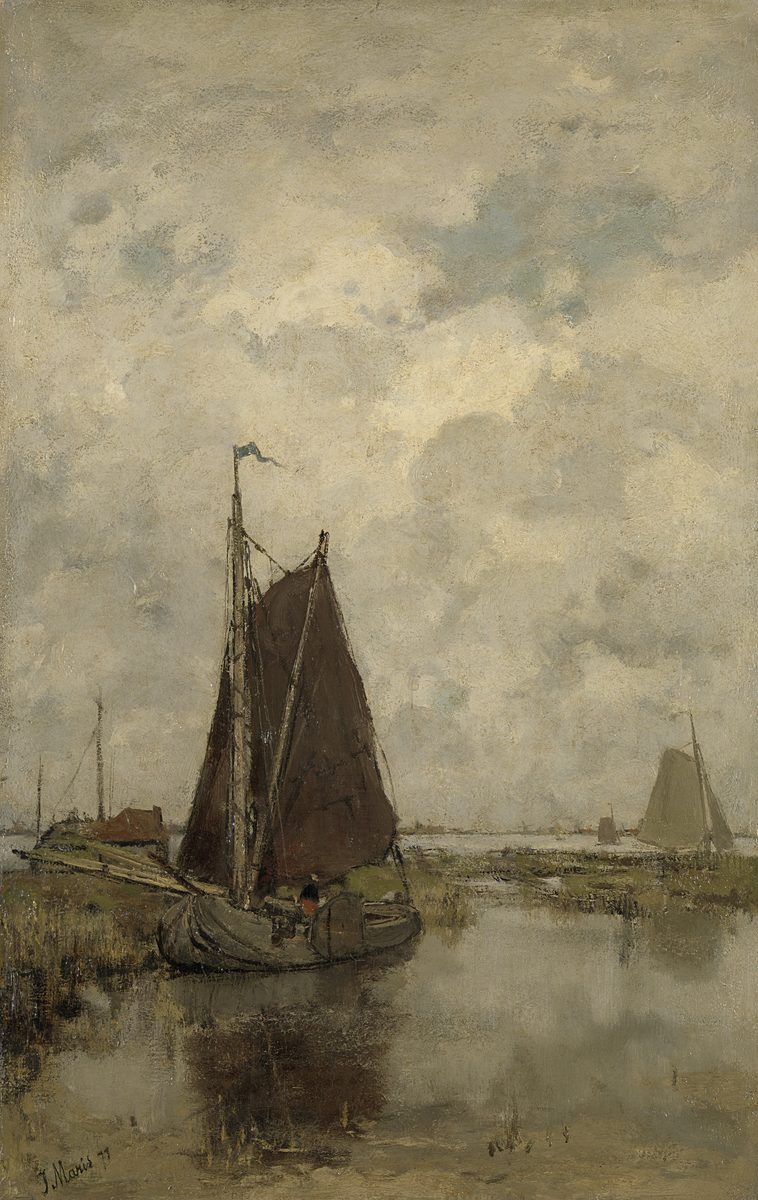
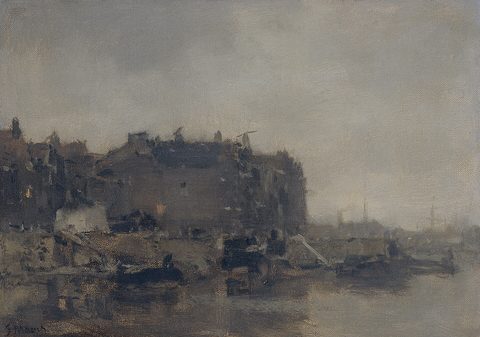
Grey Day with Ships by Jacob Maris is an oil on canvas from 1877. It is in the Rijksmuseum Amsterdam. Maris was about 40 years old when he painted it, and he worked in the loose, direct manner of the Hague School. The canvas measures 60.0 by 38.0 cm, a vertical format that leaves most of the picture to the sky. A Dutch sailing barge stands moored at a grassy bank, with a small figure in red on deck.
What the picture shows
The canvas is vertical, about 5:8. A Dutch sailing barge with two dark brown sails stands left of center, moored at a grassy bank. A small pennant flies from the top of the mast, and rigging lines are visible. A small figure, apparently in a red top, is on the deck near the bow. Behind the barge on the left sit a low red-roofed shed and a second, bare mast. On the right, further off, a boat with a pale sail appears, and a smaller dark sail is visible far on the horizon. Calm grey water in the foreground reflects the barge and sky; reeds and grass grow at the edges. The horizon is low and flat, about one third of the height, leaving the upper two thirds to heavy grey, cream and white clouds with small gaps of pale blue. The paint is applied in loose, broad strokes, with a palette of greys, browns and olive greens. The work is signed lower left 'J. Maris 77'.
When and why Grey Day with Ships was painted
Jacob Maris was born in 1837, so he was about 40 in 1877. He had trained in Antwerp and spent time in Paris before settling in the Netherlands, where he became a central figure in the Hague School. That group of Dutch painters, active in the last decades of the 19th century, preferred loose brushwork, soft grey light and straightforward scenes of water, shore and working boats. Grey Day with Ships fits that approach: a quiet waterway, a moored barge, and a sky that takes up most of the canvas. The small figure, bare mast and low shed are handled without drama, as if he recorded a working day rather than a heroic seascape.
Seeing it at home
If you commission a hand-painted copy of Grey Day with Ships, keep the original scale in mind: 60.0 by 38.0 cm is small enough that a copy at original size or slightly larger works well. Look for broad, loose handling and a limited palette of greys, browns and olive greens. The surface should not be overblended; the clouds and water depend on visible brushwork to hold the grey light.
Related paintings
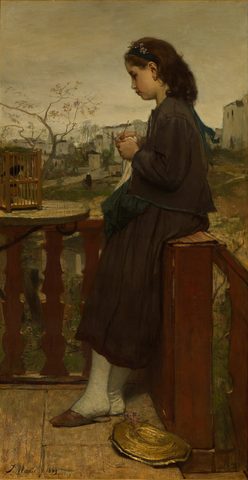
Girl Knitting on a Balcony in Montmartre
Huizen aan de Prins Hendrikkade te Amsterdam op een mistige dag
Jaagpad