Katsushika Hokusai Paintings and Prints
Katsushika Hokusai was a Japanese ukiyo-e artist born in Edo (now Tokyo) in 1760 and active until his death in 1849. He designed woodblock prints and illustrated books, and his most famous image, The Great Wave off Kanagawa, came from the series Thirty-six Views of Mount Fuji, published in the early 1830s. The series grew to 46 prints, each built around Mount Fuji in different weather and seasons. Hokusai's work matters today because his compositions and use of Prussian blue influenced European painters in the late 1800s, and his landscapes still shape how people picture Japan. The flat color and cropped compositions of prints like The Great Wave interested Claude Monet and Vincent van Gogh, both of whom collected Japanese prints. One impression of the print is in the Metropolitan Museum of Art in New York City.
Life and training
Katsushika Hokusai was born in the Honjo district of Edo in 1760, the son of a mirror maker named Nakajima Ise. At around age 12 he worked in a circulating library, where he handled illustrated books, and at 14 he became an apprentice to a woodblock carver. In 1778 he entered the studio of Katsukawa Shunshō, a leading designer of kabuki actor prints, and took the name Katsukawa Shunrō. Under Shunshō he learned to draw the human figure and to design prints for the theater trade.
After Shunshō died in 1793, Hokusai left the Katsukawa studio and spent the next decade experimenting with styles outside ukiyo-e. He studied the bold line of the Kanō school and the one-point perspective used in Chinese and European prints. He changed his art name several times; in the late 1790s he began using the name Hokusai, which means 'north studio.' In the early 1800s he supported himself with book illustrations, surimono prints for private poetry clubs, and teaching. In 1812 he visited Nagoya and produced drawings for what became the printed sketchbook series Hokusai Manga, published from 1814 onward.
The turning point came around 1830, when Hokusai was in his seventies. The publisher Nishimuraya Yohachi commissioned the series Thirty-six Views of Mount Fuji, which appeared in 1830-1832. The series included The Great Wave off Kanagawa and Fine Wind, Clear Morning, and its strong blues came from the newly imported pigment Prussian blue. The prints sold well and led to a further ten views. He continued to produce illustrated books and print series on birds and flowers.
In his final decade Hokusai produced more prints under names such as Gakyō Rōjin Manji, meaning 'old man mad about painting.' He continued to draw daily until his final illness. He died in Edo on May 10, 1849, at the age of 88.
Style and technique
Most of Hokusai's famous works are not paintings but woodblock prints. He began each design with a brush drawing on thin paper, which was pasted face down onto a cherry wood block. A carver cut away the areas around the lines, and a printer applied moist paper and colored pigments one block at a time. Hokusai supplied the design, the carver cut the block, and the printer pulled the sheets. A key block carried the outlines, and separate color blocks were added. For single-sheet prints the team could produce hundreds of impressions before the wood wore down.
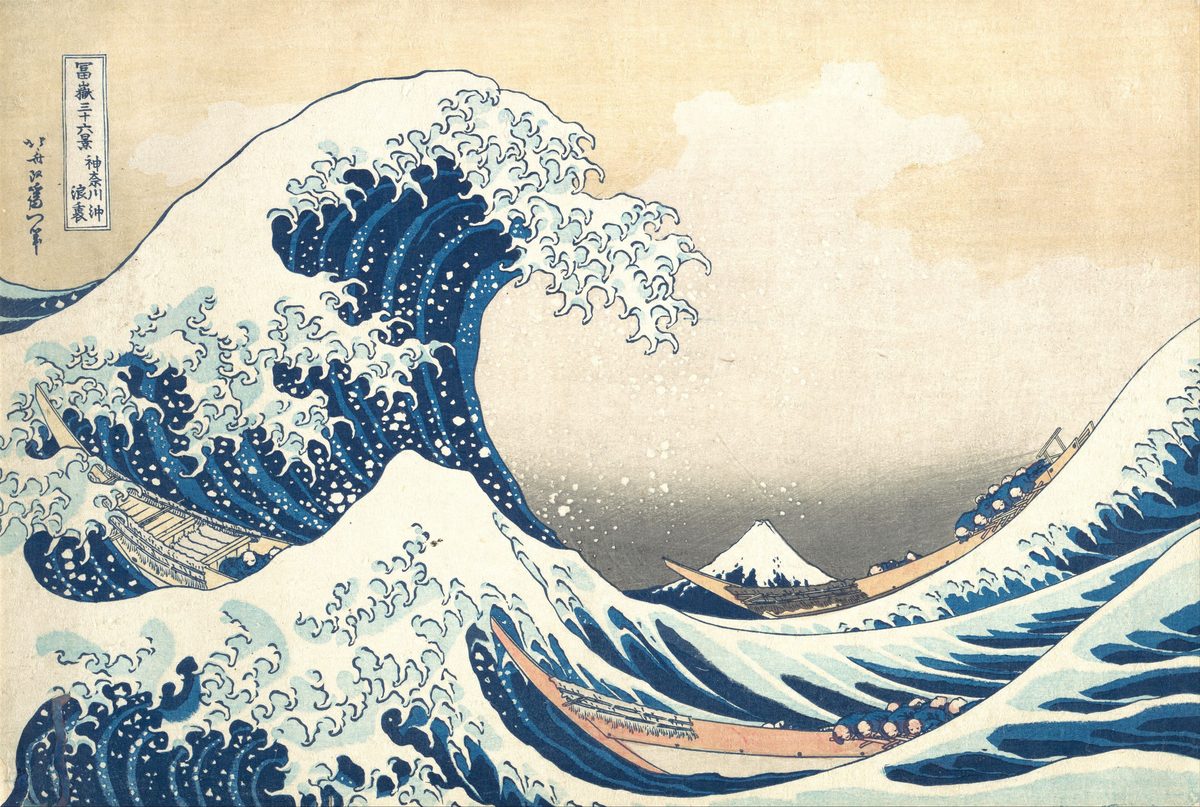
In his landscape series, Hokusai used strong outlines and flat areas of color. The key color in The Great Wave off Kanagawa is Prussian blue, a synthetic pigment that entered Japan through Dutch trade. He also used red, yellow, and green, often in small amounts. His compositions use cropping and diagonal movement, making Mount Fuji appear tiny or placed at the edge of the frame. In Fine Wind, Clear Morning he reduced the palette almost to red and blue, letting the mountain's cone fill the lower half of the print.
Early in his career Hokusai designed actor prints and book illustrations in the Katsukawa manner. By the 1820s he focused on landscapes, birds, flowers, and scenes of everyday life. His later work shows more simplified forms and bolder patterns, influenced by Chinese painting and Western perspective. The Hokusai Manga sketchbooks record his observations of animals, plants, and people in quick brush lines. He also produced ghost stories, warriors, and erotica, but the landscape series of the 1830s remain the most studied. This range shows why his designs appealed to both popular audiences and collectors.
Key Hokusai Paintings and Prints
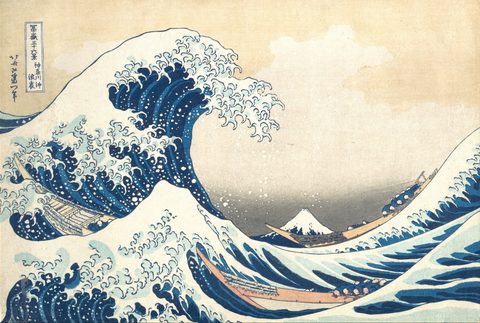
The Great Wave off Kanagawa, c. 1830-1831, is a print from the series Thirty-six Views of Mount Fuji. It shows three oshiokuri-bune, fast cargo boats, caught under a curling wave, with Mount Fuji small in the distance. The wave's foam breaks into claw-like points, and the deep Prussian blue dominates the sheet. It is one of the most reproduced images in Japanese art.
Fine Wind, Clear Morning (also called Red Fuji), c. 1830-1832, shows Mount Fuji glowing red in early light against a blue sky with a few white clouds. The composition is nearly empty, letting the mountain's cone fill the lower half. The limited palette of red, blue, and white gives the print a calm, clear effect.
Rainstorm Beneath the Summit, c. 1830-1832, sets Mount Fuji above a storm, with a bolt of lightning on its dark lower slopes. The strong diagonal of the slope and the dark ground create a sense of sudden weather, and the print shows Hokusai's control of atmosphere. Few other prints in the series depict the mountain in such unstable conditions.
Kajikazawa in Kai Province, c. 1830-1832, shows a fisherman standing on a rock and casting a net, with Mount Fuji behind him through the mist. The figure and the mountain echo each other in shape, and the print demonstrates Hokusai's ability to place human activity within a vast landscape. The diagonal lines of the net and the rocky shore pull the eye between the foreground and the peak.
Where to see the originals
The Metropolitan Museum of Art in New York City holds an impression of The Great Wave off Kanagawa, dated c. 1830-1831. Additional impressions of the print are in the British Museum in London and the Art Institute of Chicago. For other prints from Thirty-six Views of Mount Fuji, the Museum of Fine Arts, Boston, and the Tokyo National Museum have strong collections. Hokusai's printed books and drawings are also held at the Bibliothèque nationale de France in Paris and the Rijksmuseum in Amsterdam. Because woodblock prints fade in light, museums rotate them on display. Check the institution's current exhibition pages before visiting.