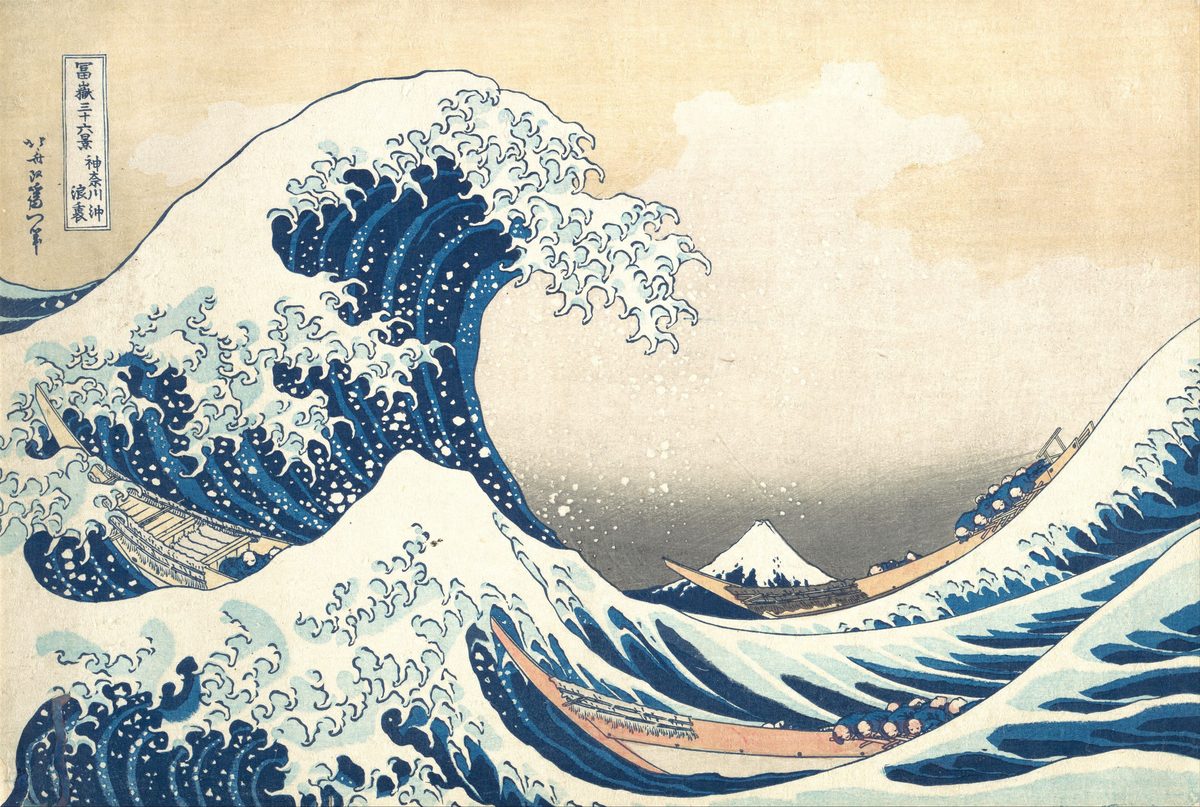
The Great Wave off Kanagawa is a woodblock print by the Japanese artist Katsushika Hokusai. Made in the early 1830s, it is printed in ink and color on paper and measures 25.7 by 37.9 centimeters. It survives in many impressions held by different collections; the one described here is in the Metropolitan Museum of Art in New York City. The print belongs to the ukiyo-e tradition, which produced woodblock images of landscape, everyday life, and popular subjects in Edo-period Japan.
What the picture shows
Look at the print as a flat arrangement of color. A huge wave rises on the left, its crest curling over into claw-like fingers of white foam. Below it, three long, narrow boats with crews of oarsmen are tossed among the waves. The oarsmen crouch low in the boats, heads down, shown as small rows of figures. In the lower center, far in the distance, a small snow-capped Mount Fuji appears between the waves. A smaller wave in the foreground echoes the mountain's shape. The sky is pale yellow-beige with gray shading toward the horizon and one light cloud on the right. In the upper left, a rectangular cartouche holds the title in Japanese characters, with a signature column beside it. The palette uses Prussian blue in several shades, white, pale beige, and light pink-ochre on the boats. Color areas are flat with sharp outlines, and spray is drawn as white dots against the blue.
When and why The Great Wave off Kanagawa was made
Hokusai was in his early seventies when he designed this print in the early 1830s. He had already worked for decades as a print designer and book illustrator in Edo, now Tokyo. The Great Wave off Kanagawa belongs to his series Thirty-six Views of Mount Fuji, which offered views of the mountain from different places and seasons. The print is part of ukiyo-e, a commercial woodblock tradition that made bright, affordable images for a wide audience. Its strong blue comes from Prussian blue, a synthetic pigment that Japanese printmakers took up around 1830. Hokusai used flat color areas and sharp outlines to organize the wave, boats, and distant mountain. The print was made in Japan during the Edo period, when travel and landscape prints were popular. Woodblock prints like this were produced by carving separate blocks for each color and printing them by hand.
Seeing it at home
Look for a hand-painted copy that keeps the original's horizontal, roughly 3:2 format and modest size of 25.7 by 37.9 centimeters. The surface should read as flat color areas with sharp outlines, not heavy brush texture. Compare the palette: Prussian blue in several shades, white foam, pale beige sky, and light pink-ochre boats. The spray should appear as small white dots against the blue rather than blended streaks.