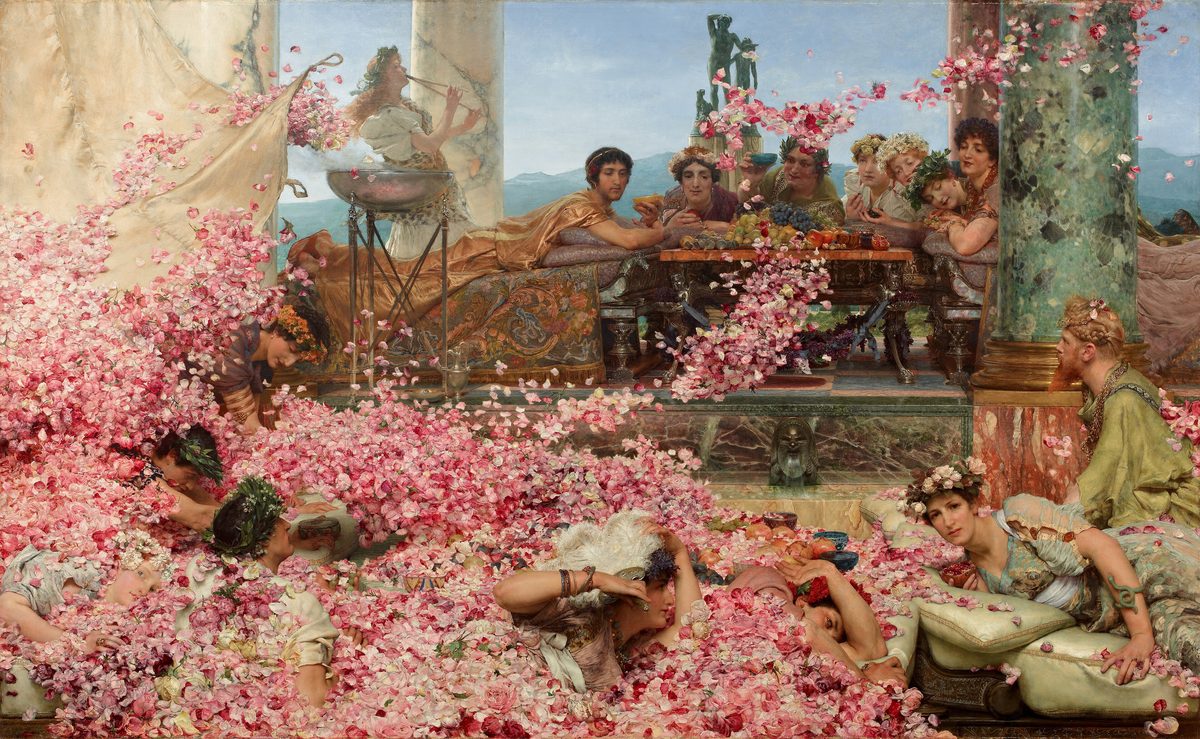
Lawrence Alma-Tadema painted The Roses of Heliogabalus in 1888, using oil paint on canvas. The horizontal canvas measures 132.0 cm high by 213.0 cm wide, a ratio of roughly five to three, and it is now in a private collection, the Pérez Simón Collection. Alma-Tadema, born in 1836, is associated with the neo-Pompeian movement; painters in this circle reconstructed daily life in ancient Rome with careful attention to marble, fabric, fruit, and light, and this canvas is one such reconstruction.
What The Roses of Heliogabalus Shows
A cascade of pink and red rose petals falls from the upper left, partway under a tan canopy, and covers the lower half of the canvas. In the foreground several reclining figures, apparently guests, are partly buried in the petals. On a raised platform in the background, people in ancient Roman-style dress recline at a banquet table laden with fruit. A central figure in a gold robe reclines at the table and looks down at the scene. At the upper left a woman in a white dress plays a double pipe beside a large bronze bowl on a tripod. A large green marble column stands on the right, and a bearded man in a green robe stands beside it. Behind them, a bronze statue and a landscape of blue mountains under a pale sky extend the view. The paint surface is smooth and highly detailed; the palette is dominated by pink, cream, green, and gold.
When and why it was painted
Alma-Tadema was 52 years old in 1888 and had already built a career on carefully reconstructed scenes of ancient Rome. The neo-Pompeian movement, named after Pompeii, encouraged painters to show daily life in antiquity with archaeological accuracy. In this picture he applies that approach to a story about the emperor Heliogabalus, though he focuses less on the cruelty of the tale than on a visual problem: a mass of petals, pale fabrics, marble, and bronze. Reclining figures, marble and flowers appear in many of his Roman scenes. Its horizontal format and careful surface detail match his established method at this date.
Seeing it at home
A hand-painted copy of this picture should keep the original's flat, smooth surface and its horizontal proportions: 132.0 cm high by 213.0 cm wide, or roughly five to three. Compare the palette first. Pink and red petals, cream drapery, green marble, and gold accents should all be present, and the cascade of petals should look dense and layered rather than flat.
Related paintings