Mary Cassatt Paintings: American Impressionist Art
Mary Cassatt was an American painter and printmaker who lived in France for more than fifty years. She was born in Allegheny City, Pennsylvania in 1844 and died at Château de Beaufresne, Le Mesnil-Théribus, France in 1926. She exhibited with the Impressionists in Paris in 1879, 1880, 1881, and 1886.
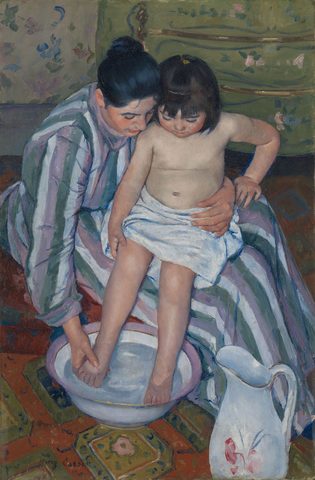
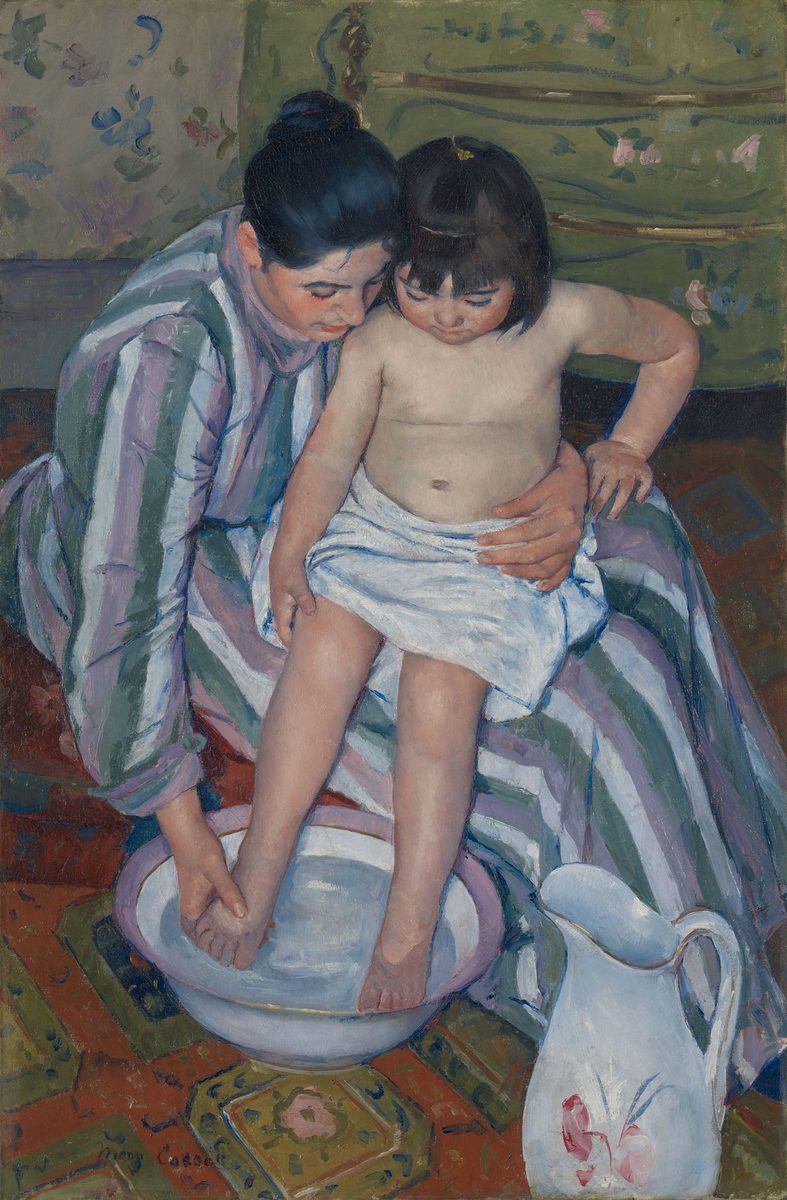
Mary Cassatt paintings remain important because they record the private routines of modern women: a child's bath, a woman reading, a mother holding a baby. Her use of flattened space, cropped figures, and quiet color was shaped by Japanese woodblock prints, which she collected. The Art Institute of Chicago owns The Child's Bath from 1893, an oil on canvas measuring 100.3 by 66.1 centimeters. That picture shows a woman washing a child's feet in a round basin, seen from above and slightly to the side.
Life and training
Mary Stevenson Cassatt was born on May 22, 1844 in Allegheny City, Pennsylvania, a town that is now part of Pittsburgh. Her family was prosperous and took her on extended trips to Europe when she was a child. At age 15 she entered the Pennsylvania Academy of the Fine Arts in Philadelphia, where she studied from 1861 to 1865. Women at the academy were not allowed to draw from nude models, so Cassatt worked from plaster casts and copied prints. She left frustrated, convinced that better training lay in Europe.
In 1866 Cassatt moved to Paris with her mother and family friends. She studied privately with Jean-Léon Gérôme, a painter known for polished academic scenes. She also obtained a permit to copy works in the Louvre. During the Franco-Prussian War of 1870 she returned to Philadelphia, where her father refused to support her art career. A commission to copy Correggio paintings in Parma, Italy, in 1871 allowed her to earn enough money to return to Europe. She traveled through Italy, Spain, and Belgium, studying old masters before settling in Paris for good in 1874.
In 1877 Edgar Degas invited Cassatt to exhibit with the Impressionists, a group that had broken with the official Salon. She accepted. Cassatt showed work in four of the eight Impressionist exhibitions: 1879, 1880, 1881, and 1886. Degas became a lifelong friend and a strong influence. He introduced her to pastel as a primary medium and to the practice of cropping figures at the edge of the frame. Under this influence Cassatt turned from historical subjects to scenes of contemporary women: at the theater, at tea, and caring for children.
Cassatt's style shifted again after the great exhibition of Japanese ukiyo-e prints at the École des Beaux-Arts in Paris in 1890. She began a series of color aquatints in which flat planes, strong outlines, and patterned surfaces dominate. In 1894 she bought Château de Beaufresne at Le Mesnil-Théribus, about 50 miles northwest of Paris. She continued to paint there, but cataracts gradually took her sight. Surgery did not restore clear vision, and she stopped painting around 1914. Mary Cassatt died on June 14, 1926 at Beaufresne. She was 82 years old.
Style and technique
Cassatt worked in oil, pastel, and printmaking. Her palette includes soft pinks, creams, pale blues, and touches of gold, often applied with loose, visible strokes in backgrounds and clothing. Faces receive tighter modeling, which keeps the sitter's expression clear. In The Child's Bath, the striped dress of the woman and the patterned carpet are flattened into broad areas of color, while the child's skin has a warm, translucent glow. Cassatt learned pastel from Degas and used it to build up layers of dry color that look powdery but precise. She also made drypoints and aquatints, experimenting with line outside oil paint.
Her compositions often cut figures at the edge, a device she took from Degas and from Japanese woodblock prints. She places the viewer slightly above the action or looks over a shoulder, as if the scene is caught from a close viewpoint. The Child's Bath uses a high angle and a cropped basin, which makes the picture feel flat and decorative rather than deep. Typical subjects are women and children in private rooms: reading, washing, dressing, or taking tea. She almost never painted landscapes alone; figures stay central.
Early works from the 1860s and early 1870s are darker and more academic, with careful drawing and restrained color. After she joined the Impressionists in 1877, her brushwork loosened and her palette lightened. The 1890 exhibition of Japanese prints at the École des Beaux-Arts pushed her further. She produced a series of ten color aquatints in 1891 that use flat outlines, diaper patterns, and unmodulated color, a style she then translated back into oil paintings like The Boating Party.
Key Mary Cassatt paintings
The Child's Bath (1893, oil on canvas, 100.3 x 66.1 cm) hangs in the Art Institute of Chicago. A woman in a striped dress bends over a young child whose feet rest in a round basin. The high viewpoint and patterned carpet flatten the scene. It is one of Cassatt's best-known paintings and a clear example of Japanese influence in her mature style.
Little Girl in a Blue Armchair (1878, National Gallery of Art, Washington, D.C.) shows a child lying back in an oversized blue armchair. The chairs and floor are cropped, and the empty space around the figure was unusual for the time. Degas helped Cassatt arrange the background. This work records a child's boredom and physical ease without sentimentality.
In the Loge (1878, Museum of Fine Arts, Boston) depicts a woman in black at the Paris opera, holding opera glasses to her eyes. A man in a distant box turns his own glasses toward her. The painting is about looking and being looked at, a theme Cassatt returned to often in depictions of theaters and mirrors.
The Boating Party (1893-94, National Gallery of Art, Washington, D.C.) shows a woman holding a baby in a rowboat while a man, seen from behind, rows. The oar creates a strong diagonal that cuts across the picture, and the water is a flat field of blue. Cassatt cropped the boat at the bottom, pushing the figures close to the viewer.
Where to see the originals
The Art Institute of Chicago holds The Child's Bath and usually displays it in the Impressionism galleries. The Art Institute's online collection search shows current gallery locations. The National Gallery of Art in Washington, D.C. owns Little Girl in a Blue Armchair and The Boating Party. The Museum of Fine Arts, Boston shows In the Loge. The Philadelphia Museum of Art and the Metropolitan Museum of Art in New York also hold works by Cassatt, including pastels and prints. The Musée d'Orsay in Paris has Cassatt paintings in its collection. Many American museums with strong nineteenth-century European collections include a Cassatt in their permanent displays. Call ahead if you want to see a specific work.