Berthe Morisot Paintings
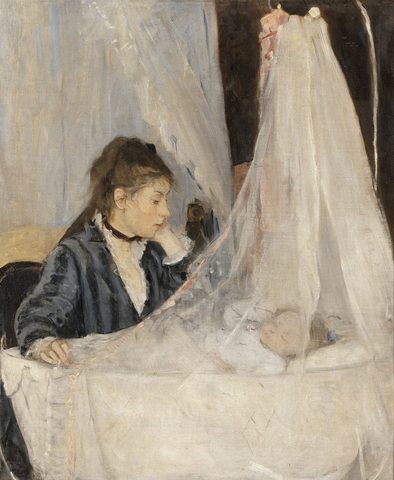
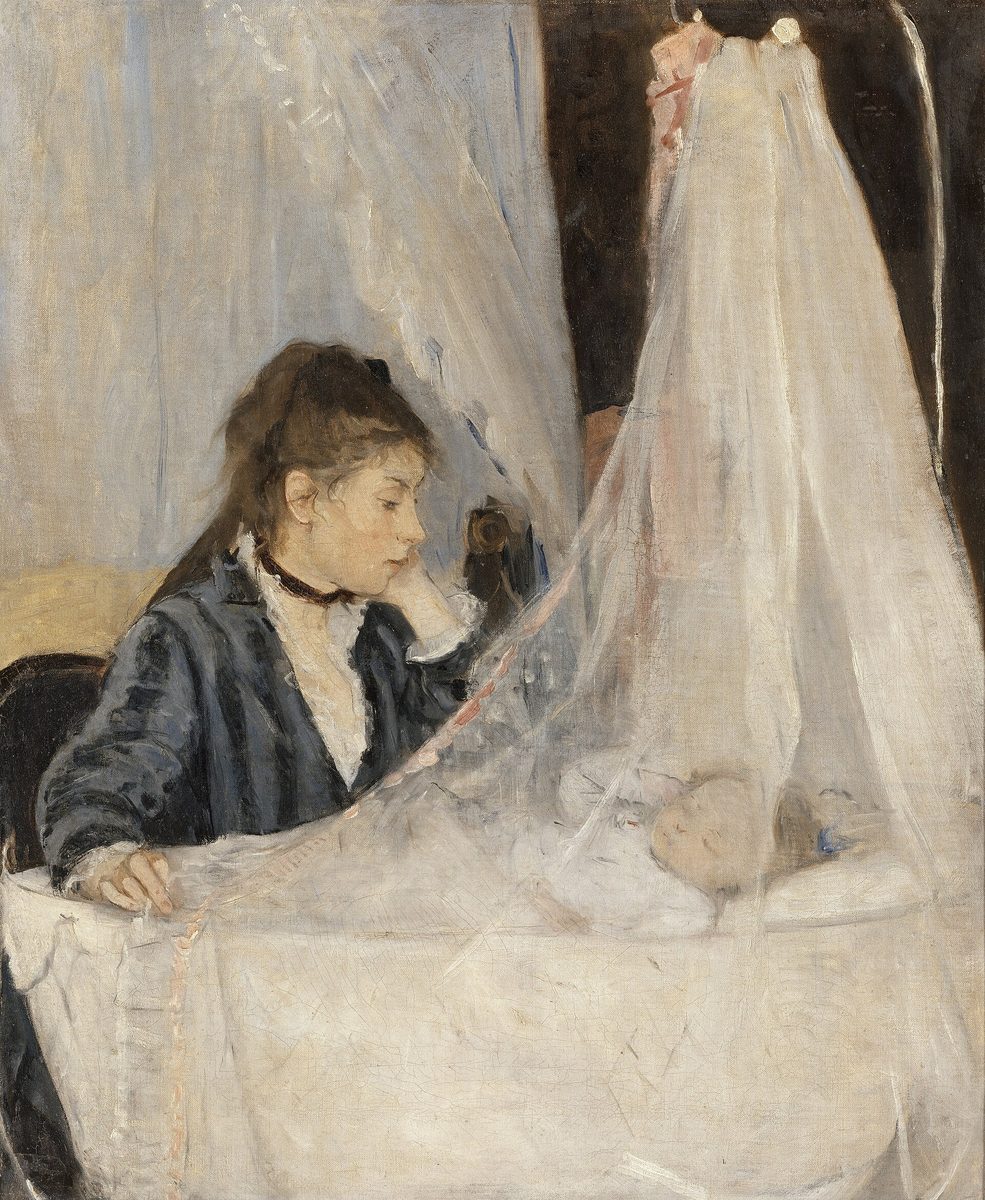
The French painter Berthe Morisot (1841-1895) was a central member of the Impressionist group. She showed work in seven of the eight Impressionist exhibitions held in Paris between 1874 and 1886. Her preferred subjects were women, children, gardens, and domestic interiors, painted with quick, visible brushwork and pale color. Berthe Morisot paintings matter because they record the private, everyday side of modern French life at a time when most Salon painters preferred history and myth. Morisot turned small rooms, open windows, and moments between mothers and children into serious pictures. Her best known work, The Cradle (1872), gives a quiet exchange between a mother and an infant the gravity of a formal portrait. Museums in Paris, London, Chicago, and Washington hold her paintings, and The Cradle hangs in the Musée d'Orsay.
Life and training
Berthe Marie Pauline Morisot was born on January 14, 1841, in Bourges, France. Her father, Edmé Tiburce Morisot, was a senior civil servant. When Berthe was a child the family moved to Passy, then a village west of Paris. She and her sister Edma began drawing lessons with Joseph Guichard in 1857. Guichard soon warned their mother that with such talent they would become painters rather than amateurs. He sent them to copy at the Louvre. Around 1860 she also took advice from Camille Corot, who encouraged her to paint landscapes outdoors and taught her to value fresh, direct observation.
In 1864 the Paris Salon accepted two of her landscapes. She exhibited at the Salon again over the following years, but grew tired of its jury system. In 1868 she met Édouard Manet while copying at the Louvre. The two became close; she posed for several of his paintings, including The Balcony (1868-69). In 1874 she joined the first independent group show later called the first Impressionist exhibition. That December she married Édouard's brother Eugène Manet, a painter and writer. She missed only the 1879 Impressionist show, which opened a few months after the birth of her daughter.
Her daughter Julie was born on November 14, 1878, and became one of Morisot's most frequent models. Julie appears with a greyhound in Julie Manet and her Greyhound Laerte, and alone in many pastel drawings. After Eugène's death in 1892, Morisot continued to paint and organized exhibitions. She died in Paris on March 2, 1895, at the age of 54. Her friends included Degas, Monet, Renoir, and the poet Stéphane Mallarmé; several of them arranged a posthumous exhibition in 1896.
Style and technique
Morisot worked primarily in oil on canvas, often on a white or pale ground. Her palette runs toward white, pale blue, pink, soft green, and gray, with small accents of red or black. She did not outline forms heavily; instead she built them with short, broken brushstrokes and loose diagonal touches. In many Berthe Morisot paintings, edges stay open and unfinished, especially at the bottom of a skirt, the curls of a child's hair, or the leaves of a tree. This technique gives even indoor scenes a sense of air and movement.
Her subjects were almost always immediate: a woman reading, a girl at a window, a mother leaning over a cradle, two figures in a boat. She rarely painted urban crowds or café life. After about 1880, her brushwork became even more rapid and calligraphic, and she sometimes left bare canvas showing through. Some critics called this sloppy; later viewers see it as a record of perception. Morisot learned from Corot's soft landscapes and from Édouard Manet's modern figure painting. Unlike Monet or Renoir, she tended to stay close to home, painting the rooms and gardens of her own houses in Paris and Bougival. Her compositions often cut off figures at the frame, a lesson from photography and Japanese prints that Degas also used. In The Cradle, the white veil is painted with only a few dragged strokes of blue, gray, and white. In the 1890s her portraits of Julie use long strokes, high-keyed rose and yellow accents, and a looser sense of silhouette. She also worked in pastel and watercolor, but oil was her main medium.
Key paintings
The Cradle (1872, oil on canvas, 56.0 x 46.5 cm, Musée d'Orsay, Paris) shows Morisot's sister Edma looking down at her sleeping daughter Blanche under a transparent veil. Morisot hung this painting in the first Impressionist exhibition in 1874. The white bed curtain and the baby's face are painted with extremely loose strokes, but the mother's raised arm and bent head keep the scene stable. It is the only Morisot painting in this catalogue.
Summer's Day (1879, National Gallery, London) shows two young women in a rowboat on the lake in the Bois de Boulogne. Wet-on-wet strokes make the water, boat, and dresses shimmer, and the picture feels like a hot afternoon glimpsed from the bank.
Woman at Her Toilette (1875-1880, Art Institute of Chicago) is a back view of a woman pinning up her hair in a mirror. The white dress, skin, and wall blend into one pale field. Morisot treats the act of dressing as a private, absorbing subject.
Hanging the Laundry out to Dry (1875, National Gallery of Art, Washington) places a woman among white bedsheets in a garden. The sheets dominate the center and echo the white ground of the canvas. The figure's face is barely indicated, but her pose and the flapping cloth are clear.
Across these works, Berthe Morisot paintings stay within the domestic world, but their open brushwork, cropped viewpoints, and modern color made them controversial in the 1870s and admired later.
Where to see the originals
The Cradle is part of the Musée d'Orsay in Paris; check the museum's current room display because Impressionist works rotate. The National Gallery in London holds Summer's Day. The Art Institute of Chicago has Woman at Her Toilette. The National Gallery of Art in Washington keeps Hanging the Laundry out to Dry. The Musée Marmottan Monet in Paris has the largest group of Morisot's paintings, including many late portraits of Julie Manet. Before visiting, confirm each painting is on view, since loans and conservation can move works out of the galleries.