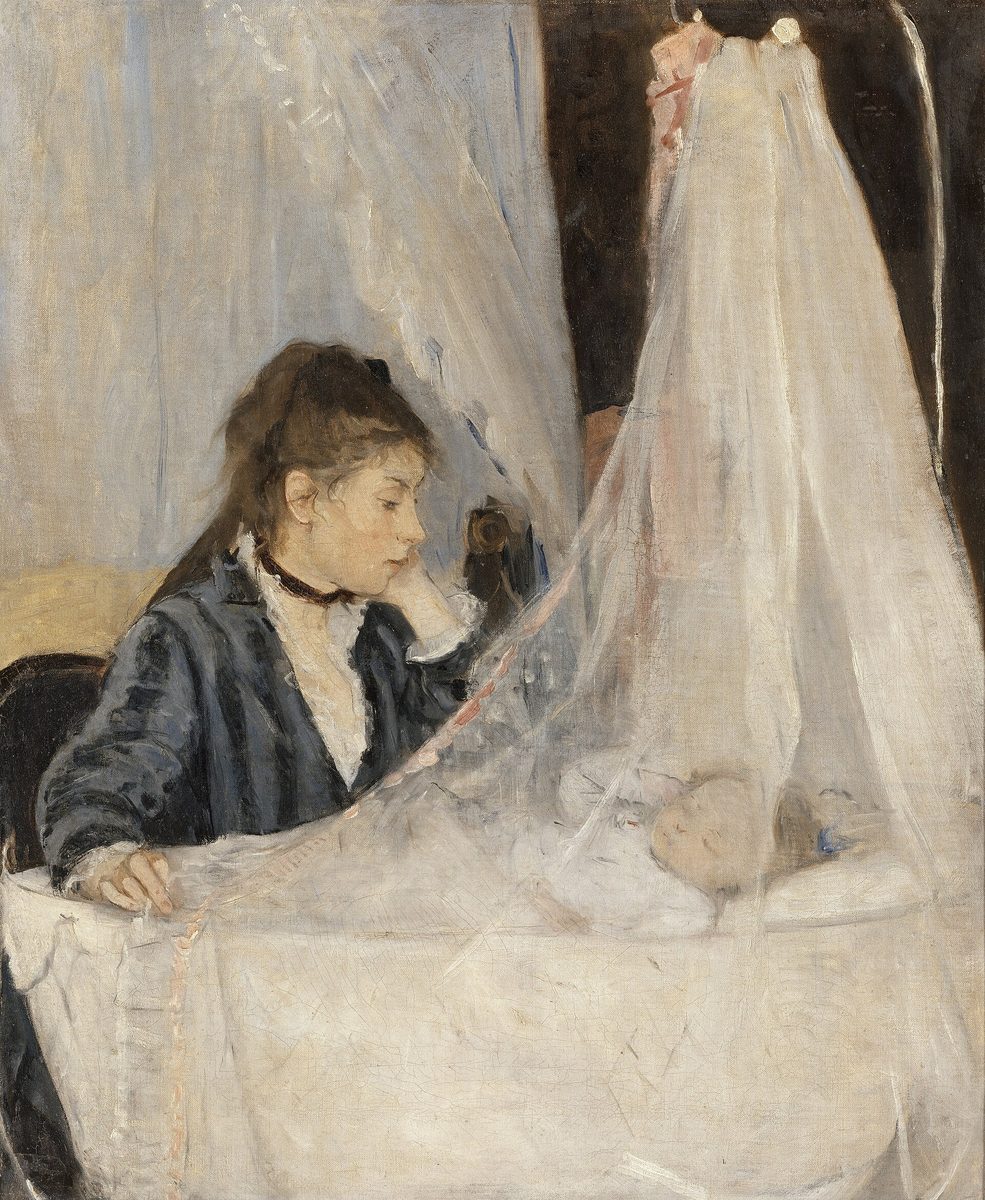
The Cradle by Berthe Morisot is an oil on canvas painted in 1872. It measures 56.0 x 46.5 cm and belongs to the Musée d'Orsay in Paris. The vertical composition is taller than it is wide, roughly five by six, and the paint surface is handled in loose, visible brushwork. The subject is a young woman sitting beside a cradle, her head resting on one hand as she looks down at a sleeping baby. Morisot painted this quiet domestic scene during the early years of Impressionism.
What the picture shows
The eye goes first to the white cradle, which fills the lower part of the picture. A young woman sits on the left beside it, her head resting on her left hand as she looks down at the sleeping baby. Her right hand rests on the edge of the cradle, holding the gauze curtain. She has long brown hair tied back and wears a dark blue-grey dress with a white lace collar and a black ribbon around her neck. The baby lies at the lower right with closed eyes and one arm raised near its head. A thin white transparent veil hangs from the top of the cradle over the baby, its edge trimmed with pink. Behind the woman, a pale greyish-white curtain hangs at the left, and a dark brown wall or curtain occupies the upper right. The palette is limited to white, grey, pale blue, dark blue, and small pink accents. The brushwork is light and sketchy, especially in the transparent veil. Faint craquelure is visible in the white areas.
When and why it was painted
Morisot painted The Cradle in 1872, the year after the Franco-Prussian War and the Paris Commune, but the picture turns inward to a private room. The seated woman is her sister Edma, and the sleeping baby is Edma's daughter Blanche. Morisot was in her early thirties in 1872 and had already exhibited at the Salon before aligning with the painters who formed the Impressionist group. The canvas is small, only 56.0 x 46.5 cm, which keeps the scene intimate. Two years later, she included The Cradle in the first Impressionist exhibition in Paris. The subject, a mother watching an infant, is modern in its ordinariness, and the loose brushwork rejects the smooth finish expected at the Salon. The contemporary domestic moment and quick handling of paint align the work with the movement's early aims.
Seeing it at home
A hand-painted copy works best at or near the original size of 56.0 x 46.5 cm, so the cradle remains intimate rather than monumental. Ask the copyist to keep the brushwork loose and visible, especially in the transparent veil and the white fabric. The palette should stay quiet: white, grey, pale blue, dark blue, with only small pink accents on the veil's edge. Avoid making the darks too heavy or the whites too bright.