Francisco Goya: The Goya Paintings You Need to Know
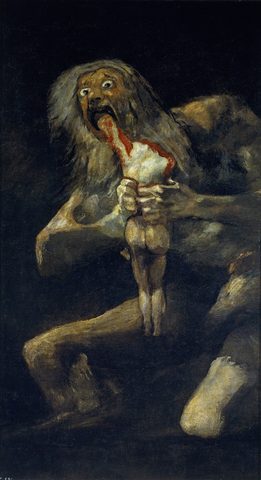
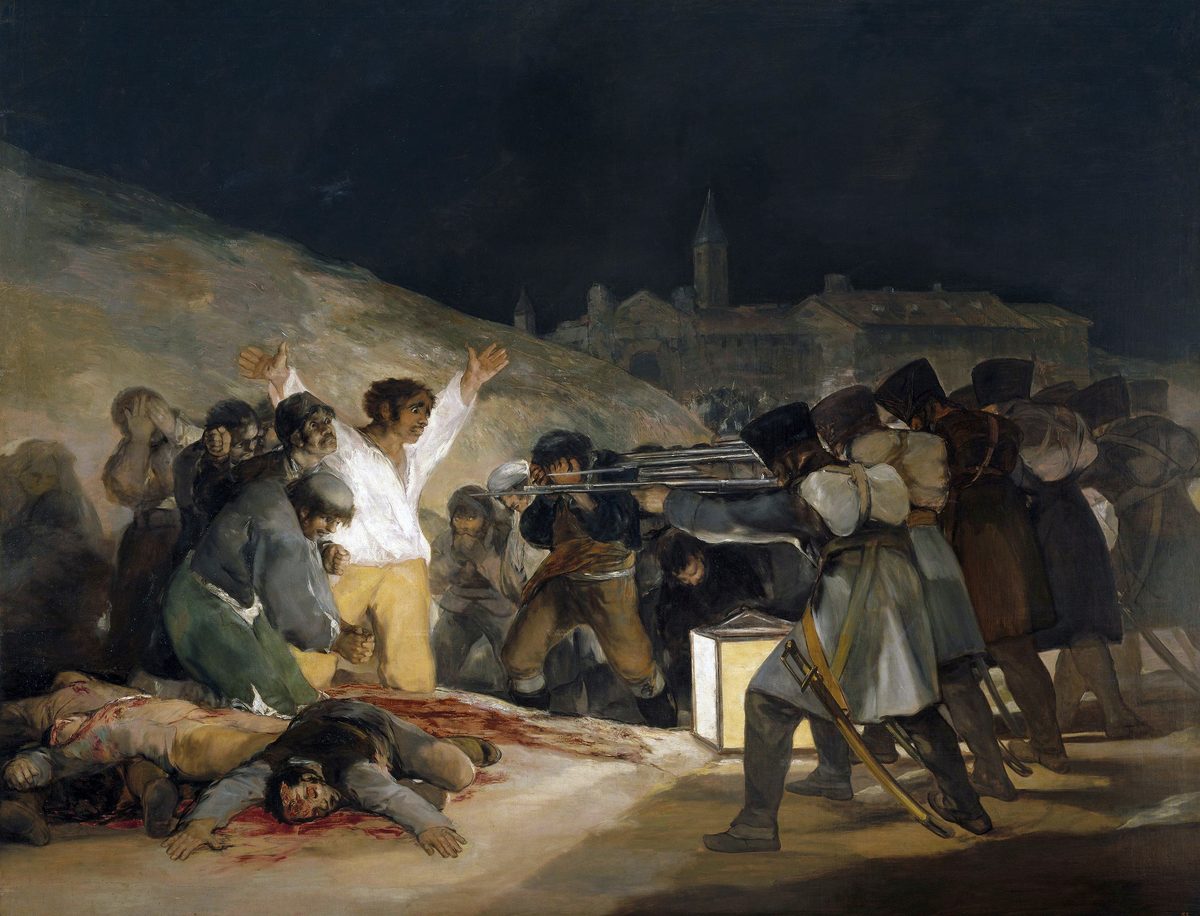
Francisco Goya (1746 to 1828) was a Spanish painter and printmaker, and his Goya paintings record a society moving from Rococo charm to war and disillusion. He was born in Fuendetodos, trained in Zaragoza and Madrid, and served as court painter to Charles IV before losing his hearing in the early 1790s. That loss did not slow his output. It pushed him toward private, often brutal images. The Third of May 1808, from 1814, shows a firing squad at close range. Saturn Devouring His Son, from 1820 to 1823, turns classical myth into a scene of raw, open-mouthed horror. These works still matter because they refuse to decorate violence. They force a direct encounter with fear, power, and the body under pressure. Goya's example shaped later painters who treated war and inner life without idealization.
Life and training
Francisco José de Goya y Lucientes was born on March 30, 1746, in Fuendetodos, a village in Aragon, Spain. His father was a master gilder, and the family soon moved to Zaragoza, where the boy began training with the painter José Luzán at about age 14. He also learned from the painter Francisco Bayeu, whose sister Josefa he married in 1773. In the 1760s and early 1770s, Goya traveled to Madrid and to Italy. In Rome he studied the work of earlier masters and entered a competition at the Academy of Parma in 1771. He did not win, but the trip widened his range. Back in Spain, he received commissions for religious frescoes in Zaragoza and in 1778 published etchings after Velázquez. He had moved to Madrid in 1775 and began designing full-size cartoons for the Royal Factory of Santa Bárbara, which wove them into wall hangings. These large oil sketches showed Spanish street life, seasonal labors, and games in bright, even light. The cartoons brought him to the attention of the court and of noble patrons such as the Duke and Duchess of Osuna. In 1786 he was named painter to the king, and in 1789 he became court painter to the newly crowned Charles IV. A severe illness in 1792 and 1793 left Goya deaf. After that, his work changed. He continued to paint official portraits, including the direct, unsmiling Family of Charles IV in 1800. At the same time, he made etchings and aquatints, such as Los Caprichos in 1799, that attacked superstition, vanity, and abuses of power. During the Peninsular War, from 1808 to 1814, he saw occupation, famine, and reprisals. The Disasters of War prints and the two large canvases of May 1808 grew from that period. In 1819 Goya bought a house outside Madrid known as the Quinta del Sordo, the Deaf Man's House. There he painted the Black Paintings directly on the plaster walls, including Saturn Devouring His Son. In 1824, after the restoration of the absolutist monarchy, he left Spain for Bordeaux, France. He died there on April 16, 1828, at age 82.
Style and technique
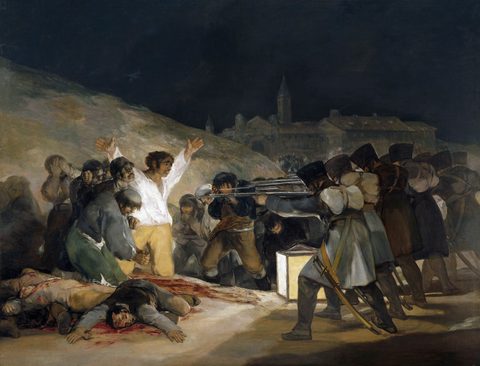
Goya's early cartoons for the Santa Bárbara factory use a light, clear palette of blues, pinks, and greens. Figures in The Parasol or The Grape Harvest are placed in bright Spanish settings, with smooth paint and a decorative Rococo rhythm. He learned from Velázquez, whose portraits he copied in etching, and from the Italian painting he saw on his trip. Brushwork in these early works is controlled; edges are clean and details are legible. By the 1790s, after his illness and deafness, the smooth court manner gave way to broader brushstrokes, darker grounds, and sharper psychological focus. The Family of Charles IV, from 1800, keeps the formal structure of a court group portrait but gives each face a specific, unflattering character. Paint is applied with visible sweeps in the clothing and jewelry. Light picks out a few whites, golds, and reds against a dark room. Goya's late paintings become more physical and economical. In The Third of May 1808 he builds the scene from a few large shapes: the white shirt, the lantern, the soldiers' dark coats, the low hill. Brushwork is loose enough to read as motion. In Saturn Devouring His Son the body of the giant is outlined with thick strokes against pure black, and the red of the blood is the only strong color. The paint surface is rough. His subjects move from Spanish leisure and aristocratic identity to war, madness, witchcraft, and private fear. The Disasters of War and the Black Paintings treat cruelty without allegorical distance. This shift from public decoration to private image-making is what makes his technique flexible: he could paint a silk dress and a mutilated corpse with the same direct observation.
Key Goya paintings
Key Goya paintings in this catalogue begin with The Third of May 1808, an oil on canvas from 1814 now in the Museo del Prado, Madrid. It shows French soldiers firing at Spanish prisoners on a hill outside Madrid. A man in a white shirt throws his arms open in the center. The lantern between the two groups lights the scene. Goya painted this six years after the event. Its blunt subject and tight composition made it a reference for later war images. Saturn Devouring His Son, from 1820 to 1823, is a mural transferred to canvas, 143.5 by 81.4 centimeters, also in the Prado. It shows the Titan Saturn gripping a smaller body and biting into its arm. The eyes are wide, the hands dig into the back, and the background is black. This was one of the Black Paintings Goya made on the walls of his house, the Quinta del Sordo. It was not meant for public display. The picture treats a mythological subject as a scene of madness and hunger. The Family of Charles IV, from 1800, sits in the same museum. The royal family stands in a shallow, dim room, dressed in silks and ribbons. Faces are pale and specific. Goya borrowed the arrangement from Velázquez's Las Meninas but removed the idealizing glow. The result is a court portrait that reads as a report on power. The Second of May 1808, also from 1814, shows the uprising in Madrid against French cavalry. Riders and civilians fight with knives and bare hands. The bodies are tangled, and the horse in the center is painted with loose, dark strokes. Together these four paintings show Goya moving from official portraiture to public violence and private terror.
Where to see the originals
The two paintings cataloged here, The Third of May 1808 and Saturn Devouring His Son, are both in the Museo del Prado in Madrid. The Prado also holds The Family of Charles IV, The Second of May 1808, and most of the Black Paintings, including the other murals from the Quinta del Sordo. In the same city, the Real Academia de Bellas Artes de San Fernando has works on paper and smaller paintings. Outside Spain, the National Gallery in London holds several Goya portraits. Check each museum's current display before visiting, because works on paper and fragile transferred murals are not always on view.