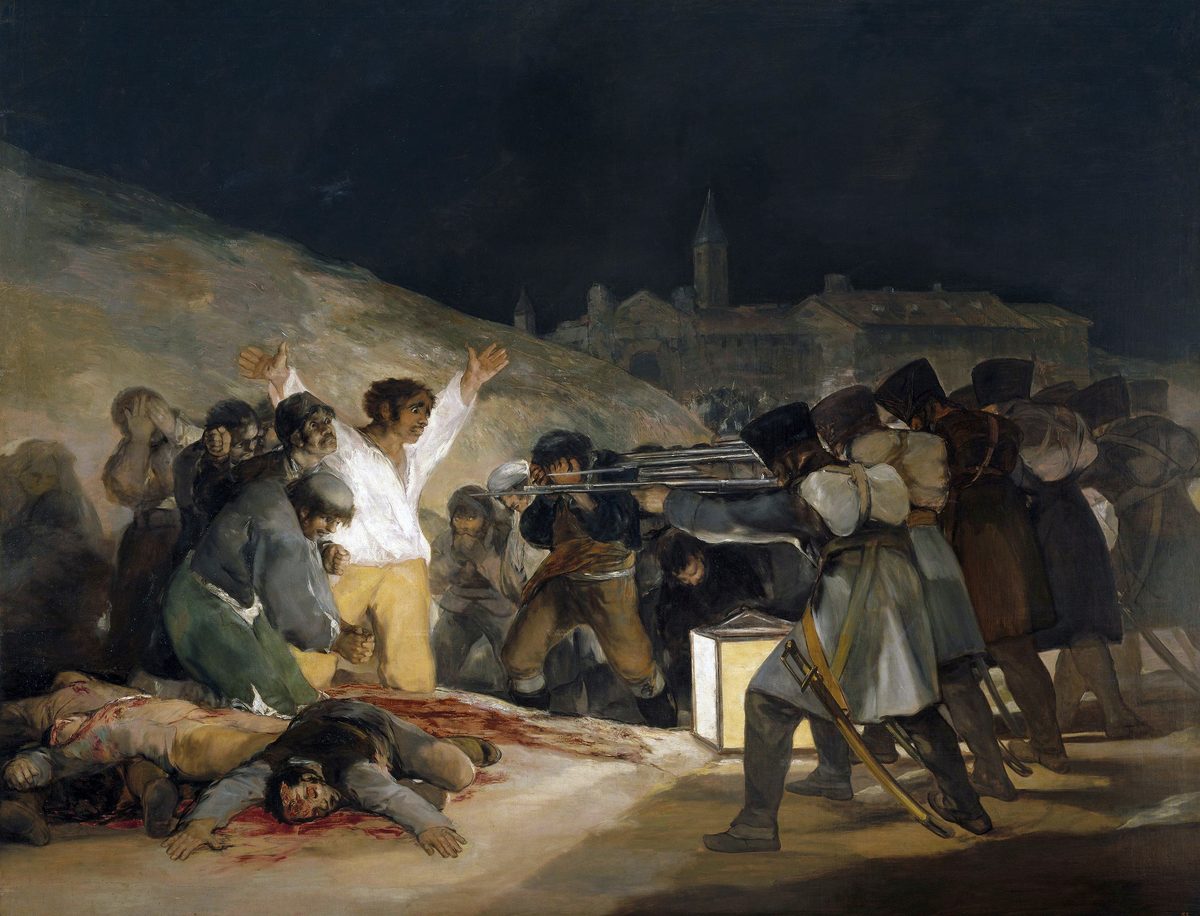
The Third of May 1808 is an oil painting by Francisco Goya, completed in 1814. It measures 268 by 347 centimeters and hangs in the Museo del Prado in Madrid. Goya painted this scene from the Peninsular War, showing Spanish civilians facing a French firing squad on the night of May 3, 1808, following the uprising in Madrid the day before. The picture is often paired with The Second of May 1808, also in the Prado, but it stands on its own as a record of the reprisals that followed the uprising.
What the picture shows
A night execution scene fills the horizontal canvas. On the right a firing squad of about six soldiers stands in a line, their backs half to the viewer, rifles levelled. They wear long greatcoats, tall shakos, and have swords at their sides; no faces are visible. Opposite them, left of centre, a man in a white shirt and yellow trousers kneels with both arms raised wide. Around him other men crouch, pray, or cover their faces with their hands. In the lower left corpses lie on the ground in pools of red blood; one man lies face down, arms spread. A large square lantern on the ground between the groups throws bright light on the victims. Behind the victims rises a bare brown hill. On the right in the distance stand buildings and a church tower under a black sky. Behind the condemned a further line of people waits, apparently next in line. The palette is dark, dominated by black, brown and grey, with the white shirt and yellow trousers as the brightest areas. The brushwork is loose and broad.
When and why The Third of May 1808 was painted
Goya was 68 years old when he completed The Third of May 1808 in 1814. He had spent decades as a Spanish court painter, and his early work belonged to the Rococo tradition. By 1814, after the Peninsular War and the French occupation of Madrid, he turned to large public subjects. He painted the picture as a companion to The Second of May 1808, both intended to commemorate the uprising against Napoleon's troops. The work's focus on arbitrary violence and powerless victims places it within Romanticism, although its loose handling also points toward later developments.
Seeing it at home
A hand-painted copy of The Third of May 1808 should use a horizontal canvas close to the original's proportions of about 268 by 347 centimeters, though smaller is fine. Look for the contrast between the dark brown and black background and the bright white shirt and yellow trousers. The copy should keep the loose, broad brushwork and the strong light falling on the victims from the square lantern.