Gustav Klimt Paintings
Gustav Klimt (1862-1918) was an Austrian symbolist painter and a central figure in Vienna's Art Nouveau movement. He trained at the Vienna School of Arts and Crafts and began with academic history painting before shifting to gilded, decorative compositions. He was born in Baumgarten near Vienna in 1862 and died in Vienna in 1918. Klimt paintings matter today because they mark a clear break from 19th-century realism. His use of gold leaf, flat patterns, and psychological portraiture shows how Viennese artists absorbed Byzantine, Egyptian, and Japanese sources. Works like The Kiss and Portrait of Adele Bloch-Bauer I anchor conversations about early 20th-century European art and the relationship between painting and ornament. The square format and visible gold surface have become shorthand for the Wiener Moderne.
Life and training
Gustav Klimt was born on July 14, 1862 in Baumgarten, near Vienna. In 1876, at fourteen, he enrolled at the Vienna School of Arts and Crafts, where he studied architectural painting. He later formed a small company with his brother Ernst Klimt and Franz Matsch. The three produced painted decorations for public buildings, including ceiling panels for the Burgtheater in Vienna and stairwell murals for the Kunsthistorisches Museum. By 1888 Klimt had received the Golden Order of Merit from Emperor Franz Joseph I, a sign of his early official success.
The deaths of his father and brother Ernst in 1892 pushed Klimt into a long period of personal crisis and artistic change. He also began to work independently, taking private commissions from the Viennese bourgeoisie. In 1897 he joined with other Vienna artists to found the Vienna Secession, which promoted new decorative painting and design. Klimt served as its first president. Around this time his work moved away from academic realism toward flattened space, ornamental surfaces, and symbolic subjects.
In 1894 Klimt received a commission for three ceiling paintings for the University of Vienna's Great Hall. His allegories of Philosophy, Medicine, and Jurisprudence, with dark, interlocking bodies, were attacked by professors and politicians. Klimt eventually returned the advance and kept the works. The University of Vienna refused the panels, and they were never installed; the canvases were later lost in a fire in 1945. The scandal damaged his public reputation but did not end his career. In 1903 he visited Ravenna and saw Byzantine mosaics, which reinforced his interest in gold and flat pattern. In 1905 he and a group of artists left the Secession.
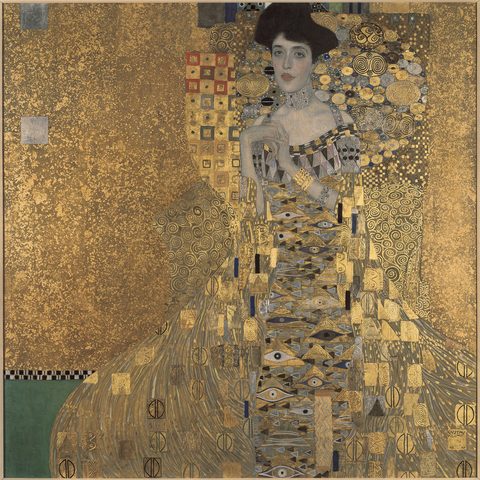
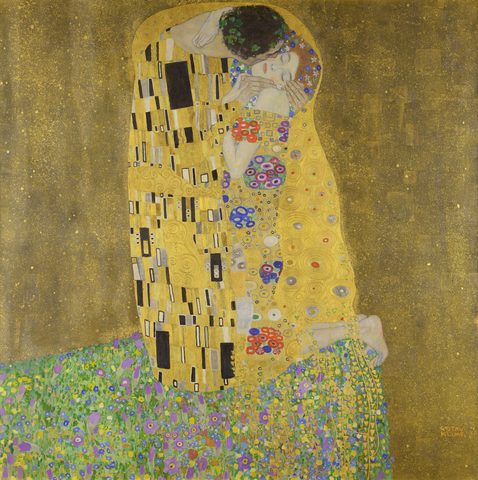
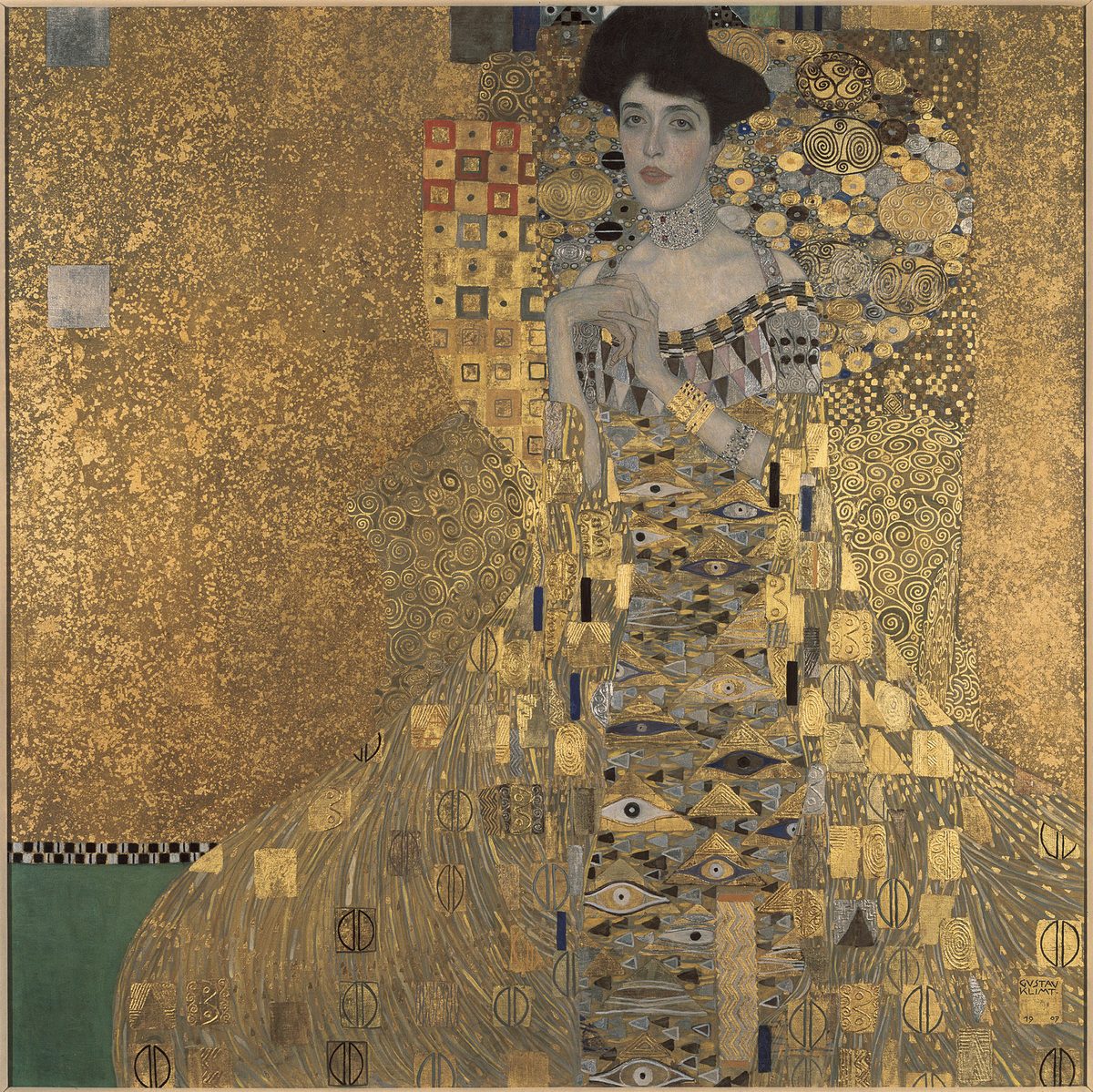
The following years brought the height of his golden period. He painted Adele Bloch-Bauer I in 1907 and The Kiss in 1907-1908. Klimt continued to receive private portrait commissions and to exhibit with smaller groups. In his last decade he painted flowers and landscapes at Attersee and finished portraits with softer color. His late portraits often show women in loose patterned robes with touches of green and blue. He died on February 6, 1918 in Vienna at age 55.
Style and technique
Klimt's mature painting method combined oil paint with applied metal leaf. In The Kiss, he used oil and gold leaf on canvas and worked on a square 180 by 180 cm format. In Portrait of Adele Bloch-Bauer I he added silver leaf to the gold and oil. He built surfaces in separate layers: a precise drawing, then areas of thin color, then gilded sections cut into flat ornamental shapes. The brushwork in faces and hands is smooth and controlled, while backgrounds collapse into patterned planes.
The palette of the golden period relies on gold, ochre, black, teal, and deep red. Shapes repeat: spiral curls, circles, rectangles, and broken checker patterns. The artist's sources include Byzantine mosaics he saw in Ravenna in 1903, Japanese woodcuts, and Egyptian wall painting. These influences led to flat, stacked compositions with no deep perspective. Ornamental motifs serve as both clothing and background, so the figure does not sit in illusionistic space. Klimt also painted landscapes with dense point-like brushwork, but the figure paintings carry the most recognizable ornamental style.
Early academic commissions looked back to Renaissance and Baroque models. After 1897 the Secession style introduced linear rhythm and symbolic subjects. After about 1910 gold leaf became less dominant and color more painterly. The change appears in portraits with looser garment patterns and in landscapes built from short dabs of paint. He also drew hundreds of nude studies, but only a fraction became finished paintings. The influence of Symbolism pushed him toward ambiguous narratives, especially in the University paintings.
Key Klimt Paintings
The Kiss (1907-1908) is an oil and gold leaf painting on canvas, 180 by 180 cm. It shows a couple embracing at the edge of a flowered patch, wrapped in patterned robes; their faces and hands are natural while the clothing becomes flat gold ornament. The Belvedere in Vienna owns the painting. It shows Klimt's handling of a couple without narrative clutter, reducing the pair to silhouettes.
Portrait of Adele Bloch-Bauer I (1907) uses oil, gold, and silver on canvas and measures 138 by 138 cm. Adele Bloch-Bauer sits frontally in a golden dress made of decorated shapes. The Neue Galerie in New York City acquired the work in 2006 after a long restitution case. The combination of silver and gold gives the portrait a cooler shine than The Kiss.
Judith I (1901) is an earlier biblical subject in oil and gold leaf on canvas. It presents Judith holding the head of Holofernes, with her torso as a column of gold ornament. The painting anticipates the golden portraits of 1907. The painting is now in the Belvedere in Vienna.
The Beethoven Frieze (1902) was painted directly for a Secession exhibition as a temporary wall cycle. Its sequence of floating figures, hostile forces, and the embrace of a choir forms a visual response to Beethoven's Ninth Symphony. At about 34 meters long, it was meant to be seen as one continuous band. The restored frieze is displayed at the Secession Building in Vienna.
The Tree of Life from the Stoclet Frieze, designed around 1909 for the Palais Stoclet in Brussels, uses spiral branches, gold surfaces, and standing female figures. The cartoons for this mosaic frieze are now in the MAK in Vienna. The central motif is usually called the Gustav Klimt tree of life, and it has become a frequently reproduced decorative design.
Where to see the originals
The Belvedere in Vienna holds The Kiss. The Neue Galerie in New York City owns Portrait of Adele Bloch-Bauer I. The Secession Building in Vienna displays the Beethoven Frieze. The MAK Vienna keeps the cartoons for the Stoclet Frieze, including the Tree of Life design. The Leopold Museum in Vienna also holds major figure paintings such as Death and Life. Check opening hours before visiting, because special exhibitions can change access. The Neue Galerie in New York City focuses on early 20th-century Austrian and German art.