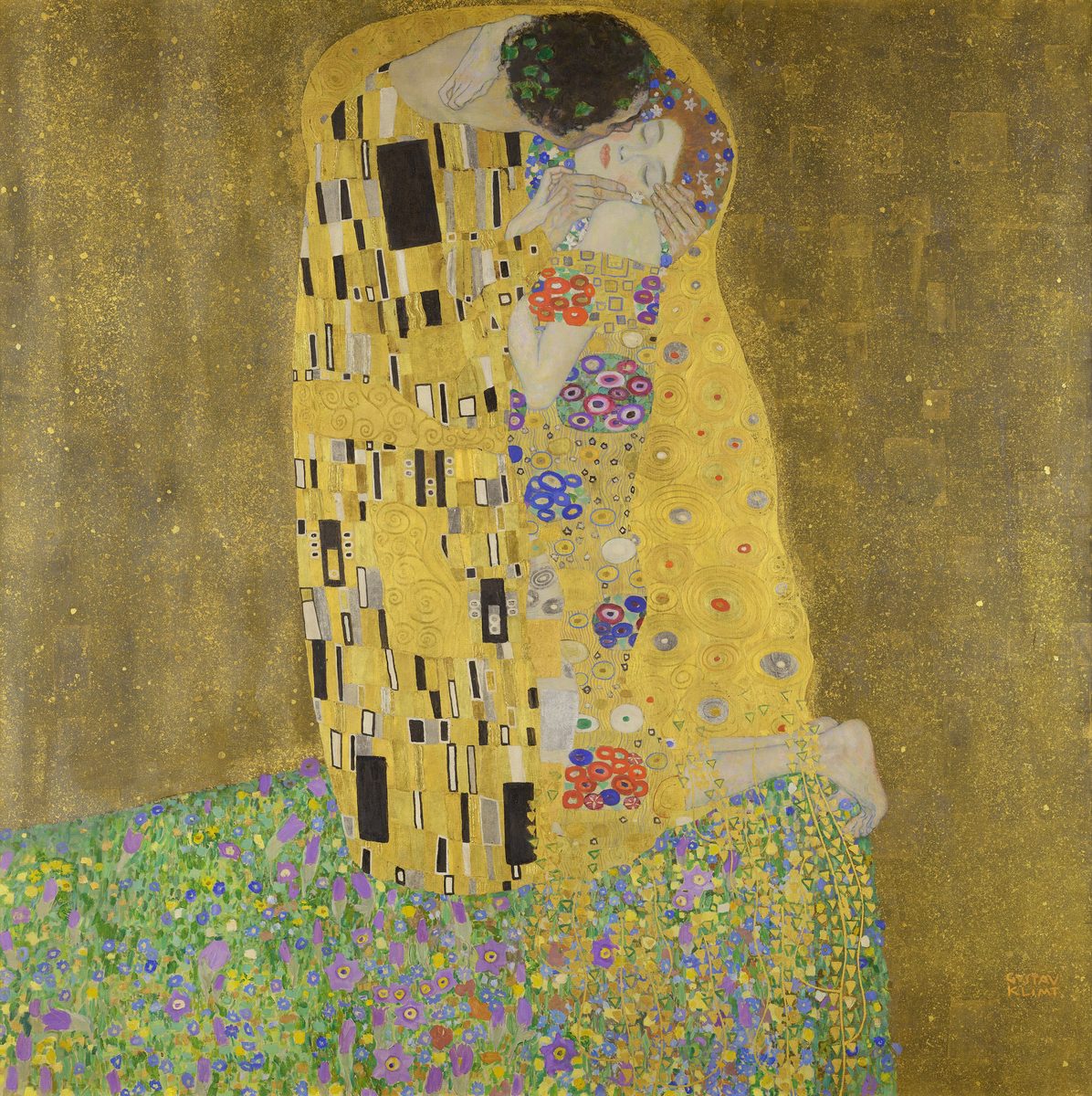
Gustav Klimt painted The Kiss between 1907 and 1908. The work is oil and gold leaf on canvas, and it measures 180 by 180 centimeters. The original hangs in the Belvedere in Vienna, where the square canvas places the embracing couple almost directly in front of the viewer. Klimt was an Austrian artist associated with Symbolism and Art Nouveau. He was born in 1862 and died in 1918, and he worked in Vienna for most of his career. The gold leaf gives the surface a metallic, flat brilliance that still reads clearly in photographs.
What The Kiss Klimt shows
In the square composition, a couple embraces on the edge of a flower meadow, placed slightly left of center. The man, seen from behind, wears a wreath of dark green ivy-like leaves in black hair. He holds the woman's face in both hands and kisses her cheek. The woman kneels, head tilted back and eyes closed, with flowers woven into her reddish hair. One arm circles the man's neck, the other hand rests on his hand at her cheek, and her bare feet curl over the meadow's edge at lower right. Both are wrapped in one golden bell-shaped form. His robe has black, white, and silver rectangles; hers has round red, blue, and violet flower motifs. The meadow is dense with small green, purple, blue, and yellow flowers, ending abruptly at a cliff-like edge. Gold tendrils hang from the woman's robe over the edge on the right. The background is flat mottled gold-brown with scattered gold flecks, no horizon or depth. The surface uses applied gold and metallic paint.
When and why it was painted
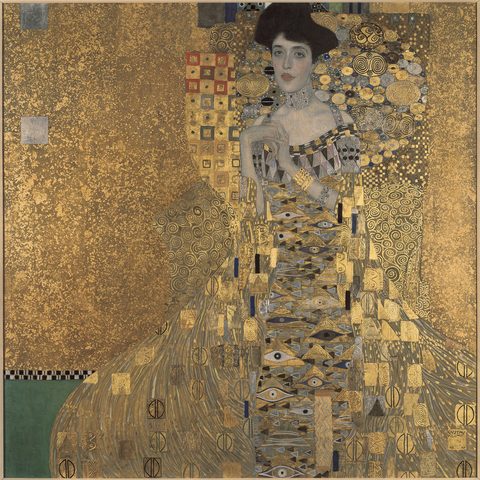
Klimt painted The Kiss between 1907 and 1908, when he was in his mid-forties and already a leading figure in Vienna's modern art world. He had trained as a decorative painter and later moved away from academic history painting toward flattened, ornamental surfaces. This period is often called his Golden Phase because he used gold leaf in several major works, including The Kiss. The painting belongs to Symbolism and Art Nouveau, two currents that favored decorative patterning and symbolic content over realistic space. During these years he often worked on portraits and allegorical subjects, combining fine detail with broad areas of metallic paint. The Kiss sits within this later, decorative phase of his career.
Seeing it at home
A hand-painted copy should keep the square format of the 180 by 180 centimeter original, even at a smaller size. Look for a flat surface with visible gold leaf or a convincing metallic effect. The palette should keep the man's black, white, and silver rectangles distinct from the woman's red, blue, and violet flower motifs, all against the mottled gold-brown ground. The meadow's small green, purple, blue, and yellow flowers matter as well.