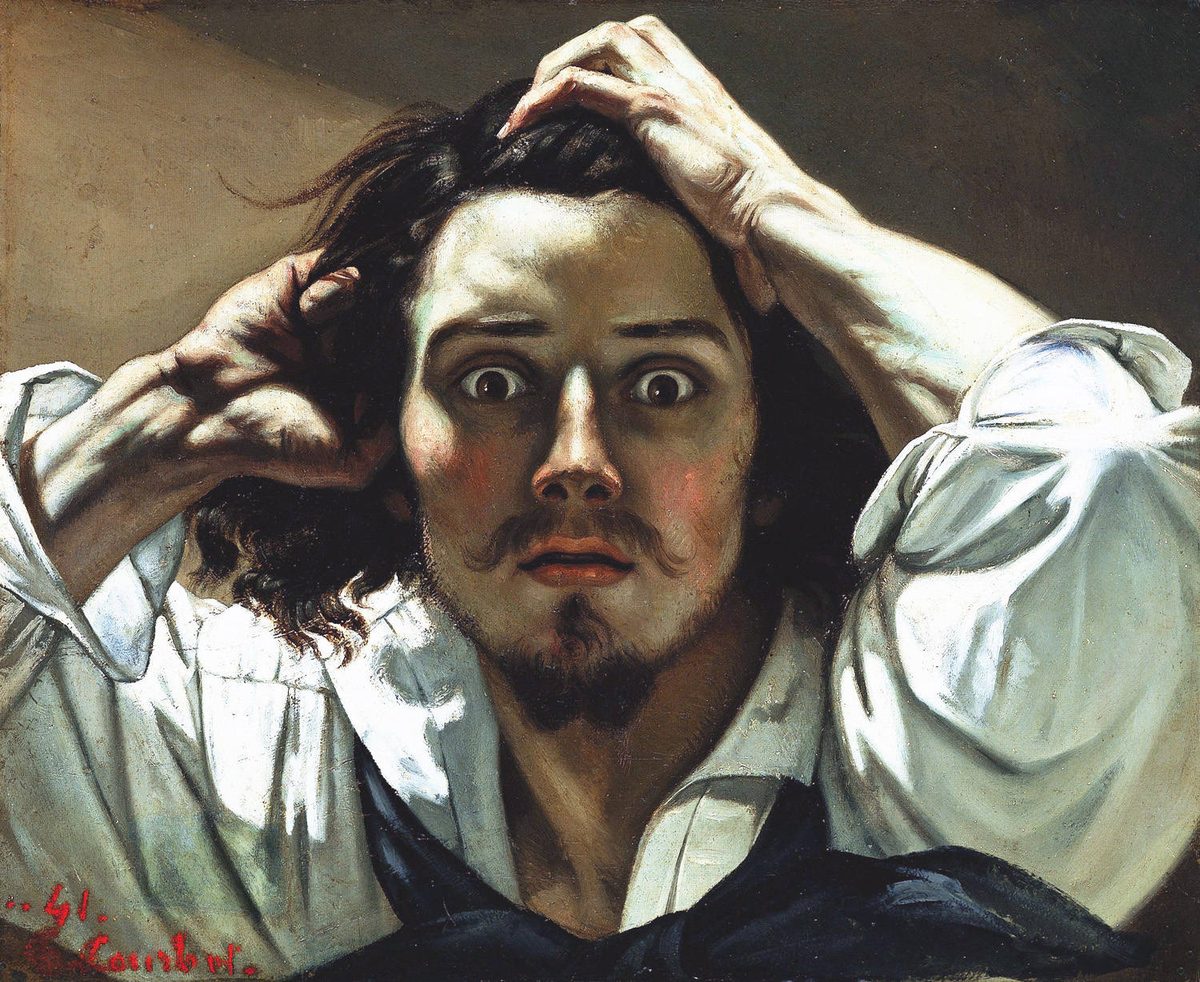
This small oil painting is one of several self-portraits Gustave Courbet made in the 1840s. The Desperate Man by Gustave Courbet is an oil on canvas painted between 1843 and 1845. It shows the artist, born in 1819, staring directly out from the picture. The canvas measures 45.0 x 54.0 cm and now belongs to a private collection. Courbet was in his mid-twenties and working in Paris, where he would soon become a central figure of French Realism. In this compact canvas the face and hands fill most of the frame.
What the picture shows
The picture is a close-up of a young man's face and shoulders filling the frame. He stares straight at the viewer with wide-open eyes. Both hands are raised to his head and grip his long dark hair. He has a moustache and a small beard, and his lips are slightly parted. He wears a loose white shirt with billowing sleeves, open at the neck. A dark blue cloth or scarf crosses the lower part of the picture. The background is plain, with a light brown area on the left and a darker brown on the right. Strong light falls from the left on the face, hands, and white shirt. The signature 'G. Courbet' appears in red at the lower left. The format is horizontal, roughly 6:5, and the close-up makes the face and hands the central focus. The white shirt stands out against the brown background, and the dark blue cloth anchors the lower edge.
When and why it was painted
Courbet was in his mid-twenties when he painted this self-portrait between 1843 and 1845. He had left Ornans, his hometown in eastern France, and was working in Paris, where he studied the Old Masters in the Louvre and painted friends and himself. The Desperate Man is one of several early self-portraits in which Courbet tried out intense facial expressions and dramatic lighting. The close-up, unidealized treatment of the face and the direct stare already point toward the blunt physicality of French Realism, the movement he would help define a few years later. In 1844 the Paris Salon accepted his Self-Portrait with Black Dog. Courbet often made himself the subject, using his own features to test new ways of showing emotion.
Seeing it at home
In a hand-painted copy of this picture, check that the canvas proportions stay close to the original's horizontal 6:5 format, about 45 x 54 cm. Look for strong left-hand light on the face, hands, and white shirt, and for the contrast between the pale shirt and the darker brown and blue areas. The paint surface should keep the visible brushwork and the red signature at lower left.