Hieronymus Bosch Paintings: Life and Art
Hieronymus Bosch (c. 1450 to 1516) was a Netherlandish painter associated with Early Netherlandish painting and the Northern Renaissance. He spent his working life in the town of 's-Hertogenbosch, which gave him his professional name, and produced oil paintings on panel that combine Christian subjects with strange, invented creatures. Bosch paintings matter today because they record a late medieval view of sin and temptation. His scenes of gardens, hay wagons, and hell punish greed and lust with sharp humor and troubling detail. Many objects in his panels carry moral meanings, from fruit and musical instruments to pigs and ladders. Museums hold only a small number of autograph works, so each surviving panel draws attention from historians and a wide public.
Life and training
Hieronymus Bosch was born about 1450 in 's-Hertogenbosch, a market town in the Duchy of Brabant, now in the Netherlands. His name comes from the town: he signed himself Jheronimus Bosch, although his family name was van Aken. His father Anthonius van Aken was a painter, and several relatives worked in the same craft. Bosch most likely trained in the family workshop, learning to prepare oak panels, grind pigments, and apply oil glazes in the manner of Early Netherlandish painting.
He married Aleyt Goyaerts van den Meervenne, a woman from a wealthy family. He stayed in 's-Hertogenbosch for his whole professional life, taking commissions from local confraternities and civic patrons. By 1486 he appears in the records of the Brotherhood of Our Lady, a wealthy religious society attached to the Church of Saint John. That membership placed him among the town's elite,.
No long travel is recorded. Bosch worked in a busy urban center that traded with Antwerp and Brussels, so he could have seen prints and panel paintings from other Netherlandish cities. His early works follow the formulas of religious painting. Later he turned to large moralizing triptychs with crowded narrative scenes, using the same oil technique but pushing the imagery further into invented creatures and satirical detail. He died in 's-Hertogenbosch in 1516.
Style and technique
Bosch painted in oil on oak panels, the standard support in the Low Countries around 1500. He often applied the paint in thin layers over a light ground. His brushwork is fine and controlled, especially in the faces, drapery folds, and small plants that fill the backgrounds. The color range includes bright blues, greens, and reds set against pale skin tones and smoky gray and brown landscapes. He used atmospheric perspective, with sharper detail in the foreground and cooler blue tones in the distance.
His subjects came from Christian sources: the life of Christ, the temptations of saints, the Last Judgment, and moral warnings about greed, lust, and false piety. He also borrowed from the visual language of manuscript margins, carved misericords, and popular proverbs. Hybrid creatures with bird heads, fish tails, and human legs populate his hells and battle scenes. These are not random inventions. They often act out a specific sin or punishment. The panels often have a high horizon, which allows many episodes to be read across the surface. Bosch rarely painted pure landscape for its own sake, but his settings carry narrative weight.
Over time Bosch moved from simpler devotional panels to wide triptychs with many scenes. Later panels, including The Garden of Earthly Delights and The Haywain Triptych, place the same religious message inside a busy landscape with dozens of figures and objects. The technique remains careful, but the later compositions are denser and the moral satire becomes more explicit. His approach influenced later printmakers and painters, especially in the 16th century.
Key paintings
The Adoration of the Magi (copy) in the Philadelphia Museum of Art dates from about 1500 to 1515. The panel measures 94.0 by 74.4 cm and is oil on panel. It shows the three kings in costly robes presenting gifts to the Christ child. The painting is a version of a Bosch composition made by a follower or copyist.
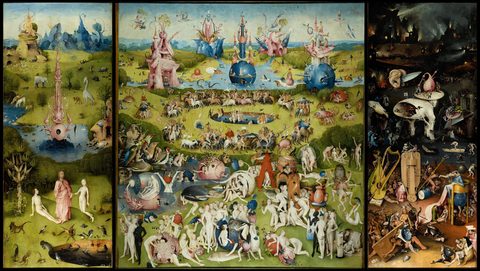
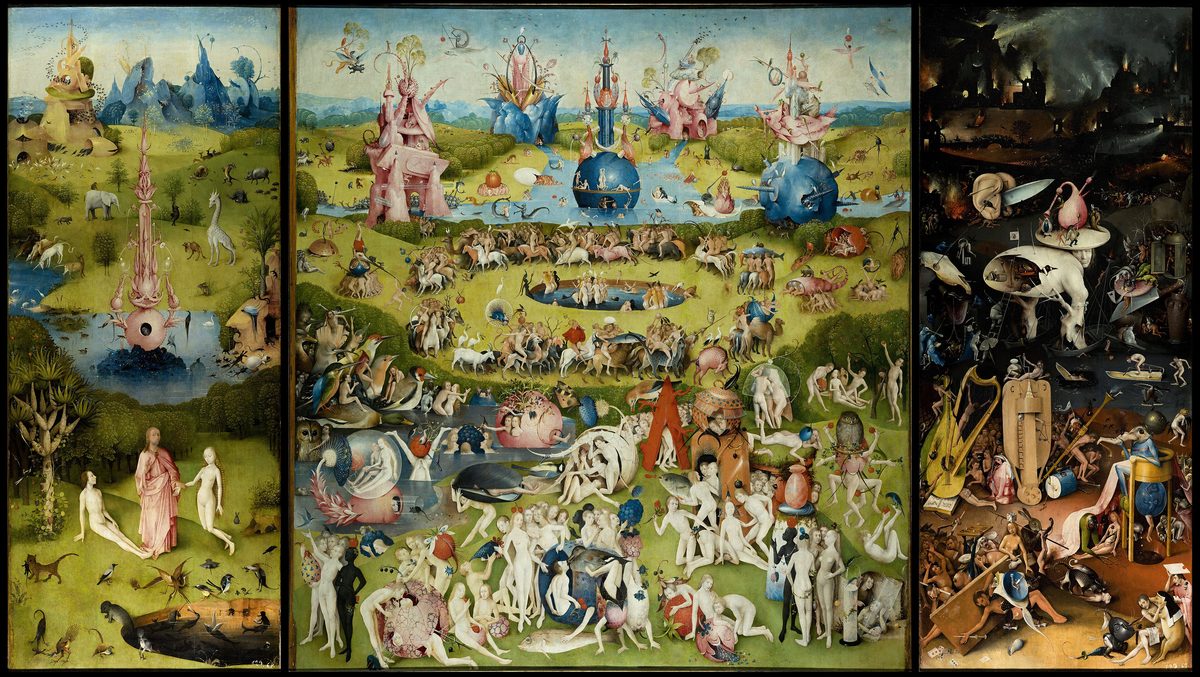
The Garden of Earthly Delights (c. 1490 to 1510, Museo del Prado, Madrid) is a large triptych in oil on oak. The left panel shows God presenting Eve to Adam in Eden. The central panel shows nude figures, giant fruits, birds, and strange structures in a garden. The right panel is a hell scene with fire, musical instruments used as torture devices, and hybrid demons. The work links the creation of humanity to the wages of sin.
The Temptation of St. Anthony (c. 1500 to 1510, Museu Nacional de Arte Antiga, Lisbon) is a triptych that shows the hermit saint besieged by demons. The central panel places Anthony in a ruined landscape with water, boats, and grotesque figures. The side panels show further episodes of his trials. The painting is an important example of Bosch's use of the saint's trials to picture mental struggle.
The Haywain Triptych (c. 1510 to 1516, Museo del Prado, Madrid) shows a hay wagon being pulled by demons toward hell. Crowds of people fight for hay, while Christ appears above. The left panel shows Eden and the right panel shows damnation. The image uses a common proverb, the world is a haystack, and each person grabs what he can.
Where to see the originals
The Philadelphia Museum of Art owns the catalogue work, The Adoration of the Magi (copy). Madrid's Museo del Prado holds The Garden of Earthly Delights and The Haywain Triptych. Lisbon's Museu Nacional de Arte Antiga holds The Temptation of St. Anthony. Check each museum's website for current display status before a visit, because panels on oak can be rotated for conservation or loan.
Because only about two dozen paintings are widely accepted as autograph, viewing a Bosch painting often means traveling to a specific city. The Philadelphia copy shows how his designs were repeated by followers and copyists.
Paintings by Hieronymus Bosch