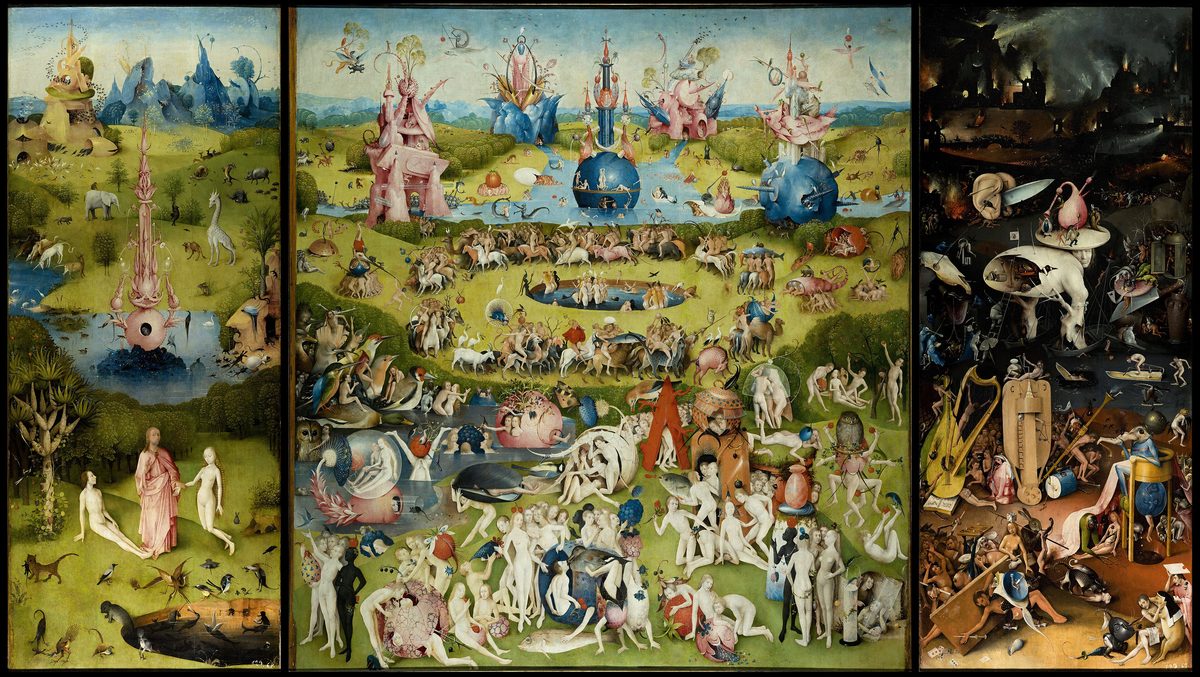
Hieronymus Bosch painted The Garden of Earthly Delights around 1490 to 1510; the exact date is debated. It is a triptych in oil on oak panels, 205.5 cm high and 384.9 cm wide when open. The Museo del Prado in Madrid holds the work. Bosch was born around 1450 and died in 1516; he spent his career in 's-Hertogenbosch, the town that gave him his name. When the wings are opened, the left and center panels glow with greens, pinks, and blues; the right wing falls into browns and blacks.
What The Garden of Earthly Delights shows
The triptych opens to reveal three connected scenes. On the left wing a green landscape holds a pink fountain-like spire in a pond, with an elephant, a giraffe and birds nearby. In the foreground a robed figure stands between a seated nude man and a standing nude woman. The central panel is crowded with hundreds of small nude figures in a green landscape. At its middle a circular pool is ringed by riders on horses, camels and other animals. Above, a blue lake is dotted with pink and blue structures, one a blue sphere. In the lower part figures carry giant fruits, berries, shells and transparent bubbles, while oversized birds appear nearby. The right wing is a dark night scene: burning buildings glow at the top, and below sit large musical instruments, a pale hollow figure with tree-trunk legs, and a bird-headed creature on a high chair. The left and center panels are bright greens, pinks and blues; the right wing is dark browns and blacks with orange firelight. The paint has clear outlines and smooth surfaces.
When and why it was painted
Bosch was a mature painter when he made The Garden of Earthly Delights. Oil on panel was the dominant medium in Early Netherlandish painting, and Bosch used thin layers of paint to build precise figures and smooth surfaces. The work belongs to the Northern Renaissance, a culture that valued sharply observed detail and dense symbolic arrangements. A triptych like this one allowed Bosch to present a sequence of scenes side by side, from the green landscape on the left wing to the dark firelit right wing. The large central panel shows his interest in filling a wide space with many small human figures.
Seeing it at home
A hand-painted copy of this triptych should match the original proportions, 205.5 cm high and 384.9 cm wide when open. The surface of the original is smooth oil paint, so the copy needs the same finish without heavy impasto. Pay attention to the palette: bright greens, pinks and blues on the left and center panels, dark browns and blacks with orange firelight on the right.