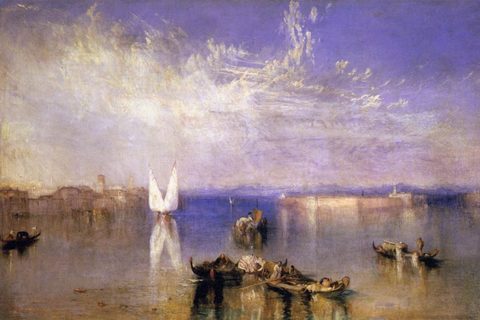
J. M. W. Turner Paintings
Joseph Mallord William Turner was an English painter and draftsman, born in 1775 and active until his death in 1851. He worked across marine art, history painting, and landscape, but turner paintings are known for making light, weather, and movement the main subject. A single work can record a ship, a waterfall, or a burning sea while the paint itself appears to dissolve into vapor, spray, and smoke. He entered the Royal Academy Schools in 1789 and showed his first oil painting there in 1796. Today museums in London, Edinburgh, Indianapolis, and elsewhere hold his work.
Life and training
Turner was born in London in 1775. His father worked as a barber and wigmaker in Covent Garden. Early drawings of the city and the Thames led to the Royal Academy Schools, which he entered in 1789 at age 14. He first showed a watercolor at the Royal Academy in 1790 and an oil painting in 1796. By 1799 he was elected an Associate of the Royal Academy, and in 1802 he became a full Academician at 26.
During the 1790s Turner made sketching tours through Britain, recording cathedrals, abbeys, and coastal towns. In 1793, at about 18, he produced the watercolor 'Evesham, The Church of St Lawrence, Seen through the Arch of the Bell Tower', now in Tate Britain. These early sheets gave him a store of architectural subjects and taught him how to build a composition from precise observation.
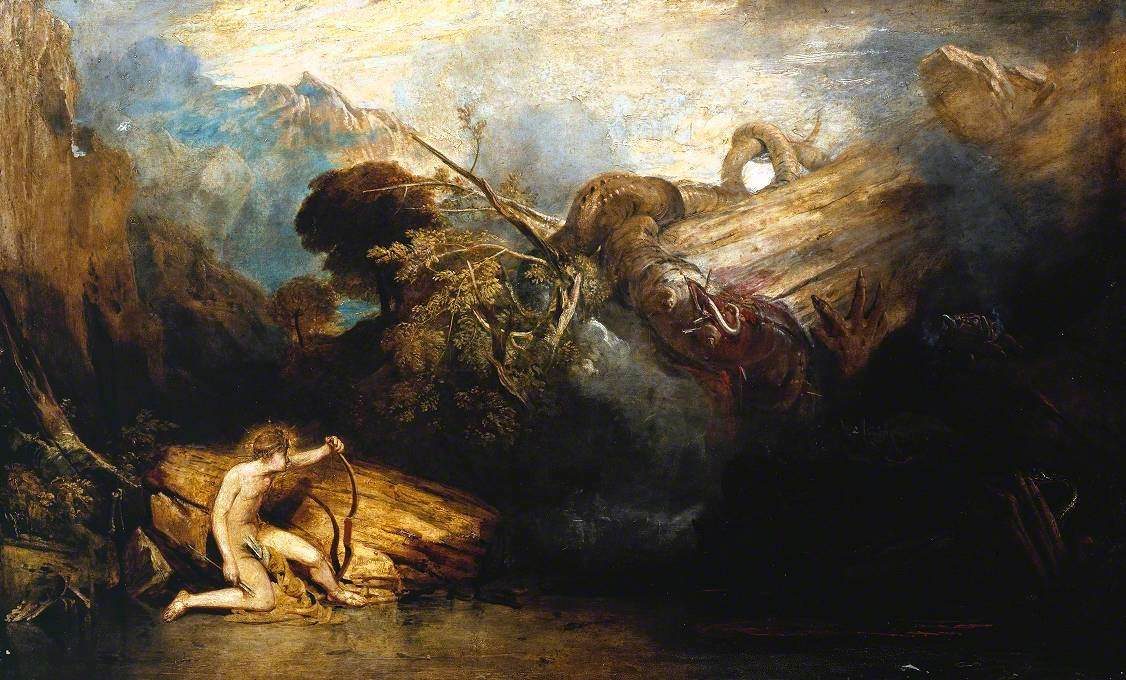
Turner began traveling to continental Europe in 1802, during a brief peace in the Napoleonic Wars. He visited France and Switzerland, and later worked in Italy, Germany, and the Low Countries. The 1811 oil 'Apollo and Python' (Tate Britain) draws on a classical myth. In 1819 he showed 'Entrance of the Meuse: Orange-Merchant on the Bar, Going to Pieces', a 175.0 x 246.0 cm canvas now at Tate Britain, in which a merchant ship founders on a sandbar. By the 1830s and 1840s his paint handling became looser and his color more intense, often linked to specific places like the Rhine falls at Schaffhausen and the lagoon at Venice.
Turner kept working until his final years. Around 1840 to 1850, at about 75, he painted 'Europa and the Bull' and 'Falls of the Clyde'. He died in Chelsea in 1851. His will left many paintings and sketchbooks to the British nation, which is why Tate Britain now holds the largest public collection of his oil paintings.
Style and technique in Turner paintings
Turner's technique changed sharply over six decades. Early sheets such as the 1793 watercolor 'Evesham, The Church of St Lawrence, Seen through the Arch of the Bell Tower' depend on careful pencil underdrawing and controlled washes. In oil, the 1811 'Apollo and Python' keeps clear contours but pushes the composition toward a sweeping landscape with a huge snake and a muscular figure. Turner admired the 17th-century painter Claude Lorrain and studied his balanced landscapes.
By the 1810s and 1820s Turner often used watercolor for quick effects of weather and disaster. 'Eruption of Vesuvius' (1817, Yale Center for British Art) sets a red glow against dark smoke and pale reflections. The 1819 oil 'Entrance of the Meuse: Orange-Merchant on the Bar, Going to Pieces' is a large sea piece. In the 1830s and 1840s his brushwork became looser, and outlines dissolve into light. 'Fire at Sea' (circa 1835, Tate Britain) is built from orange, white, and brown with no fixed horizon.
He returned to similar subjects in different media. The Rhine falls at Schaffhausen appear in an oil of around 1805-1806, and in watercolors of 1841. Another waterfall, 'Falls of the Clyde', dates from around 1840-1850. He also combined gouache and watercolor on paper, as in 'Isola di San Giorgio Maggiore' (1840, Tate Britain).
Key paintings
Apollo and Python (1811, Tate Britain) measures 145.4 x 237.5 cm and turns a classical myth into a large landscape. The subject is Apollo's fight with the serpent Python. It matters because Turner used a history painting format on the scale of a grand landscape.
Eruption of Vesuvius (1817, Yale Center for British Art) is a 28.6 x 39.7 cm watercolor. The volcano throws red light against dark smoke, recorded with quick, controlled washes.
Entrance of the Meuse: Orange-Merchant on the Bar, Going to Pieces (1819, Tate Britain) is a 175.0 x 246.0 cm oil. A merchant ship has run aground at the river mouth in rough water, as the title says.
Fall of the Rhine at Schaffhausen (circa 1805-1806, Museum of Fine Arts, Boston) is a 144.7 x 233.7 cm oil. Turner returned to this subject in watercolors of 1841.
Fire at Sea (circa 1835, Tate Britain) is a 171.5 x 220.5 cm oil with loose, open forms. It shows how far Turner moved from the precise watercolors of the 1790s.
Where to see the originals
Tate Britain in London holds the largest public group of Turner oil paintings, including 'Apollo and Python', 'Entrance of the Meuse', and 'Fire at Sea'. The Scottish National Gallery in Edinburgh has several Rhine falls subjects and other Continental scenes. In the United States, visitors can see works at the Yale Center for British Art in New Haven, the Indianapolis Museum of Art, the Museum of Fine Arts in Boston, and the Taft Museum of Art in Cincinnati. The Lady Lever Art Gallery in Port Sunlight and the Manchester Art Gallery also hold individual paintings. Watercolors and drawings rotate often, so check the museum's current display before planning a trip.
Paintings by J. M. W. Turner
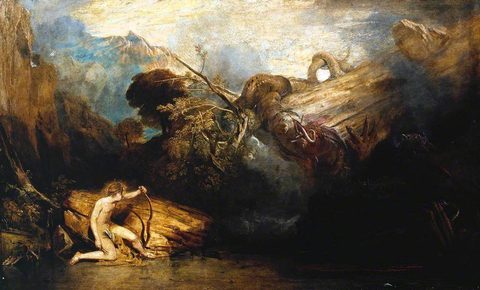
Apollo and Python
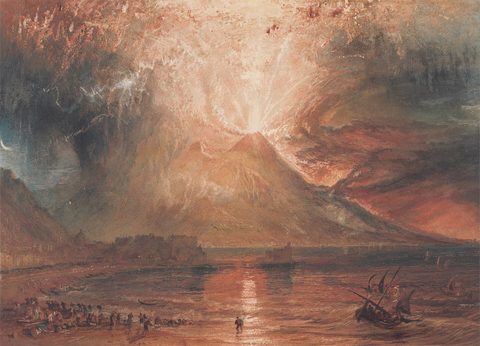
Eruption of Vesuvius
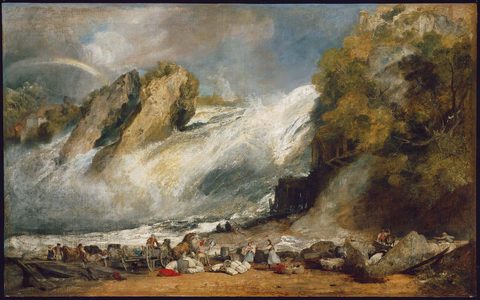
Fall of the Rhine at Schaffhausen
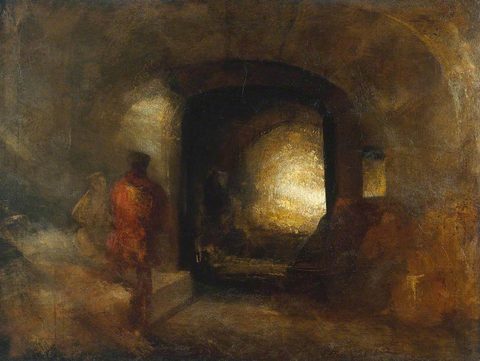
Figures in a Building
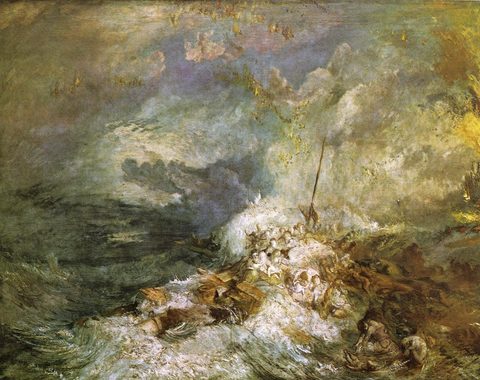
Fire at Sea
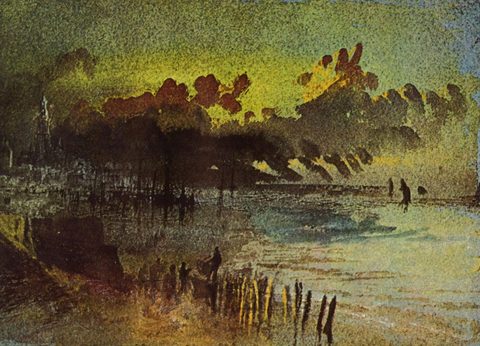
Honfleur
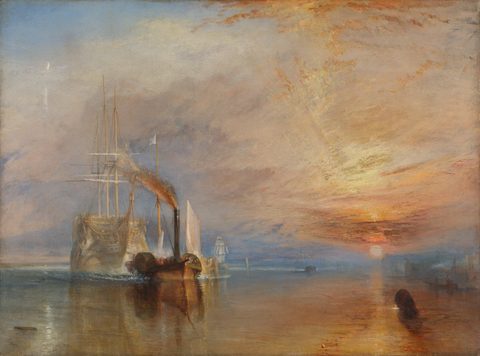
The Fighting Temeraire
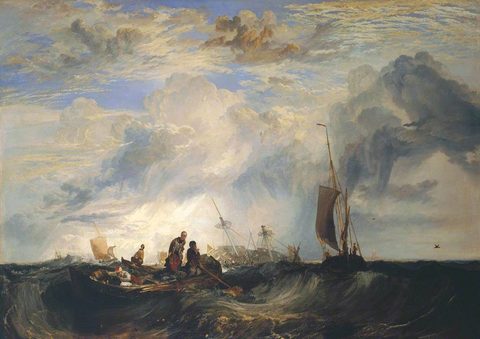
Entrance of the Meuse: Orange-Merchant on the Bar, Going to Pieces