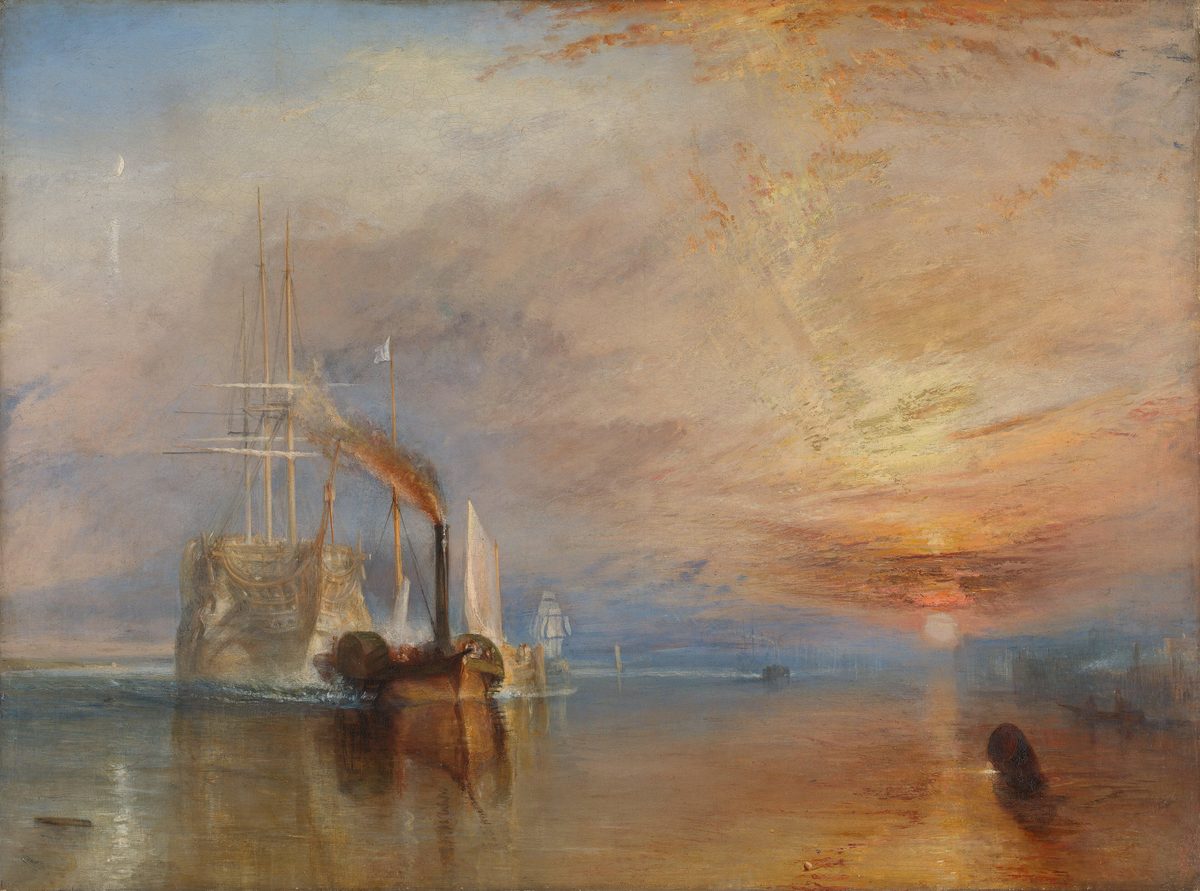
J. M. W. Turner painted The Fighting Temeraire in 1839. The oil on canvas measures 90.7 x 121.6 cm and now hangs in the National Gallery, London. It shows an old three-masted sailing warship with furled sails, pale against the sky, being towed along calm water by a small dark steam tug as the sun sets low to the right; the water mirrors the sunset in gold, orange and grey, while Turner laid on the sky with heavy, scraped strokes.
What the picture shows
Stand in front of the canvas and the picture divides almost in two. On the left, a pale three-masted warship with furled sails sits on calm water, cool blue-grey above and around it. A small dark steam tug with a tall black funnel is in front of the ship and tows it toward the right; its red-brown smoke drifts back. At right-centre a small sailing boat with a white sail passes, and farther back there is another sailing ship. The right half belongs to the sunset: the sun is low on the horizon, with streaks of orange, red and yellow cloud spreading across the right half of the sky. A thin crescent moon is visible near the left edge in the pale blue and grey upper sky. The still water reflects the ships and sunset in gold, orange and grey; a dark buoy floats in the lower right, with a faint shoreline and low buildings at the far right. Turner alternated thin and thick paint, keeping the handling loose; the sunset sky is laid on with heavy, scraped strokes.
When and why it was painted
Turner made this picture in 1839, when he was in his sixties and had long been known for sea and landscape subjects. The Fighting Temeraire had taken part in the Battle of Trafalgar in 1805, and in 1838 the old warship was towed up the Thames to be broken up. Turner pairs the pale sailing ship with dark modern machinery. The contrast fits the Romantic period, which often looked at change, memory and the passage of time through landscape and light. Turner exhibited the painting at the Royal Academy in 1839. He worked in oil on canvas, using a horizontal format to spread the scene between cool blue-grey air and a heavily painted orange-gold sky.
Seeing The Fighting Temeraire at home
In a hand-painted copy of The Fighting Temeraire, keep the proportions close to the original 90.7 x 121.6 cm, a wide horizontal shape. Look for a surface with visible variation: thin, smooth handling in the left sky and heavy, scraped paint in the sunset clouds. The palette should move from cool blue-grey on the left to orange, yellow and gold on the right, with the warship kept pale and the steam tug and its tall black funnel dark against the water.
Related paintings
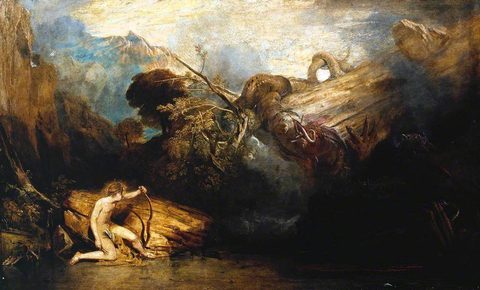
Apollo and Python
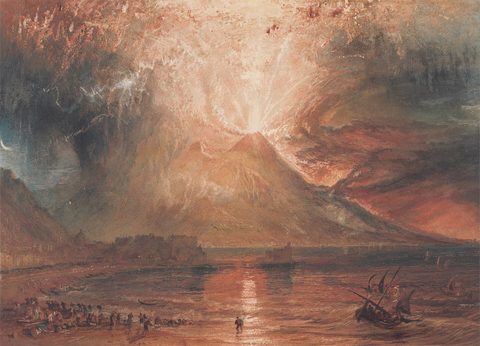
Eruption of Vesuvius
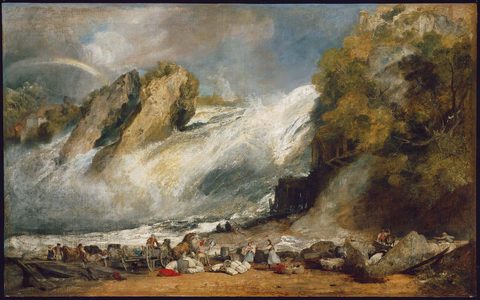
Fall of the Rhine at Schaffhausen