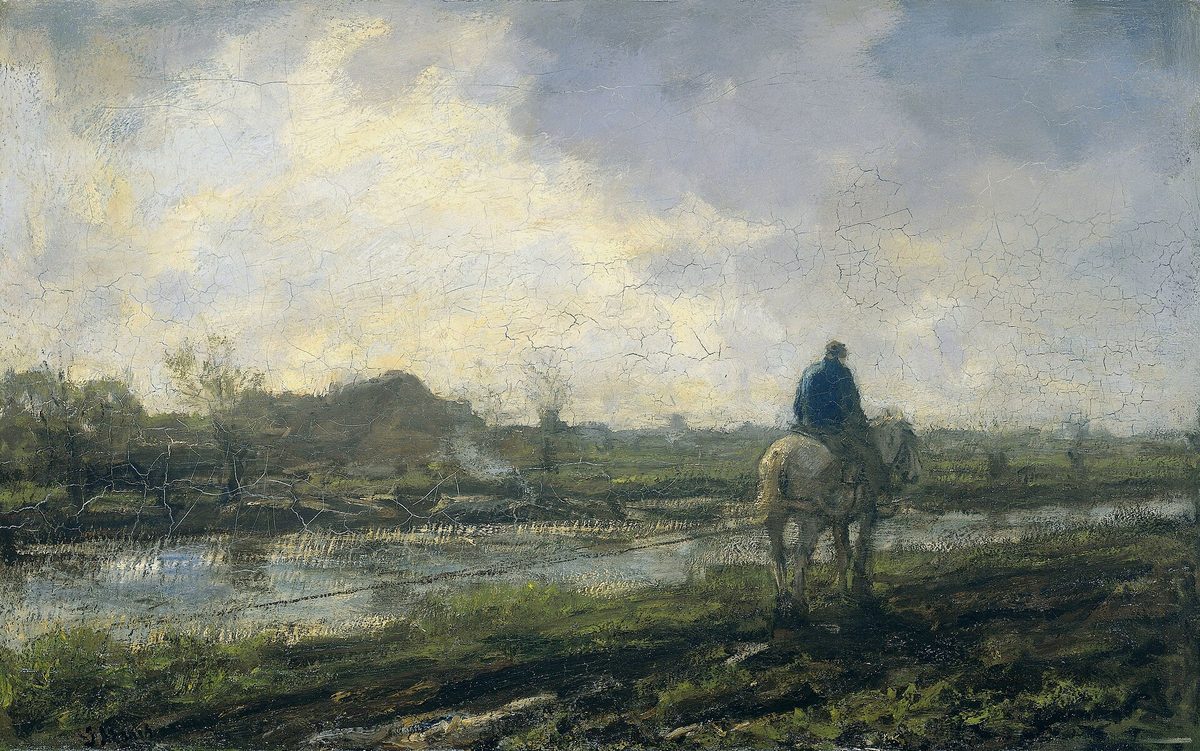
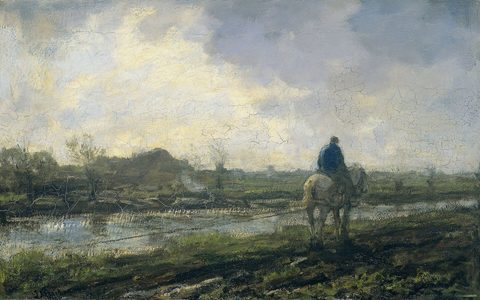
Jaagpad by Jacob Maris is an 1894 landscape. The Dutch word jaagpad means towpath, and the painting shows a rider moving away along such a path beside water. Maris made it at roughly 57 years old, late in a career closely linked to the Hague School. The horizontal format, close to 8:5, places the horizon below the halfway line, leaving most of the canvas to the sky.
What the picture shows
Stand in front of it and the eye goes first to the rider right of center. He sits on a pale grey-white horse, seen from behind, wearing a blue jacket and a dark cap, moving away along the path. The path runs across a flat, wet meadow with a long strip of shining water stretching left to right across the middle. In the foreground, muddy dark-green grass and puddles anchor the scene. The horizon sits low, below the halfway point, so the sky fills the upper part. On the left, bright white and cream clouds break; on the right, grey-blue masses gather. Low trees and a dark mound or haystack shape mark the left horizon, with faint trees along the right. The palette stays in greens, browns, blue-grey and white, applied with thick, energetic brushwork. A heavy craquelure network is visible across the whole surface, especially in the sky. The signature is lower left.
Jaagpad by Jacob Maris: when and why it was painted
By 1894 Jacob Maris was about 57 and had spent decades painting Dutch landscapes. Born in 1837, he died five years later, in 1899. He was associated with the Hague School, a group of artists working around The Hague who favored the flat countryside, wide skies and damp light of the Netherlands. Their paintings often kept the paint visible and the mood overcast rather than polished. A towpath subject gave Maris a simple structure: a low horizon, a strip of water, a path disappearing into the distance, and a sky that carries much of the picture. It was the kind of working landscape he and other Hague School painters returned to.
Seeing it at home
For a hand-painted copy, look for a horizontal canvas with proportions close to 8:5. The surface should not be too smooth; the original has heavy craquelure, especially across the sky, and thick, energetic brushwork. The palette should stay within greens, browns, blue-grey and white, with bright white and cream clouds on the left. Keep the rider small and right of center.