Joaquín Sorolla Paintings: Light, Sea, and Garden Scenes
Joaquín Sorolla (1863 to 1923) was a Spanish painter from Valencia who made sunlit beach scenes, portraits, and garden views his main subjects. He trained in Valencia, Madrid, and Rome and became a leading figure in Spanish painting around 1900. He absorbed old master painting at the Prado and modern tendencies in Paris, then returned to Spain with a preference for real light over studio formulas. Sorolla paintings matter today because they show Mediterranean light with direct, confident brushwork and a sharp documentary eye for working life. In works like Bath time, Valencia (1908) and The Return from Fishing (1894), he records ordinary moments on the Valencian coast. Many of his paintings are in the Museo Sorolla and the Hispanic Society of America.
Life and training
Joaquín Sorolla was born in Valencia, Spain, on February 27, 1863. He was orphaned as a small child and raised by an aunt and uncle. His drawing ability was noticed early, and he began formal study at the Escuela de Bellas Artes de San Carlos in Valencia while still in his teens. He later went to Madrid, where he copied Spanish masters at the Museo del Prado, above all Velázquez.
In 1885 Sorolla received a grant to study in Rome. He married Clotilde García del Castillo in 1888, and the couple had three children. From Rome he also spent time in Paris, where he saw work by naturalist painters. That exposure pushed him toward natural light and modern subjects. He returned to Spain and settled in Madrid in 1890, but the Valencian coast remained his main subject source.
His reputation grew in the 1890s with large social scenes. The Return from Fishing (1894) shows two oxen pulling a boat through surf and won him international notice; it is now in the Musée d'Orsay. Portrait commissions followed, including Portrait of Countess of Santiago (1894) and The Painter Jose Moreno Carbonero (1895). In 1900 he painted Roses, a garden still life now in the Museo Sorolla. In 1906 he painted A Rooftop with Flowers.
During the 1910s Sorolla took on a major decorative commission for the Hispanic Society of America in New York: a series of large panels representing Spanish regions. He traveled across Spain to observe regional dress, markets, and landscapes for that project. Two of those panels are Seville, the Bullfighters (1915) and Extremadura, The Market (1917). A stroke in 1920 left him unable to paint. He died in Cercedilla, near Madrid, on August 10, 1923. His family home and studio in Madrid became the Museo Sorolla.
Style and technique
Velázquez was an early influence, visible in the modeling of heads and hands. Sorolla's early academic training never disappeared, but his mature style developed around direct observation of sunlight. He painted most of his pictures directly from life, often out of doors, with fluid oil paint. Bath time, Valencia (1908) is a square canvas, 150 x 150.5 cm, painted in this way.
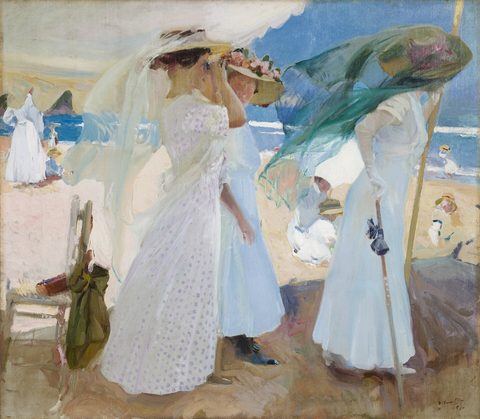
His palette for beach and sea pictures leans on silver blues, sandy ochres, pinks, and strong whites. He often drags thin paint across the canvas for moving water, then lays thick ridges of light on the wet sand. Small studies like The Beach, Valencia (Oxen Pulling a Boat) (1904) use oil on cardboard and keep the brushwork quick. Larger canvases such as Under the awning at Zarauz beach (1910) show the same directness on a bigger scale.
Gardens and portraits share this kind of observation. Roses (1900) is a small canvas, 57.5 x 45.5 cm, where the blossoms are painted with separate strokes rather than smooth blending. After about 1900 the tone opens up, and his later works are defined more by sunlight than by studio shadow.
Key Sorolla paintings
The Return from Fishing (1894) is an early large canvas, 265 x 325 cm, now in the Musée d'Orsay. It shows two oxen pulling a fishing boat through the shallows. The painting belongs to Sorolla's early naturalist scenes of working life and helped establish his name internationally.
Bath time, Valencia (1908) is a square canvas of 150 x 150.5 cm in the Museo Sorolla, Madrid. The picture is an example of his mature beach paintings, where the main subject is Mediterranean light itself.
Under the awning at Zarauz beach (1910), also in the Museo Sorolla, measures 98 x 124.5 cm. It places a group under a shaded canopy while the beach and sea stay bright beyond the cloth.
Extremadura, The Market (1917) belongs to the Hispanic Society of America in New York. At 351 x 302 cm it is one of the large panels in the Vision of Spain cycle. The scene arranges a crowded market with animals, baskets, and figures, painted with the same plein-air brightness Sorolla used on the coast.
Roses (1900) is a small still life, 57.5 x 45.5 cm, in the Museo Sorolla. It shows that Sorolla did not need wide space or human figures to record strong daylight.
Where to see the originals
The Museo Sorolla in Madrid is the artist's former home and studio and holds the largest public collection, including Bath time, Valencia, Roses, Under the awning at Zarauz beach, and The Smugglers (study). The Museo Nacional del Prado in Madrid has the early Praying Saint (1888). In Paris, the Musée d'Orsay keeps The Return from Fishing (1894). The Hispanic Society of America in New York owns Extremadura, The Market (1917), Seville, the Bullfighters (1915), and the small study The Beach, Valencia (Oxen Pulling a Boat) (1904). Museo Franz Mayer in Mexico City has Garden, Alcazar, Seville (1908). Several works remain in private collections and are not regularly on public view. Check museum hours before visiting.
Paintings by Joaquín Sorolla
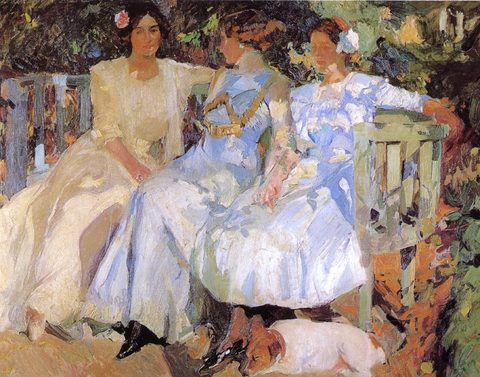
My Wife and Daughters in the Garden
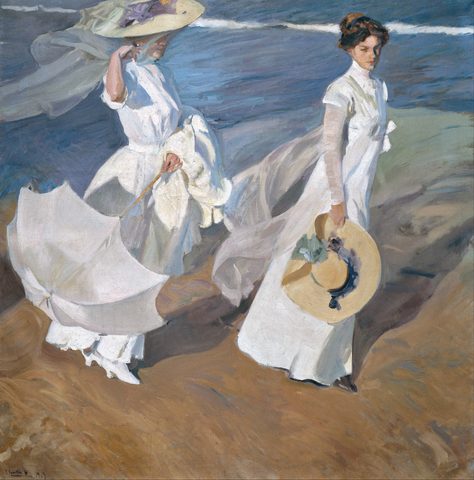
Strolling along the Seashore
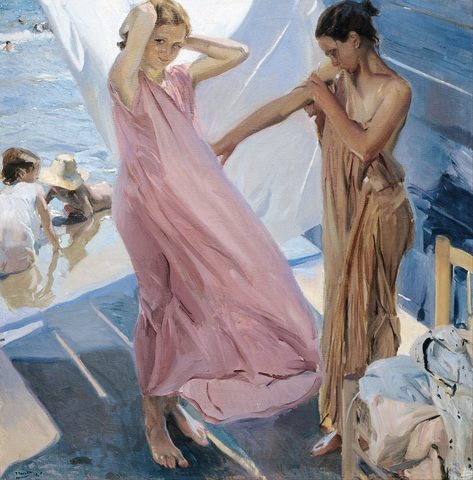
Bath time, Valencia
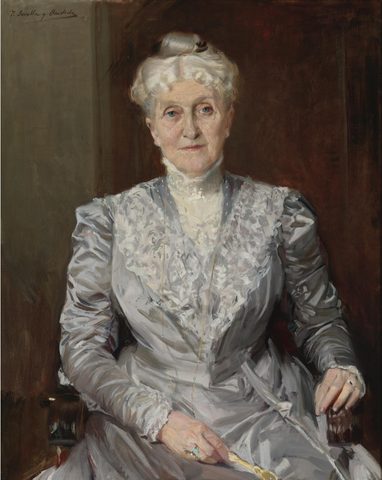
Emily Perkins
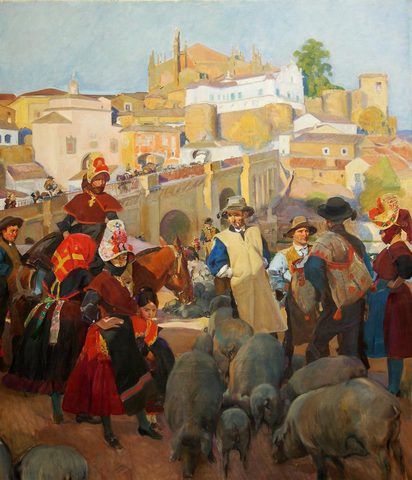
Extremadura, The Market
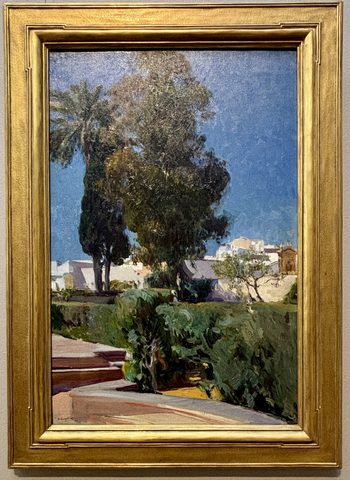
Garden, Alcazar, Seville
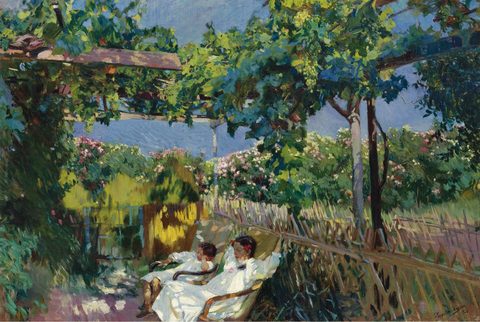
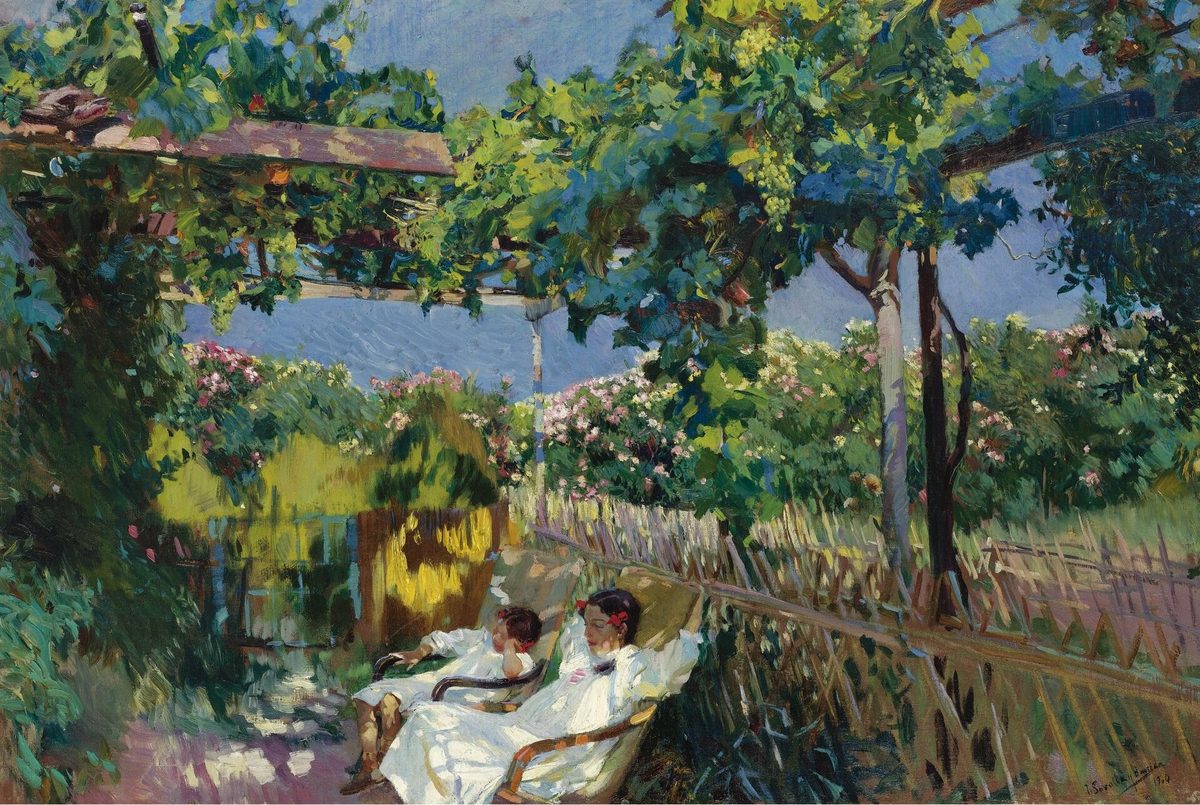
Siesta in the Garden