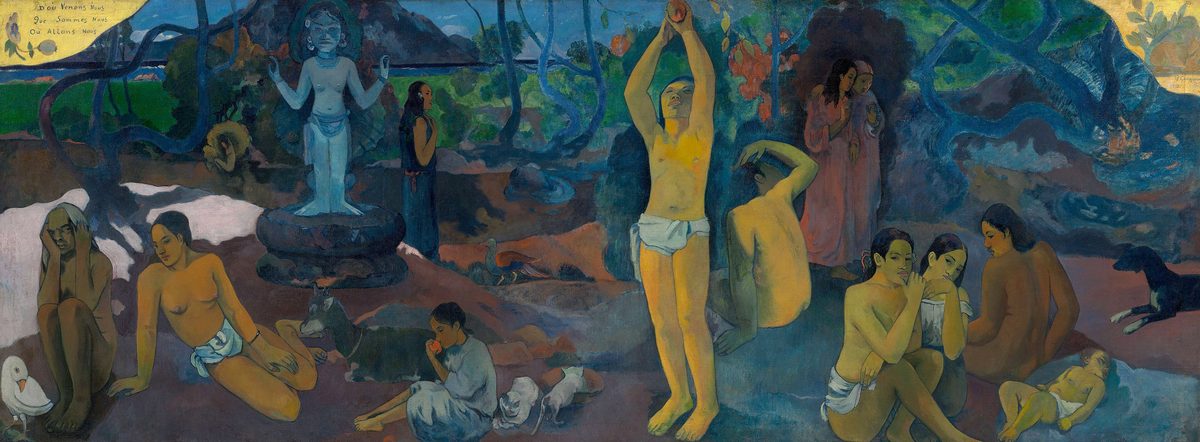
Paul Gauguin, a French Post-Impressionist and Symbolist painter, painted Where Do We Come From? What Are We? Where Are We Going? in 1897-1898 during his second stay in Tahiti. The oil on canvas measures 139.1 x 374.6 cm and has the proportions of a very wide frieze, roughly 2.7:1. Today it hangs in the Museum of Fine Arts Boston. The upper left corner carries a French inscription, and the upper right corner carries the artist's signature. The rough canvas texture remains visible in places.
What the picture shows
Read the frieze from right to left. At the far right a sleeping baby lies on the ground; next to it three seated young women and a black dog. In the right middle, two figures in long pinkish robes walk in the shadow of the trees. At the centre a young man in a white loincloth stands with both arms raised, picking a fruit from a branch above. In the foreground centre a child eats a fruit; small white cats and a goat lie on the ground. At the left middle a pale blue-grey idol stands on a round base, arms raised. At the far left a hunched old woman crouches with her hands to her face; next to her a white bird holds a lizard. The background has dark blue and green trees, a stream, the sea and mountains, with patches of red-orange earth.
The palette is flat: deep blue, turquoise, green, yellow-ochre and brown. The two upper corners are bright yellow; the upper left carries the French inscription, the upper right the signature.
When and why it was painted: Where Do We Come From? What Are We? Where Are We Going? by Paul Gauguin
Gauguin made this painting in 1897-1898, around age fifty, during his later years in French Polynesia. He had already developed the flat colour and simplified forms associated with the Pont-Aven School and Symbolism. By the mid-1890s his work had moved away from Impressionist naturalism toward a more decorative, symbolic arrangement of figures. The very wide canvas follows a frieze format, read from right to left, and gathers figures of different ages: a baby, a child, a young man, an old woman. These figures sit among a landscape of dark trees, sea and mountains. The French inscription in the upper left asks the three questions of the title, which suggests a personal, philosophical summing-up rather than a scene from everyday life. Gauguin died in 1903, five years after completing it.
Seeing it at home
A hand-painted copy should preserve the original's very wide, frieze-like proportions, roughly 2.7:1. If the reproduction is smaller, the figure groups may feel compressed; a wider format keeps the right-to-left rhythm. Look for a flat, matte surface with visible canvas texture in places. The palette should stay close to deep blue, turquoise, green, yellow-ochre, brown, with bright yellow upper corners and patches of red-orange earth.