Gauguin Paintings: Color, Symbol, and the Search for a Primal World
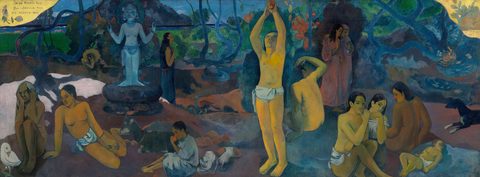
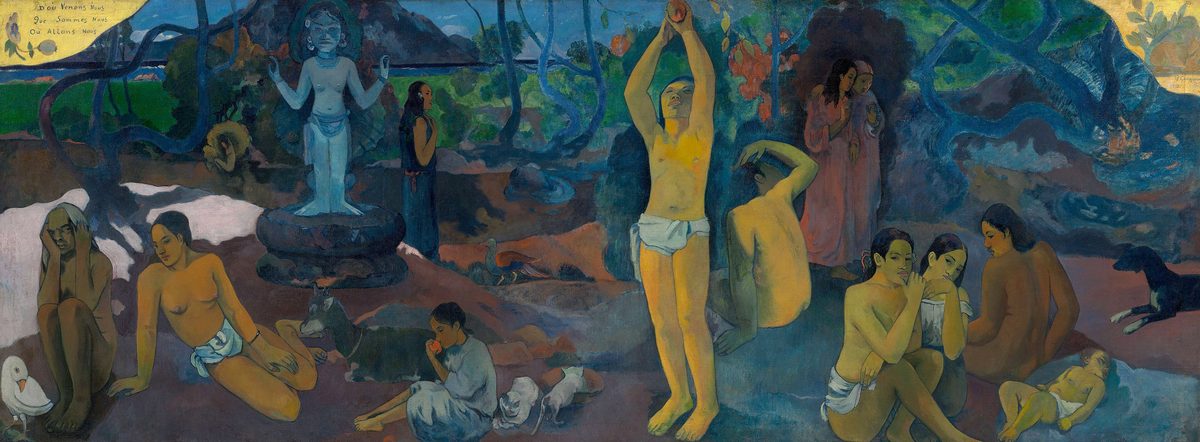
Paul Gauguin (1848 to 1903) was a French painter and printmaker who began as a stockbroker and became a central figure of Post-Impressionism and Symbolism. After leaving his career and family, he moved from Paris to Brittany, Martinique, Arles, and finally Polynesia, where he produced his most radical paintings. His importance today rests on how he changed color: he treated it as an independent, emotional force rather than a tool for describing nature. Gauguin's paintings set flat, saturated areas side by side, simplified figures, and folded in references to non-Western art, Japanese prints, and medieval stained glass. That visual language helped open the door to Fauvism and early abstraction. The monumental painting Where Do We Come From? What Are We? Where Are We Going? in the Museum of Fine Arts Boston shows the ambitions and risks of his late work.
Life and training
Paul Gauguin was born on June 7, 1848, in Paris. His father was a journalist, and his mother was of Peruvian descent. When Gauguin was one, the family left France for Peru; his father died on the voyage, and Gauguin spent his early childhood in Lima before returning to France at age seven. He attended school in Orléans and later joined the merchant marine, then the French Navy. In 1871 he settled in Paris and became a stockbroker. He had no formal academic training. In 1873 he married Mette-Sophie Gad, a Danish woman, and they had five children.
Gauguin painted in his spare time and met Camille Pissarro, who encouraged him to exhibit with the Impressionists from 1879 to 1886. In his early work he followed Pissarro's advice, painting outdoors with small brushstrokes and observing changes of light. After the Paris stock market crash of 1882, Gauguin began to think about art as a full-time occupation. In 1885 he separated from his family, leaving them in Copenhagen, and focused on painting.
Gauguin first visited Pont-Aven in 1886 and returned several times; the town became a base for his experiments. In 1887 he traveled to Martinique, where the bright color and tropical vegetation pushed his palette toward stronger, flatter planes. In October 1888 he stayed with Vincent van Gogh in Arles; their nine weeks together ended in Van Gogh's breakdown and Gauguin's return to Paris. In 1891 Gauguin left for Tahiti, where he lived intermittently for the rest of his life. He returned to Paris in 1893, but by 1895 he was back in Polynesia. In 1901 he moved to Atuona on Hiva Oa in the Marquesas Islands, where he died on May 8, 1903.
Style and technique
Gauguin's paintings look different from Impressionist work because he abandoned naturalistic color and broken brushwork. In mature works such as Vision After the Sermon and The Yellow Christ, he laid down large, flat areas of unmodulated color and enclosed them with dark outlines, a technique called cloisonnism. He often worked from memory and imagination rather than direct observation, which let him rearrange figures and colors for emotional effect. He often painted on coarse canvas or burlap, which gave the surface a rough, matte texture. His palette moved from the lighter tones of his early Impressionist landscapes to intense reds, yellows, blues, and greens.
His subjects included Breton peasants, Tahitian women, still lifes, and self-portraits. He painted many self-portraits as a way to test his changing identity and technique. He simplified faces and bodies into solid, sculptural forms, ignoring academic perspective. Japanese woodblock prints, medieval stained glass, and the folk art of Brittany shaped this approach. Gauguin also used color symbolically, for mood rather than description. He rarely used one-point perspective; instead he stacked motifs or placed figures in shallow, stage-like spaces. In his prints and woodcuts, the same bold contours and flat shapes appear, reinforcing the painted style.
Over time his compositions became more decorative and flat. In Tahiti, he combined observed details such as pareo patterns and carved idols with imagined settings, creating paintings that are both documentary and symbolic. The paint surface in his late canvases can be thin, letting the weave show through, or built up in heavy impasto in selected areas. This deliberate roughness was part of his break with salon finish. These choices made his surfaces feel modern and deliberately handmade.
Key paintings
Where Do We Come From? What Are We? Where Are We Going? is an oil on canvas from 1897 to 1898, measuring 139.1 by 374.6 cm and now in the Museum of Fine Arts Boston. The long horizontal canvas reads from right to left, starting with a sleeping baby, then a group of women, a standing figure with arms raised, a crouching old woman, and a blue idol. Gauguin intended the composition as a philosophical frieze about the stages of life, and he considered it a summing-up of his ideas.
Vision After the Sermon (Jacob Wrestling with the Angel), painted in 1888, shows Breton women in white caps and black dresses watching a biblical struggle in a brilliant red field. The upper right corner contains Jacob and the angel. The red ground is not natural; it communicates spiritual intensity, and the flat color separated Gauguin from Impressionist observation. The painting is in the National Gallery of Scotland.
The Yellow Christ, from 1889, shows a yellow-skinned Christ on a wooden cross in a Breton landscape. Three women in traditional costume kneel at the foot of the cross. Gauguin used dark outlines, simplified shapes, and an unmodulated yellow body, a combination that gives the painting the directness of folk art and stained glass. It hangs in the Albright-Knox Art Gallery.
Tahitian Women on the Beach, 1891, depicts two seated women on a shore. Gauguin painted it during his first stay in Tahiti, mixing observed details with an imagined composition. The color is flat and saturated. The work is in the Musée d'Orsay.
Spirit of the Dead Watching, 1892, shows a nude Tahitian girl lying face down and a dark-cloaked figure behind her. Color and shadow carry the fear and the supernatural presence; the composition is deliberately unstable. It is also in the Albright-Knox Art Gallery.
Where to see the originals
Where Do We Come From? What Are We? Where Are We Going? is in the Museum of Fine Arts Boston at 465 Huntington Avenue. Rotations and loans can change, so check before visiting. Vision After the Sermon is in the National Gallery of Scotland, Edinburgh. The Yellow Christ and Spirit of the Dead Watching are in the Albright-Knox Art Gallery, Buffalo. Tahitian Women on the Beach is in the Musée d'Orsay, Paris. The Metropolitan Museum of Art in New York and the Art Institute of Chicago also hold important Gauguin paintings. Check each institution's website for current display status.