Peter Paul Rubens
Peter Paul Rubens (1577-1640) was a Flemish painter whose large oil panels set the pace for European Baroque art. He trained in Antwerp, spent eight years in Italy, and returned to the Spanish Netherlands as a court painter and diplomat. Rubens paintings appear in major museums from Madrid to London, and their amplified figures and restless movement still shape how viewers imagine 17th-century Europe. His blend of Venetian color, Roman monumentality, and Flemish surface realism produced a visual language that later painters from Van Dyck to Watteau studied. He also built one of the most productive workshops of the century. Assistants prepared large compositions that he corrected and glazed, which let him move between altarpieces, mythologies, portraits, and diplomatic missions without losing a recognizable hand.
Life and training
Peter Paul Rubens was born on June 28, 1577, in Siegen, a town in Westphalia where his father, a lawyer from Antwerp, had settled after religious troubles in the Southern Netherlands. The family moved back to Antwerp after Jan Rubens died in 1587. Rubens trained in Antwerp under three painters: Tobias Verhaecht, Adam van Noort, and Otto van Veen. Rubens entered the Antwerp painters' guild as a master in 1598.
In 1600 he traveled to Italy and entered the service of Vincenzo I Gonzaga, Duke of Mantua. The duke sent him to Rome, Genoa, and in 1603 on a diplomatic errand to the Spanish court of Philip III. He studied Titian, Veronese, and Tintoretto in Venice, drew from ancient sculpture and Michelangelo in Rome, and absorbed the dramatic light and darkness of Caravaggio's altarpieces. In 1608 word reached him in Italy that his mother was dying. He returned to Antwerp that autumn and stayed. In 1609 the archdukes Albert and Isabella made him court painter to the Spanish Netherlands, and he married Isabella Brant, daughter of an Antwerp city official.
The next decade brought large altarpiece commissions, a busy workshop in his Italianate house near the Meir, and international fame. His language skills and courtly polish made him useful in diplomacy as well as in art. Between 1627 and 1630 Rubens traveled to Madrid and London in attempts to improve relations between Spain and England. Charles I of England knighted him in 1630, and Philip IV of Spain did the same in 1631. After Isabella Brant died in 1626, he married Hélène Fourment in 1630, when she was sixteen and he was fifty-three. He bought the country estate Het Steen in 1635 and often painted landscapes there. Rubens died in Antwerp on May 30, 1640.
Style and technique
Rubens worked mostly in oil on wood panels and later on large canvases. His method often began with a brown-toned ground or an oil sketch in grisaille, then moved to bold underlayers and translucent glazes. In his mature paintings the palette leans on warm Venetian colors: vermilion, ochre, deep blue, and green, set against creamy, pearly flesh. His brushwork ranges from tight finishing in faces to loose, sweeping strokes in drapery and sky. He gave skin a living glow by alternating soft half-tones with cool shadows and then placing a touch of red or pink along the edges and cheeks.
His subjects came mostly from the Bible, Ovid's Metamorphoses, classical history, and portraiture. He turned heroic bodies into engines of action: twisting torsos, raised arms, falling or rising figures, and billowing cloth create a spiraling energy across the picture plane. This comes from his study of Titian's color and Venetian brushwork, the muscular sculpture of Michelangelo and the ancient Laocoon, and the sharp lighting of Caravaggio. From his Flemish training he kept a careful observation of surfaces, fur, metal, fabric, and leaves.
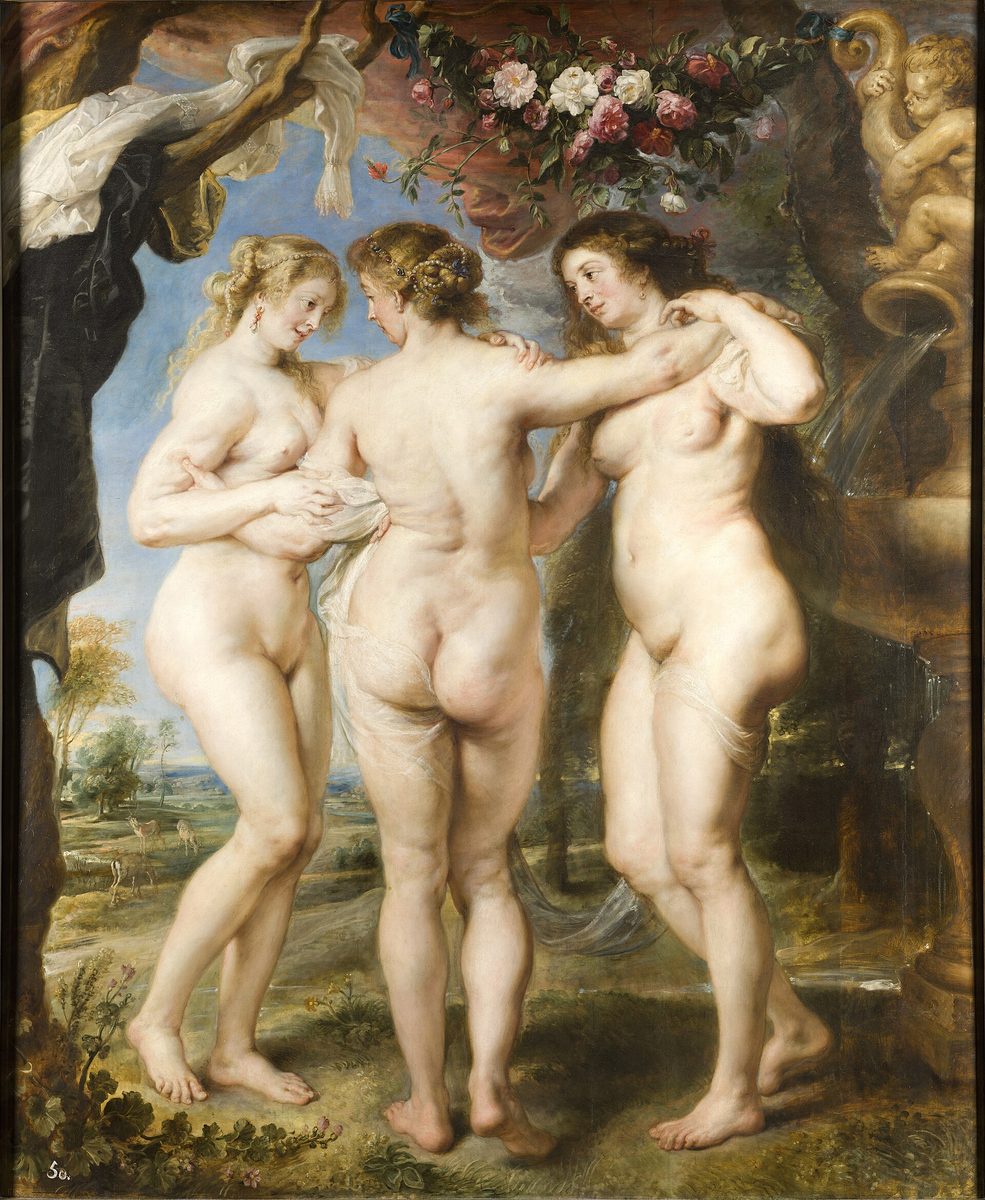
Rubens also organized a large studio. Assistants transferred his oil sketches to full scale, and he retouched the final stages, sometimes painting key heads and highlights himself. His later manner became looser. Beginning in the mid-1620s, and especially after 1630, his brushwork grew more spontaneous, his landscapes more atmospheric, and his palette more silvery and blond. Late works such as The Three Graces and The Garden of Love show softer contours and warmer sunlight. The oil sketches from his last years, painted on small panels, are now prized for their speed and directness.
Key Rubens paintings
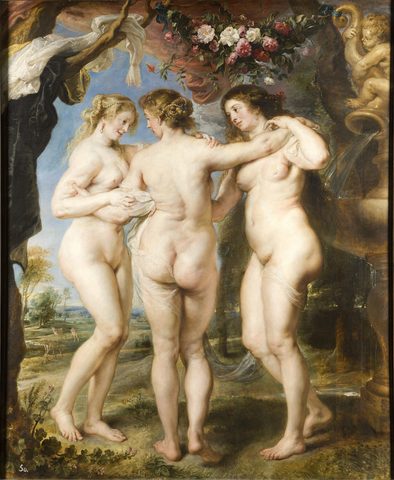
The Three Graces (1630-1635, Museo del Prado) is the one Rubens painting listed in the collection on this site. The three daughters of Zeus stand together, their bodies full and warm against a landscape background. The panel measures 220.5 by 182.0 cm. The translucent glazes on the flesh build from pale yellow-white to rose, and the linked arms draw the eye around the circle.
The Raising of the Cross (1610-1611, Cathedral of Our Lady, Antwerp) is a triptych made soon after Rubens returned from Italy. On the central panel, a group of men strain to lift Christ's cross by ropes and muscle alone. The strong diagonal gives the scene a sense of physical effort, and the muscular bodies show what he learned in Italy.
The Descent from the Cross (1612-1614, Cathedral of Our Lady, Antwerp) shows Christ's body being lowered from the cross in a white sheet, with Saint John and Nicodemus supporting his weight. The pale corpse is set against red drapery and blue cloth, and the movements of the figures slow into a careful, almost ceremonial rhythm.
The Garden of Love (1633, Museo del Prado) is a later courtly scene of couples in a garden near a grotto and fountain. The figures wear silver and rose and gold, and the light softens the whole scene. Rubens painted it on canvas, and it shows his late ease with a bright palette and social subject matter.
Where to see the originals
The Three Graces hangs in the Museo del Prado in Madrid. The Cathedral of Our Lady in Antwerp keeps The Raising of the Cross and The Descent from the Cross. The Rubens House in Antwerp, the artist's former home and studio, displays smaller works and gives a sense of his working rooms. The National Gallery in London, the Hermitage in Saint Petersburg, the Alte Pinakothek in Munich, and the Kunsthistorisches Museum in Vienna all hold major panels. Smaller oil sketches are kept in the Rubens House and the Hermitage, showing his preparatory thinking.