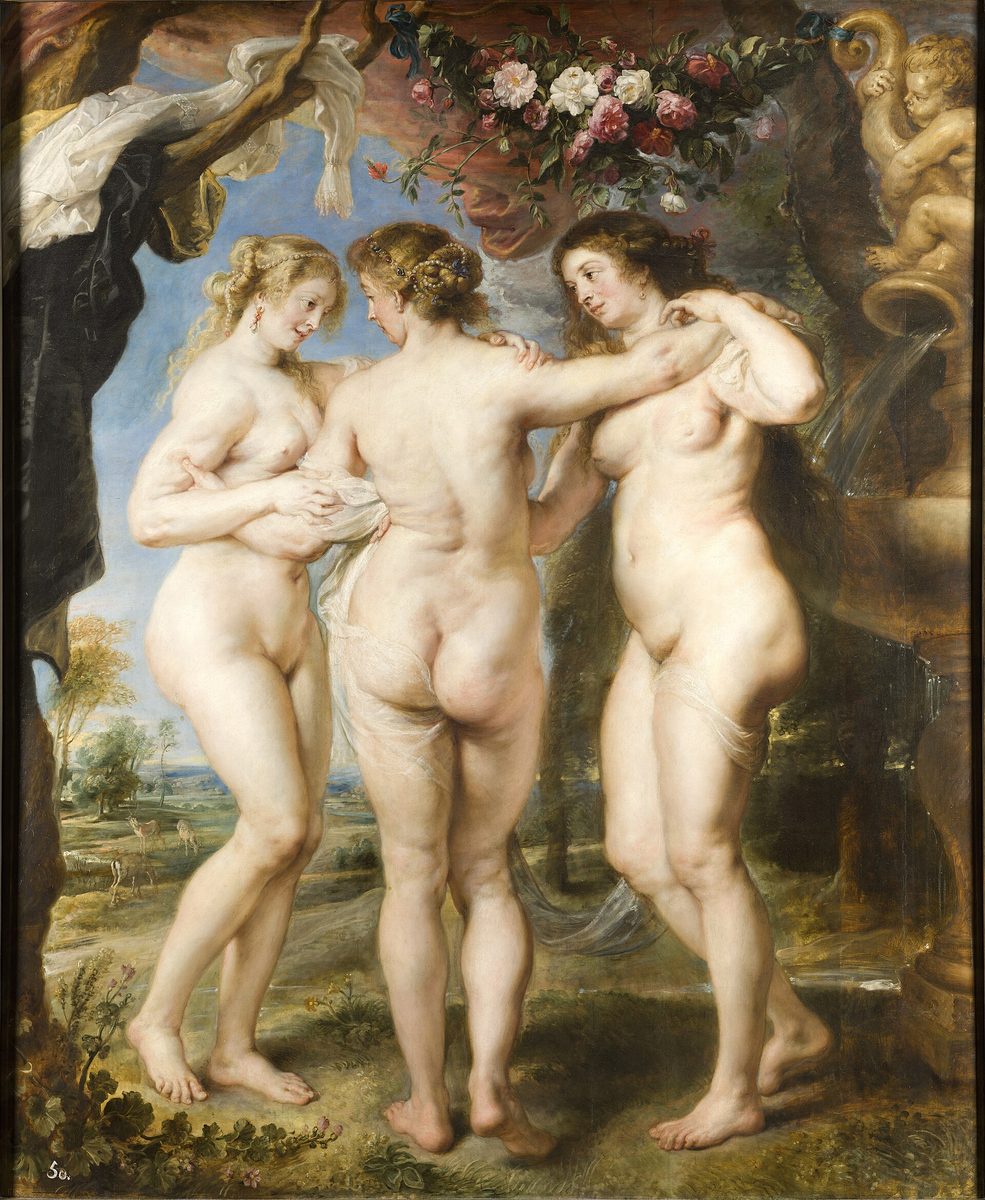
Peter Paul Rubens painted The Three Graces late in his career, between 1630 and 1635. The oil on panel measures 220.5 by 182.0 cm, and its vertical format is roughly four to five. The picture shows three nude women standing together with arms around each other, beneath a rose garland, beside a small fountain with a putto. Rubens was a Flemish Baroque painter, and the painting hangs in the Museo del Prado in Madrid.
What the picture shows in The Three Graces by Peter Paul Rubens
Three nude women stand close together in the center, arms around each other's shoulders and waists. The woman in the middle is seen from behind. The two on either side face her and turn toward the viewer. The left figure has blonde hair with pearls; the right figure has brown hair and looks at the middle one. A thin transparent veil runs between their bodies and hips. Above them a garland of pink, red and white roses hangs from a branch, with white cloth draped over the tree on the upper left. On the right a stone fountain has a putto holding a horn, and water pours from it. In the background on the left are trees, a meadow and several deer under a blue sky. Soft pink-white flesh tones dominate, and dark tree trunks frame the left side. The composition is vertical, about four to five. A small inventory number 50 is painted in the lower left corner.
When and why it was painted
Rubens was in his fifties and active in Antwerp when this panel was made. He had returned from diplomatic missions in Spain and England, and from about 1630 he focused more on painting. In 1635 Rubens bought the country estate Het Steen outside Antwerp. In these years he also painted landscapes and mythological subjects. The Three Graces belongs to Flemish Baroque painting in its full, soft handling of flesh and its classical subject. Rubens had studied ancient sculpture and Italian Renaissance art, and he reworked the old motif of the three companions. The picture is quieter than his earlier energetic scenes, but the physical weight and pink-white skin remain his own.
Seeing it at home
Look for the vertical proportions of the original, roughly four to five, with the figures kept close together. The copy should not shrink the picture so much that the three bodies lose their weight. Smooth transitions in the skin matter more than sharp outlines, and the palette should stay warm: pink-white flesh, dark tree trunks, blue sky, and touches of red, pink and white in the rose garland. A thin veil is a good test of careful handling.