Renoir Paintings: A Guide to the Artist's Key Works
Pierre-Auguste Renoir was a French painter and sculptor born in Limoges in 1841 and active in Paris until his death in 1919. He helped shape Impressionism through bright color, quick brushwork, and scenes of modern leisure. His Renoir paintings matter today because they show how ordinary moments, a dance at Montmartre, a lunch by the Seine, a woman reading on a bench, can hold shifting light and social detail. Works like Bal du moulin de la Galette (1876) and Luncheon of the Boating Party (1880-1881) remain in major museums and are still studied for their handling of sunlight and group composition. Unlike a formal portrait or historical set piece, these pictures treat friends and strangers as equal parts of a lively, specific world. He returned again and again to faces, skin, fabric, and water.
Life and training
Pierre-Auguste Renoir was born on 25 February 1841 in Limoges, a city in central France. His father was a tailor and his mother a seamstress. When he was about three, the family moved to Paris, close to the Louvre. At 13, Renoir became an apprentice in a porcelain workshop, where he painted delicate flowers and figures on cups and plates. This work taught him speed and a feel for translucent color. In 1862 he enrolled at the École des Beaux-Arts and entered the studio of Charles Gleyre. There he met Claude Monet, Alfred Sisley, and Frédéric Bazille. During the early 1860s the group painted together outdoors in Fontainebleau forest and along the Seine, using light, broken strokes.
Renoir had a painting accepted at the Paris Salon in 1864, but steady income came slowly. He made portraits for patrons and took on decorative work. In 1874 he joined the first Impressionist exhibition in Paris, showing paintings made with rapid, luminous strokes. Throughout the 1870s he painted riverside cafes, dance gardens, family groups, and portraits. In 1881 he traveled to Italy. In Venice, Rome, and Naples he studied Raphael, Titian, and Pompeian wall painting. That trip changed his approach: for about six years he emphasized firm contours and smoother surfaces, often called his linear period.
From the 1890s, Renoir suffered from rheumatoid arthritis, which deformed his hands and made holding a brush difficult. He continued to paint, adapting how he held the brush. Around 1903 he settled in Cagnes-sur-Mer in the south of France, where the warm climate eased his pain. He bought the estate Les Collettes in 1907 and built a studio there. In his last years he also made sculptures, working with assistants who translated his directions into clay and bronze. Renoir died on 3 December 1919 at Cagnes-sur-Mer.
Style and technique
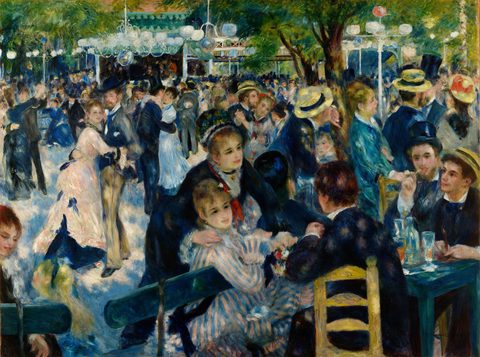
Pierre-Auguste Renoir paintings are built from small, soft strokes of color rather than hard outlines. In the 1870s he used blues, greens, and lavenders in shade, set against warm pinks, creams, and oranges in sunlight. His brushwork often followed the shape of a cheek, a sleeve, or a leaf. In Bal du moulin de la Galette he painted dappled light with short dashes of blue and yellow.
His subjects came from modern Paris: dance halls, boating parties, family groups, women bathing, flowers, and still lifes. He borrowed from eighteenth-century French painters such as Watteau and Boucher, especially their rosy flesh tones and pleasure scenes. Courbet and Delacroix also shaped his early use of heavy paint and warm reds. After the 1881 trip to Italy, he admired Raphael and Ingres. For a time he drew with tighter contours and flattened surfaces, visible in The Umbrellas and The Large Bathers.
By the 1890s Renoir returned to a softer, more rounded manner. His late nudes have full shapes and warm pearly skin, often set in olive and umber landscapes. He layered thin glazes over a smooth ground, then added accents of red and gold. His brushwork remained visible but calmer than in the 1870s. Even when arthritis twisted his fingers, he adjusted his grip and kept the same soft, warm palette.
Renoir often preferred human figures to pure landscape because faces and bodies gave him a denser surface of color. He worked wet into wet, letting skin tones blend on the canvas rather than mixing each tint on a palette. In later canvases he sometimes scraped and reworked areas, giving fabric and foliage a slight blur. That combination of loose touch and careful observation links his early dance scenes to his final bathers.
Key Renoir paintings
Bal du moulin de la Galette (1876) shows a Sunday afternoon dance at an open-air cafe in Montmartre. The canvas measures 131.0 x 175.0 cm and is oil on canvas. It hangs at the Musée d'Orsay in Paris. Renoir placed friends and models among working-class dancers, filling the space with patches of sunlight and shadow. The composition feels like a snapshot of movement, with couples turning and glasses lifting. It matters because it made a large modern crowd scene feel as serious as history painting.
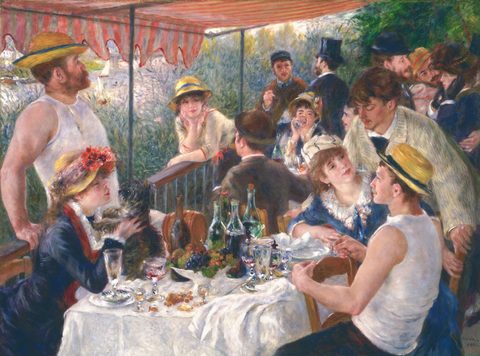
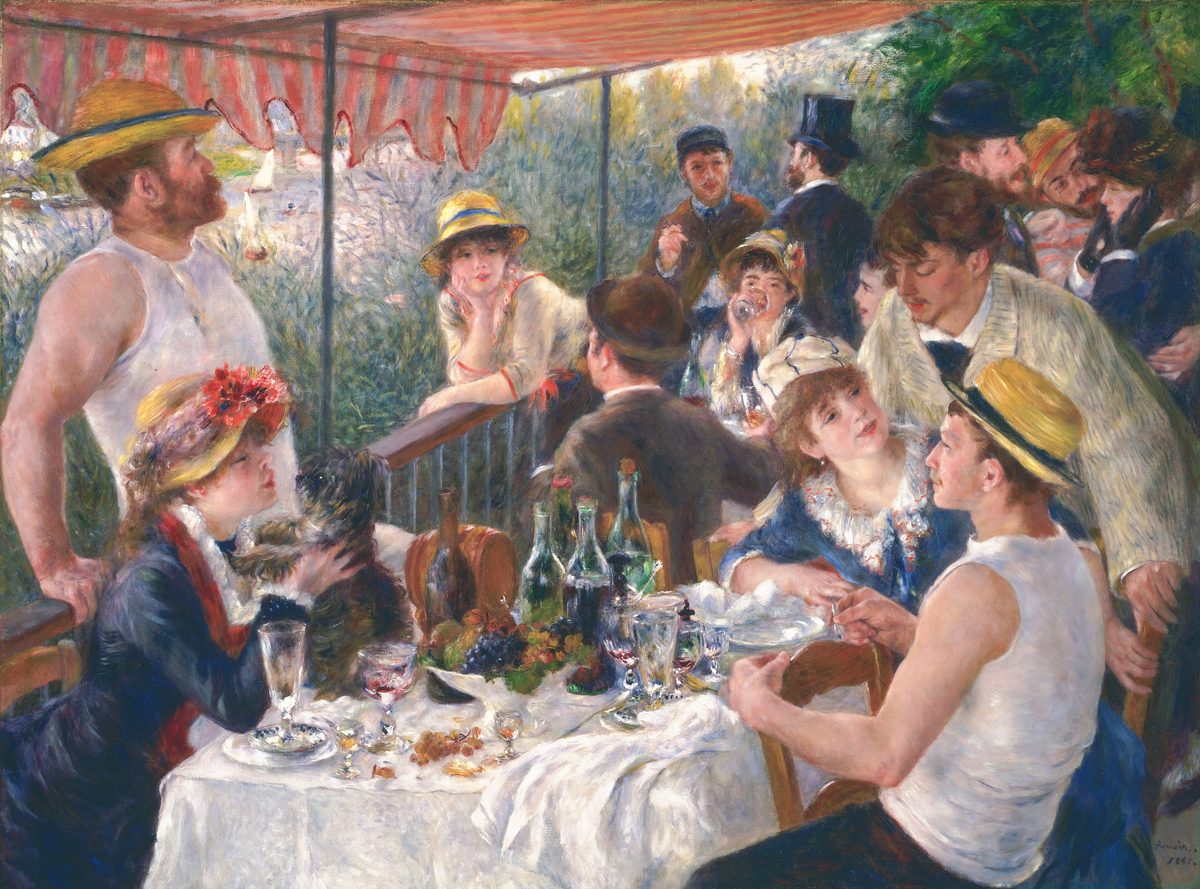
Luncheon of the Boating Party (1880-1881) is an oil on canvas measuring 130.2 x 175.6 cm, now at The Phillips Collection in Washington, D.C. It presents a group of Renoir's friends at the Maison Fournaise restaurant on the Seine, with wine, fruit, and a striped awning in view. The painting shows his shift toward more defined figures and still-life detail while keeping bright outdoor light.
The Umbrellas, painted around 1881 to 1886, is in the National Gallery in London. It combines two periods: the right side uses loose Impressionist strokes, while the left side, finished later, has harder contours and gray-blue tones. The picture depicts a crowd under umbrellas on a rainy Paris street, with a young woman carrying a hatbox.
The Large Bathers (1884-1887) at the Philadelphia Museum of Art shows three women in a landscape, their bodies modeled with smooth, firm shapes. It reflects Renoir's study of Raphael and classical sculpture after Italy. The painting was central to his so-called linear period and influenced later artists who wanted more solid form.
Girls at the Piano (1892) in the Musée d'Orsay shows two young women at an upright piano in a bourgeois interior, with warm reds and soft focus. It illustrates his late interest in intimate domestic scenes.
Where to see the originals
The Musée d'Orsay in Paris owns Bal du moulin de la Galette and Girls at the Piano, though the latter may rotate between galleries. The Phillips Collection in Washington, D.C. keeps Luncheon of the Boating Party on view most of the year. The National Gallery in London displays The Umbrellas, and the Philadelphia Museum of Art holds The Large Bathers. The Musée d'Orsay is on the left bank of the Seine in Paris; the Phillips Collection is in the Dupont Circle neighborhood of Washington, D.C. Check each museum's website before visiting, because major canvases sometimes leave for temporary exhibitions. Timed tickets are often required for the Musée d'Orsay during peak hours.