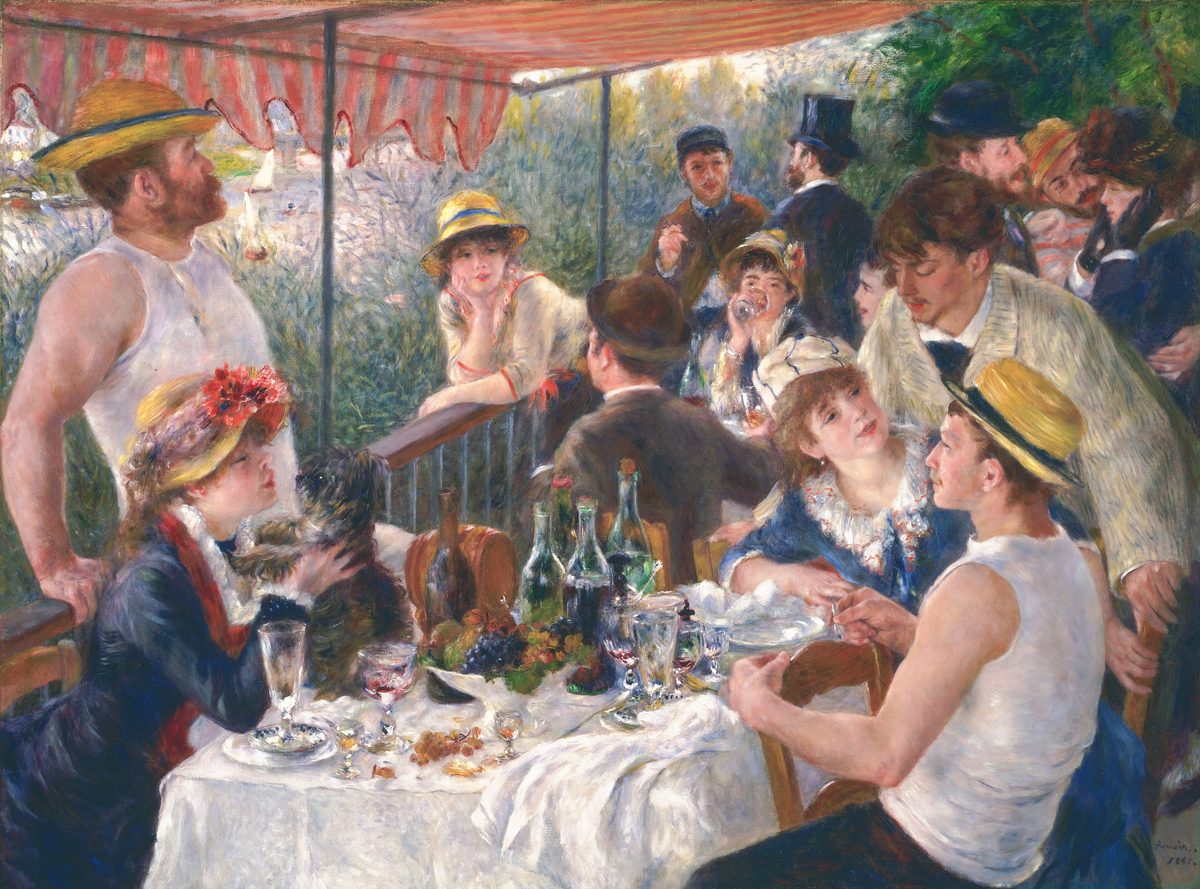
Pierre-Auguste Renoir painted Luncheon of the Boating Party in 1880-1881. The oil on canvas measures 130.2 x 175.6 cm and now hangs in The Phillips Collection in Washington, D.C. The composition gathers about fourteen people on a balcony under a red-and-white striped awning, with a table of wine, fruit, and plates in the lower center-left. A young woman in the lower left holds a small dog up to her face, and bright, warm light carries white, blue, red, yellow, and green across the scene.
What the picture shows
About fourteen people gather on a balcony or terrace under a red-and-white striped awning. In the lower center-left, a table with a white cloth holds bottles, glasses of red wine, grapes, fruit, and plates. A young woman in a dark dress and flowered hat is in the lower left and holds a small dog up to her face; standing behind her on the left, a man in a sleeveless white vest and straw hat leans on the railing. On the lower right, a young man in a white sleeveless vest and straw hat sits astride a chair turned backwards. A woman leaning on the railing in the middle rests her chin on her hand. Other figures in the background drink, talk, and lean toward each other. Behind the railing, the river, trees, and small sailing boats appear in sunlight. The light is bright and warm, with white, blue, red, yellow, and green in the loose brushwork. Renoir signed and dated the canvas at the lower right.
When and why Luncheon of the Boating Party was painted
Renoir was born in 1841, so he was about thirty-nine when he began this canvas in 1880 and forty when he finished it in 1881. He had already been associated with French Impressionism for years, and the picture's bright outdoor light and loose brushwork fit that movement. At the same time, the fourteen figures form a carefully composed group rather than a casual snapshot, with the red-and-white awning and the white tablecloth anchoring the foreground. During this period Renoir was making figure paintings and portraits set in modern leisure spots, and this terrace above the river gave him a chance to combine figures, food, and boats in daylight.
Seeing it at home
A hand-painted copy should keep the original's wide horizontal format, about four by three, so the table, railing, and group of fourteen stay in the same relation. The paint surface should preserve the loose, visible brushwork, not a smooth, airbrushed finish. The palette should follow the original's white tablecloth, blue river, red-and-white awning, yellow straw hats, and green trees.