Raphael Paintings: A Guide to the High Renaissance Master
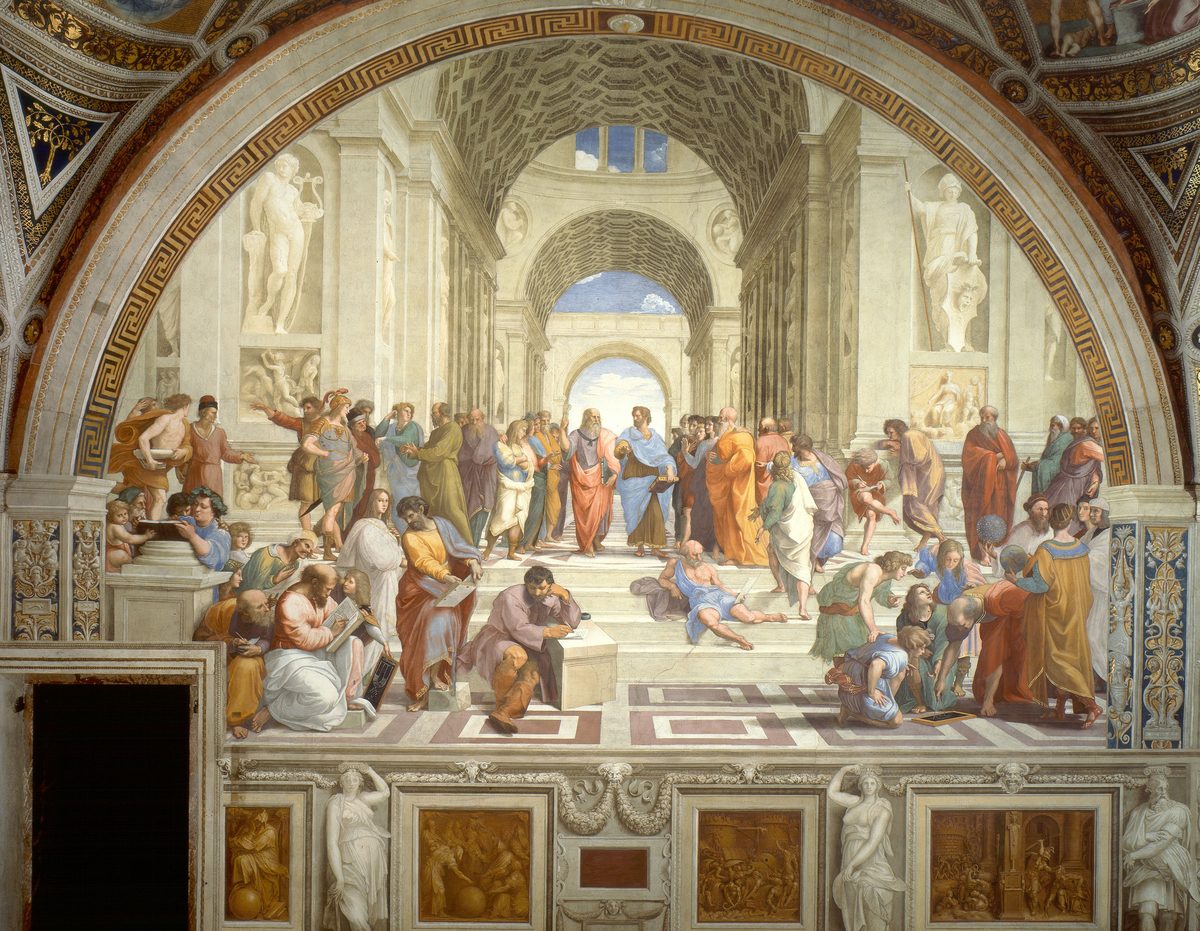
Raphael (Raffaello Sanzio da Urbino, 1483-1520) was an Italian painter and architect of the High Renaissance. Born in Urbino, he trained under Perugino, worked in Florence, and spent his final twelve years in Rome. His Raphael paintings set a standard for clear composition, balanced figure groups, and calm, legible storytelling. The School of Athens, a fresco in the Vatican Stanze, shows how he placed ancient philosophers in one grand architectural space. Raphael's work matters today because it shows how painting can organize complex ideas into a single, readable image. His oil technique and fresco designs influenced academic art for centuries. The two works in this catalogue, The School of Athens and the Sistine Madonna, show the range of his public fresco and private devotional commissions.
Life and training
Raphael was born in Urbino in 1483, the son of Giovanni Santi, a painter at the court of the Montefeltro dukes. His mother died in 1491 and his father in 1494, leaving him orphaned by age eleven. Around 1500 he entered the workshop of Pietro Perugino in Perugia, where he absorbed Perugino's soft landscapes, graceful figure types, and clear compositions. His early altarpieces, such as the Oddi Altarpiece (1502-1504), already show a confident hand. Urbino's ducal palace held a library and a collection of Flemish and Italian paintings, giving the young Raphael an early view of courtly art.
In 1504 Raphael moved to Florence, where he studied the works of Leonardo da Vinci and Michelangelo. His Florentine Madonnas, including the Madonna of the Goldfinch (c. 1506, Uffizi), use Leonardo's pyramidal grouping and soft modeling. The influence of Michelangelo's sculpture appears in the heavier drapery and more solid figures of panels like The Entombment (1507, Galleria Borghese). Florence gave him a repertoire of figure poses and landscape backgrounds that he used for the rest of his career. The Madonna del Prato (1506, Kunsthistorisches Museum, Vienna) belongs to the same Florentine group.
In 1508 Pope Julius II called Raphael to Rome to paint the papal apartments. The Stanza della Segnatura, his first room there, included The School of Athens. Raphael also took on architecture: in 1514, after Bramante's death, he became architect of St. Peter's. He painted the Sistine Madonna around 1512-1513 for the church of San Sisto in Piacenza. He also designed ten tapestries for the Sistine Chapel, and his portrait of Pope Julius II (1511, National Gallery, London) established a new model for papal portraiture. Raphael died in Rome on 6 April 1520, aged thirty-seven, and was buried in the Pantheon. Giorgio Vasari's biography, published in 1550, described his training with Perugino and his Roman commissions. His short career produced a large number of altarpieces, portraits, frescoes, and drawings, many of which survive in major collections.
Style and technique
Raphael's technique relied on careful underdrawing and a smooth application of paint. In his panel paintings he built up thin layers of oil and tempera, leaving little visible brushwork. His palette favored warm ochres, deep blues, and vermilion, often set against green or gray landscapes. Drawings in silverpoint, red chalk, and pen survive in large numbers and show how he worked out poses and drapery before painting. He also transferred designs to plaster with pouncing, a method using pricked cartoons and charcoal dust.
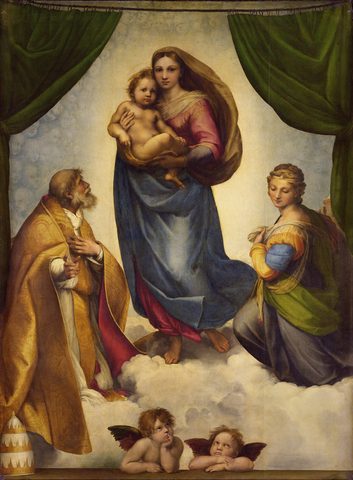
His compositions often arrange figures in pyramids or balanced groups. The School of Athens uses one-point perspective to place Plato and Aristotle under a coffered barrel vault, while surrounding figures form smaller clusters. The Sistine Madonna, painted in oil on canvas around 1512-1513, sets the Virgin and Child against a background of clouds and parted curtains, with two cherubs leaning on the lower edge. The fresco technique required painting on wet plaster in sections called giornate, visible under raking light.
Influence from Perugino appears in the gentle faces and symmetrical settings of his early altarpieces. From Leonardo he took soft modeling, called sfumato, and the triangular arrangement of mother and child. From Michelangelo he learned bold contrapposto and larger scale, but Raphael kept his figures clear and composed. In his last Roman years he moved toward stronger color and more dramatic gestures, as in the Transfiguration, where the upper scene is filled with light and the lower scene shows agitated apostles. Raphael's portraits range from the direct gaze of Pope Julius II to the informal pose of Baldassare Castiglione (c. 1514-1515, Louvre). He often placed the sitter against a plain background and used the hands to carry expression. His self-portraits show a calm, well-dressed young man with brown hair and a steady glance.
Key Raphael Paintings
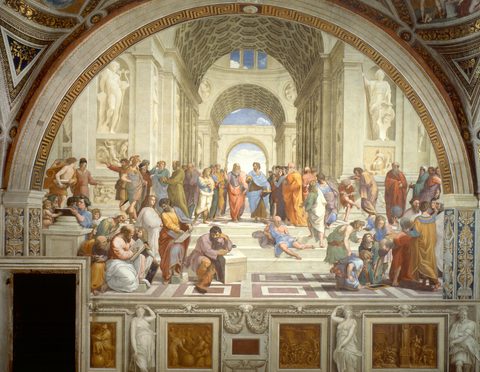
The School of Athens, 1512. Painted in fresco around 1512, The School of Athens covers one wall of the Stanza della Segnatura in the Vatican. Plato points upward, Aristotle gestures forward, and around them are gathered philosophers and mathematicians, including Diogenes on the steps and Euclid bending with a compass. The architecture, a barrel-vaulted hall with coffered ceiling, gives the scene a measured, stage-like clarity. The fresco measures 550 by 770 cm and was commissioned by Pope Julius II.
Sistine Madonna, c. 1512-1513. The Sistine Madonna, oil on canvas, shows the Virgin standing on clouds with the Christ Child. Saint Sixtus and Saint Barbara appear at the sides, and a green curtain is drawn back. Two cherubs lean on the bottom edge. It measures 269.5 by 201 cm. The painting entered the Royal Collection in Dresden in 1754 and hangs in the Gemäldegalerie Alte Meister, Dresden. The two cherubs at the bottom have become a widely reproduced motif.
Transfiguration, 1516-1520. Raphael's last altarpiece, the Transfiguration, was left unfinished at his death in 1520 and completed by Giulio Romano. The upper half shows Christ in glory with Moses and Elijah, while the lower half shows the apostles failing to heal a possessed boy. The oil on wood panel measures 405 by 278 cm and hangs in the Pinacoteca Vaticana.
La Fornarina, c. 1518-1519. La Fornarina, a portrait of a young woman with bare breasts, sits in the Galleria Nazionale d'Arte Antica in Rome. The model is often identified with Margherita Luti, a baker's daughter. The painting shows Raphael's late Roman style: warm flesh tones, dark foliage, and an armband inscribed with his name.
Where to see the originals
The School of Athens is still on the wall of the Stanza della Segnatura in the Vatican Museums, Vatican City. The Sistine Madonna hangs in the Gemäldegalerie Alte Meister, Dresden. Raphael's Transfiguration is in the Pinacoteca Vaticana, and La Fornarina is in the Galleria Nazionale d'Arte Antica, Rome. Other major collections with paintings by Raphael include the Uffizi in Florence, the Louvre in Paris, the National Gallery in London, and the Prado in Madrid. The National Gallery in London owns several works, including the portrait of Pope Julius II and the Mond Crucifixion. Drawings by Raphael are kept in the Ashmolean Museum, Oxford, and the Albertina, Vienna. Check museum websites before visiting, as loans and gallery rotations change.
Paintings by Raphael
Sistine Madonna