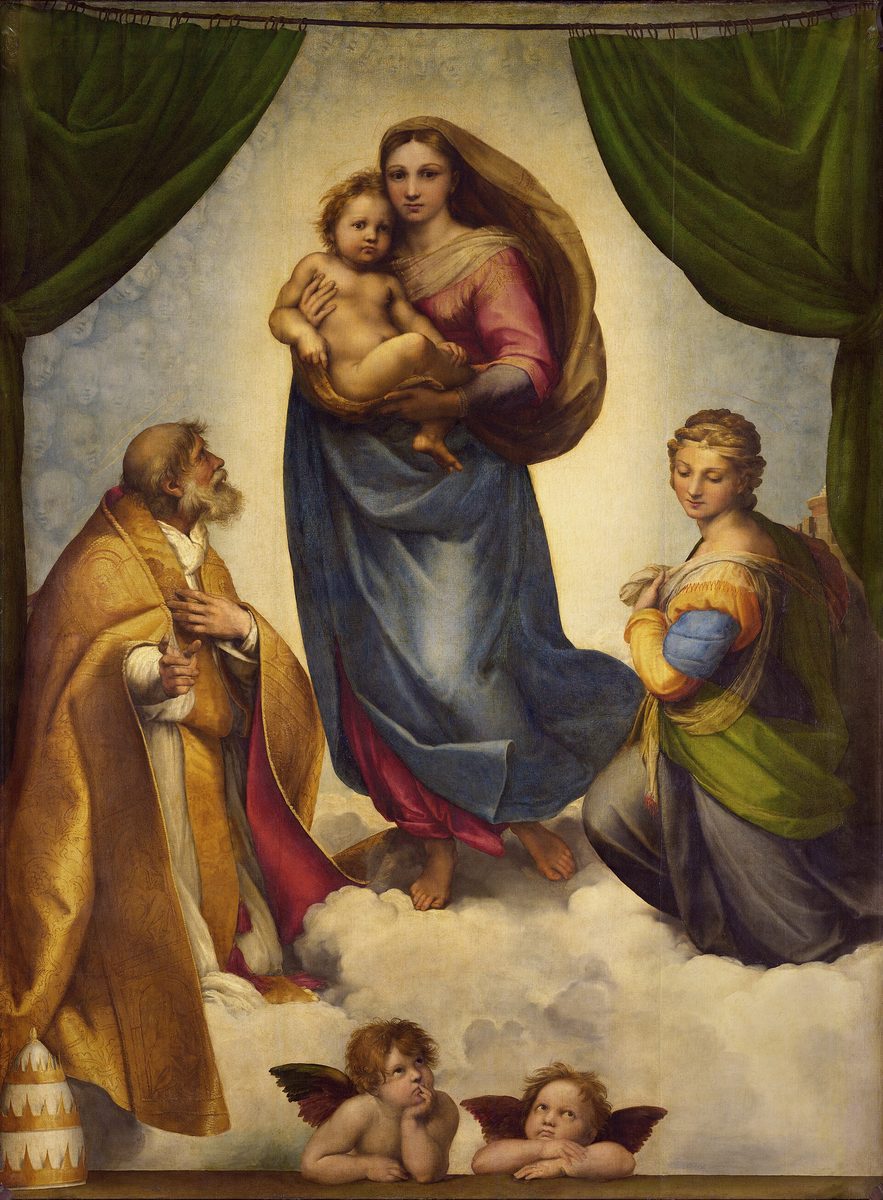
The Sistine Madonna is an oil on canvas painted by Raphael, the Italian High Renaissance master, in about 1512-1513. The painting, measuring 269.5 by 201.0 cm, now hangs in the Gemäldegalerie Alte Meister of the Staatliche Kunstsammlungen Dresden, Germany. Its tall vertical composition places the Virgin and Christ Child at the center, with two kneeling saints and two small winged children near the lower ledge, all against clouds and green curtains drawn back at the sides.
What the picture shows
The central figure is the Virgin, barefoot on clouds, holding the nude Christ Child in her arms. Both look out toward the viewer. She wears a red dress, a blue mantle, and a golden-brown veil that billows behind her. On the left, an old bearded man in a gold brocade cope kneels and looks up; his right hand points out of the picture toward the viewer. On the right, a young woman in a green, yellow, and violet dress kneels and looks down.
A gold-and-white papal tiara rests on a ledge at the lower left. At the bottom center, two small winged children lean on the ledge and look up; one rests his chin on his hand. Green curtains hang from a rod across the top and are drawn back to both sides. The pale light behind the figures is filled with faint faces of many small angels in clouds. The palette stays close to blue, red, gold, green, and pale cloud-white, with a smooth surface and soft modelling.
When and why the Sistine Madonna was painted
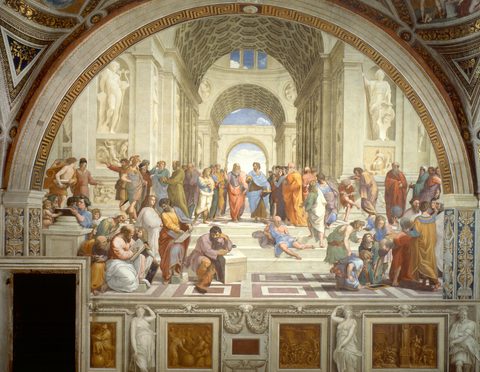
Raphael painted the Sistine Madonna around 1512-1513, during his years in Rome working for Pope Julius II. He had been in the city since 1508, painting the papal apartments; by this date he had finished the Stanza della Segnatura, was working on the Stanza di Eliodoro and was considered a leading painter of the High Renaissance. The Sistine Madonna was made for the high altar of the church of San Sisto in Piacenza, a city in northern Italy, from which it takes its name. Like his other altarpieces of these years, it shows his command of large-scale composition, soft oil modelling, and monumental figures. The painting is an example of High Renaissance clarity and calm, with large, balanced forms.
Seeing it at home
A hand-painted copy of the Sistine Madonna is closest to the original when it is reproduced at roughly full scale, 269.5 by 201.0 cm, so the standing Virgin and wide green curtains keep their presence. The painted surface should have soft oil modelling rather than hard edges. The palette should stay close to the original blues, red, gold, green, and pale cloud-white, especially in the saint's gold cope and the angels in the clouds.
Related paintings