Van Gogh Paintings: A Guide to the Artist and His Work
Vincent van Gogh (1853 to 1890) was a Dutch painter linked to Post-Impressionism and early Expressionism. He worked across landscapes, still lifes, portraits, and cityscapes, producing more than 800 oil paintings despite selling almost none during his lifetime. The catalogue here includes 20 van gogh paintings, from the dark rural scenes of 1885 to the strong color of 1890, such as Japanese Vase with Roses and Anemones. His work matters today because it preserves a short, intense career in direct brushwork and unusual color. Museums in Amsterdam, Paris, São Paulo, and elsewhere hold these original van gogh paintings, Even a small canvas such as Landscape with Couple Walking and Crescent Moon (49.5 x 45.5 cm) shows his habit of turning a simple scene into a patterned, emotional image.
Life and training
Vincent van Gogh was born in 1853 in Zundert, a village in the southern Netherlands. His father was a Protestant minister. As a young man he worked for the art dealers Goupil & Cie in The Hague, London, and Paris, which gave him an early look at prints and paintings by contemporary artists. After losing that job and failing as a lay preacher in a Belgian mining district, he decided in 1880 to become an artist.
He was largely self-taught. He drew from plaster casts and copied prints, then worked in oil. In 1881 he worked for a time with his cousin by marriage, the painter Anton Mauve, who taught him watercolor and encouraged drawing from the model. He also drew farm workers and weavers around Nuenen, where his parents then lived. In 1885, while living in Nuenen, he painted dark rural studies such as Landscape at Dusk and Landscape with Church and Farms. The same year he painted the larger peasant scene The Potato Eaters, whose earth tones and coarse figures show his early debt to Dutch realism. He also experimented with watercolor and lithography during these years, often based on the same rural models.
In early 1886 he moved to Paris and lived with his brother Theo. There he saw Impressionist and Neo-Impressionist work, brightened his palette, and studied Japanese woodblock prints. He bought and traded hundreds of prints and pinned them to the walls of his room. The 1887 painting Japonaiserie: Oiran (after Kesai Eisen) is a direct copy of a Japanese print by Kesai Eisen, and Interior of a Restaurant from the same year shows his new interest in modern city subjects. The Paris period lasted two years and transformed his subject matter from peasant labor to cafés, boulevards, and still lifes.
In February 1888 Van Gogh moved to Arles in the south of France. He hoped to found an artists' studio and rented the Yellow House. He painted orchards, harvest scenes, and the plain of La Crau; the 1888 drawing La Crau Seen from Montmajour records the wide horizon in pen and ink. Paul Gauguin joined him in October, but the collaboration collapsed in December, when Van Gogh cut off part of his left ear. He was hospitalized in Arles, then admitted himself in May 1889 to the asylum at Saint-Rémy-de-Provence. Works such as Landscape with Trees and Figures (1889) and Le Peiroulets Ravine (1889) come from this period.
In May 1890 he moved to Auvers-sur-Oise, north of Paris, to be near Dr. Paul Gachet. He painted more than 70 works in about 70 days, including Landscape with Couple Walking and Crescent Moon and Japanese Vase with Roses and Anemones. On 27 July 1890 he was wounded by a gunshot, generally accepted as self-inflicted, and he died two days later, aged 37.
Style and technique
Van Gogh's early Dutch paintings use a narrow, dark palette: browns, ochres, and gray greens. Lane with Poplars (1885) and Landscape at Dusk (1885) rely on heavy outlines and thick, sometimes dry paint. The brushwork in these years is broad and often somber, suited to rural labor and overcast skies. He often painted peasants and weavers at close range, but these early pictures rarely use the saturated color of his later work.
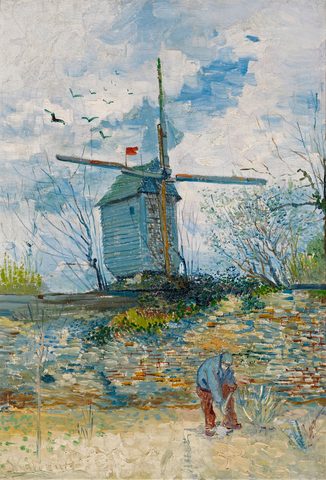
In Paris from 1886 his palette shifted toward reds, blues, and yellows. He adopted the broken brushstrokes of the Impressionists and the flat color areas of Japanese prints. Works such as Le Moulin de la Galette (1886) and Interior of a Restaurant (1887) show shorter strokes and brighter surfaces. The 1887 copy Japonaiserie: Oiran (after Kesai Eisen) uses black outlines, flat planes, and decorative patterning. A view such as Lane in Voyer d'Argenson Park at Asnieres (1887) shows trees and paths in quick, separated touches. He also began to use blue and orange side by side, a pairing that appears in several restaurant and park scenes.
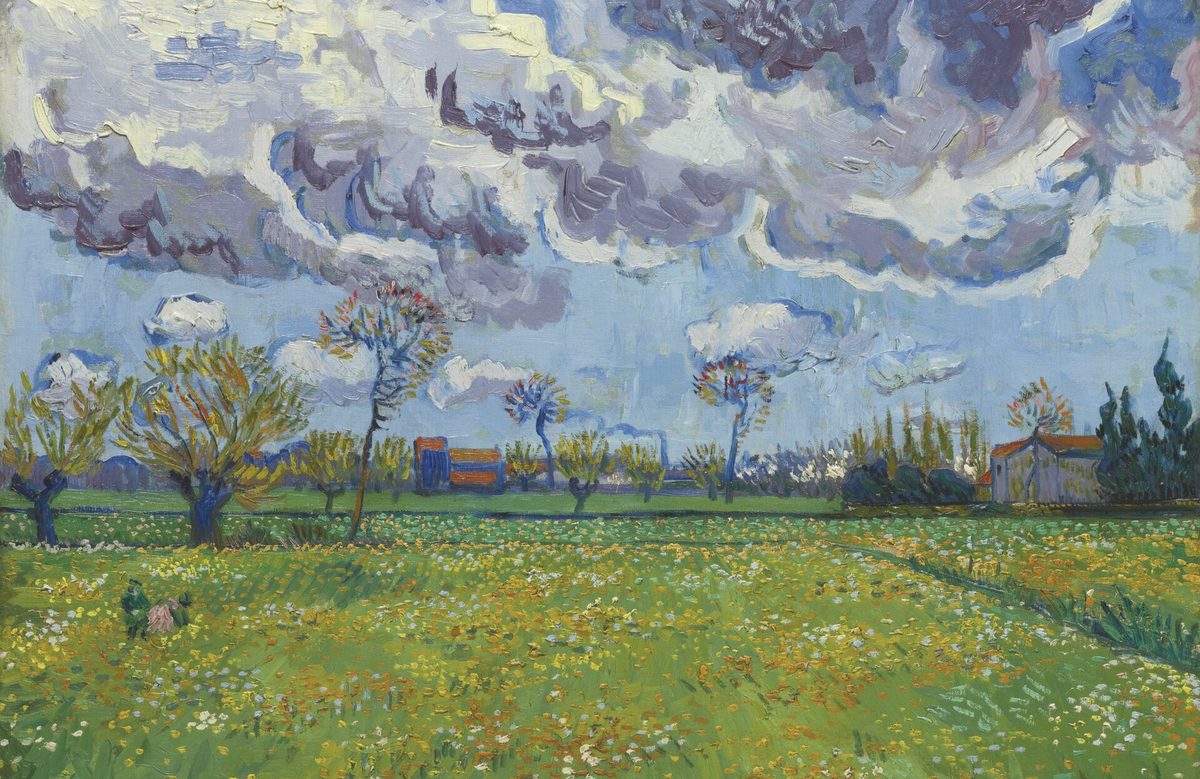
After moving to Arles in 1888, Van Gogh pushed the paint into thicker ridges and used complementary colors, often blue against yellow or green against red. Landscape under a Stormy Sky (1888) sets dark green fields under a cloud mass, while La Crau Seen from Montmajour uses pen and ink to build the wheat plain from tiny marks. In 1889 and 1890 the strokes became more curled and rhythmic. La Berceuse (Augustine Roulin) (1889) places a green-clad woman against a floral wallpaper and chair; the repeated petals and wavy lines create a decorative surface that still feels personal. Works from 1890 such as Landscape with Three Trees and a House (64.0 x 78.0 cm, Kröller-Müller Museum) use rolling, repeated marks across the whole surface. The physical force of the brushstroke became as important as the motif.
Key van Gogh paintings
Five of the 20 works in this catalogue mark distinct turns in Van Gogh's career.
Interior of a Restaurant (1887, private collection) shows a Paris dining room with empty tables, red-and-white tablecloths, and a few seated figures. The space is flattened and patterned, with strong diagonals. It marks his break from the dark Dutch interior toward a more modern, decorative design.
Japonaiserie: Oiran (after Kesai Eisen) (1887, Van Gogh Museum) copies a Japanese woodblock print of a courtesan in a patterned kimono. At 105.5 x 60.5 cm, the canvas keeps the tall, narrow format of the print and surrounds the figure with a bamboo frame and a lotus pond. It is one of the clearest records of his Japanese print study in Paris.
La Berceuse (Augustine Roulin) (1889, private collection) is a portrait of the postman's wife, seated and holding a rope that once rocked a cradle. The green dress, floral wallpaper, and red floor make a dense color field. Van Gogh painted several versions of this composition, intending it as a consoling image for sailors.
Landscape with Couple Walking and Crescent Moon (1890, Museu de Arte de São Paulo Assis Chateaubriand) shows a small couple beneath a dark cypress and a yellow crescent moon. The 49.5 x 45.5 cm canvas compresses sky, field, and figures into a rhythmic pattern of short strokes, pointing toward the late style he developed in Auvers-sur-Oise.
Japanese Vase with Roses and Anemones (1890, Musée d'Orsay) is a square still life, 51.0 x 51.0 cm. Painted in June 1890, it places a Japanese vase with roses and anemones against a blue background. The flowers are painted with quick, curling touches that give the bouquet a lively, unstable edge. This late still life shows the same compressed energy as the landscape works.
Where to see the originals
The Van Gogh Museum in Amsterdam holds the largest group in this catalogue, including Japonaiserie: Oiran (after Kesai Eisen) and the drawing La Crau Seen from Montmajour. The Musée d'Orsay in Paris has Japanese Vase with Roses and Anemones. The Kröller-Müller Museum in Otterlo shows Le Moulin de la Galette (1886) and Landscape with Three Trees and a House (1890). In the United States, the Baltimore Museum of Art owns Landscape with Trees and Figures, and the Yale University Art Gallery holds Lane in Voyer d'Argenson Park at Asnieres. Rotterdam's Museum Boijmans Van Beuningen holds Lane with Poplars (1885). The Carnegie Museum of Art in Pittsburgh owns Le Moulin de la Galette (1887). The Museu de Arte de São Paulo Assis Chateaubriand owns Landscape with Couple Walking and Crescent Moon. Several paintings remain in private collections and appear in temporary exhibitions; check museum websites before visiting.
Paintings by Vincent van Gogh
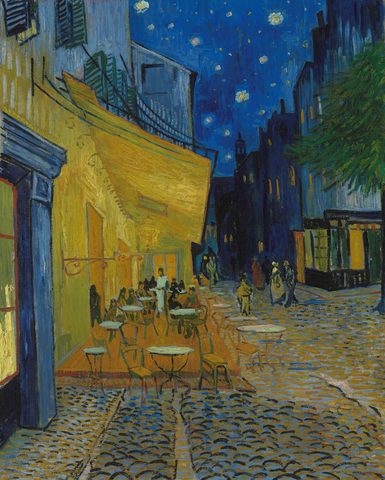
Café Terrace at Night
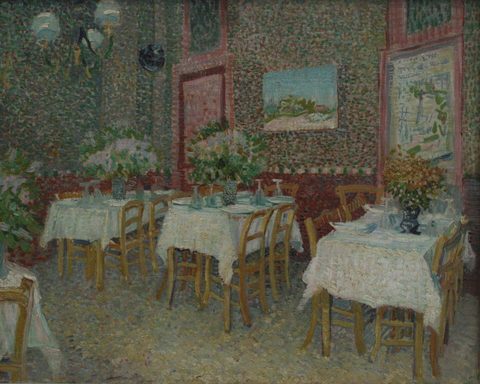
Interior of a Restaurant
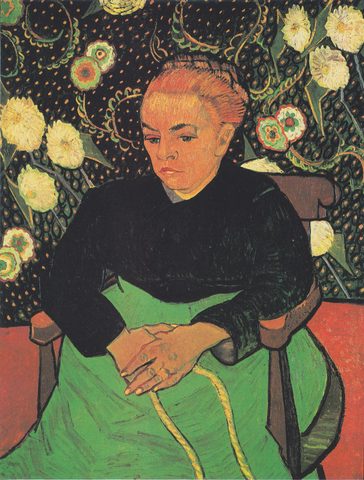
La Berceuse (Augustine Roulin)
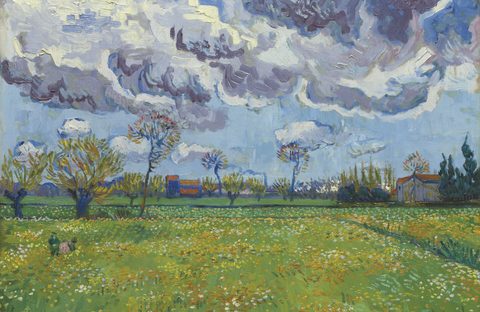
Landscape under a Stormy Sky
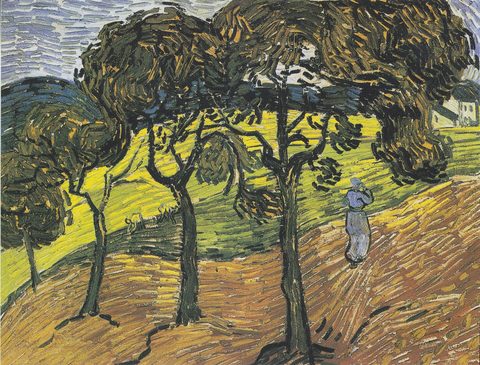
Landscape with Trees and Figures
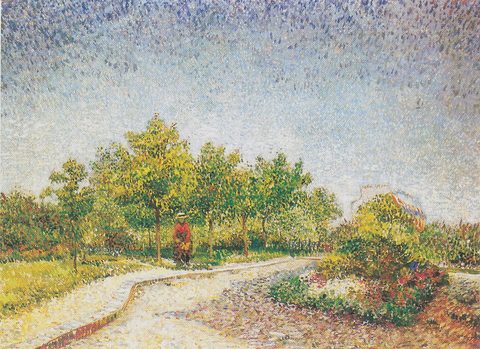
Lane in Voyer d'Argenson Park at Asnieres
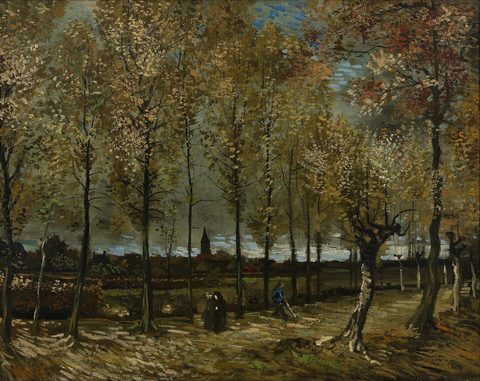
Lane with Poplars
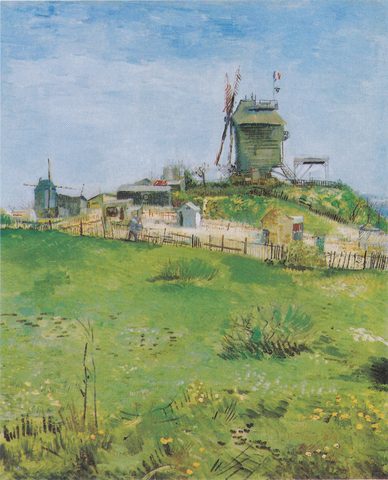
Le Moulin de la Galette
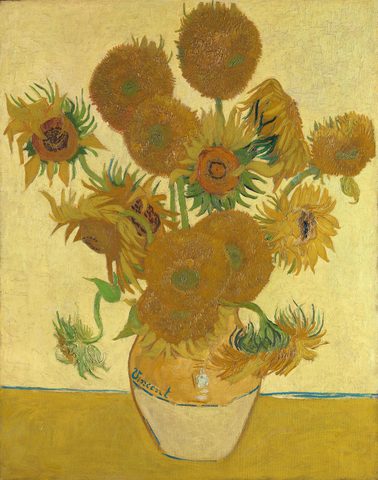
Sunflowers
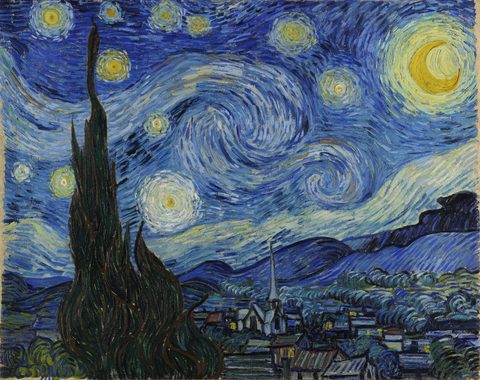
The Starry Night
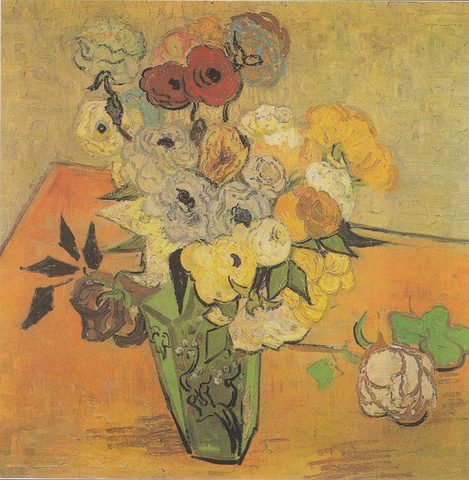
Japanese Vase with Roses and Anemones
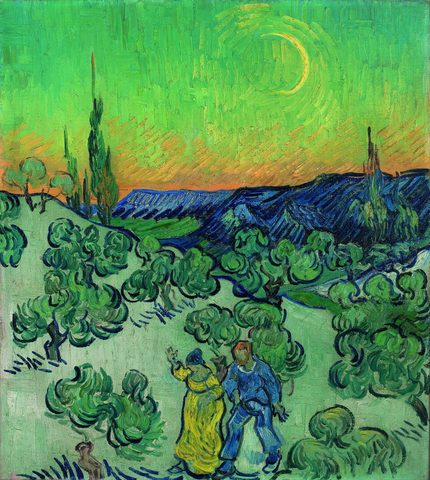
Landscape with Couple Walking and Crescent Moon
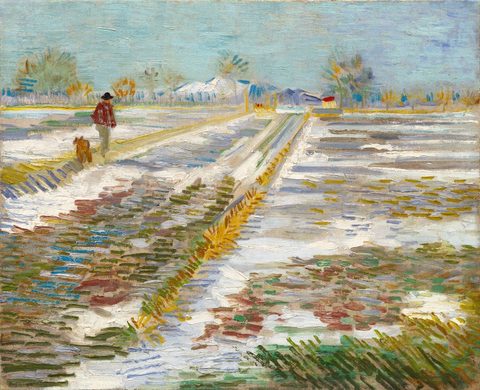
Landscape with Snow
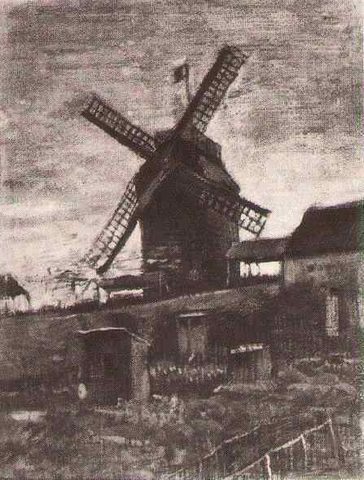
Le Moulin de Blute-Fin