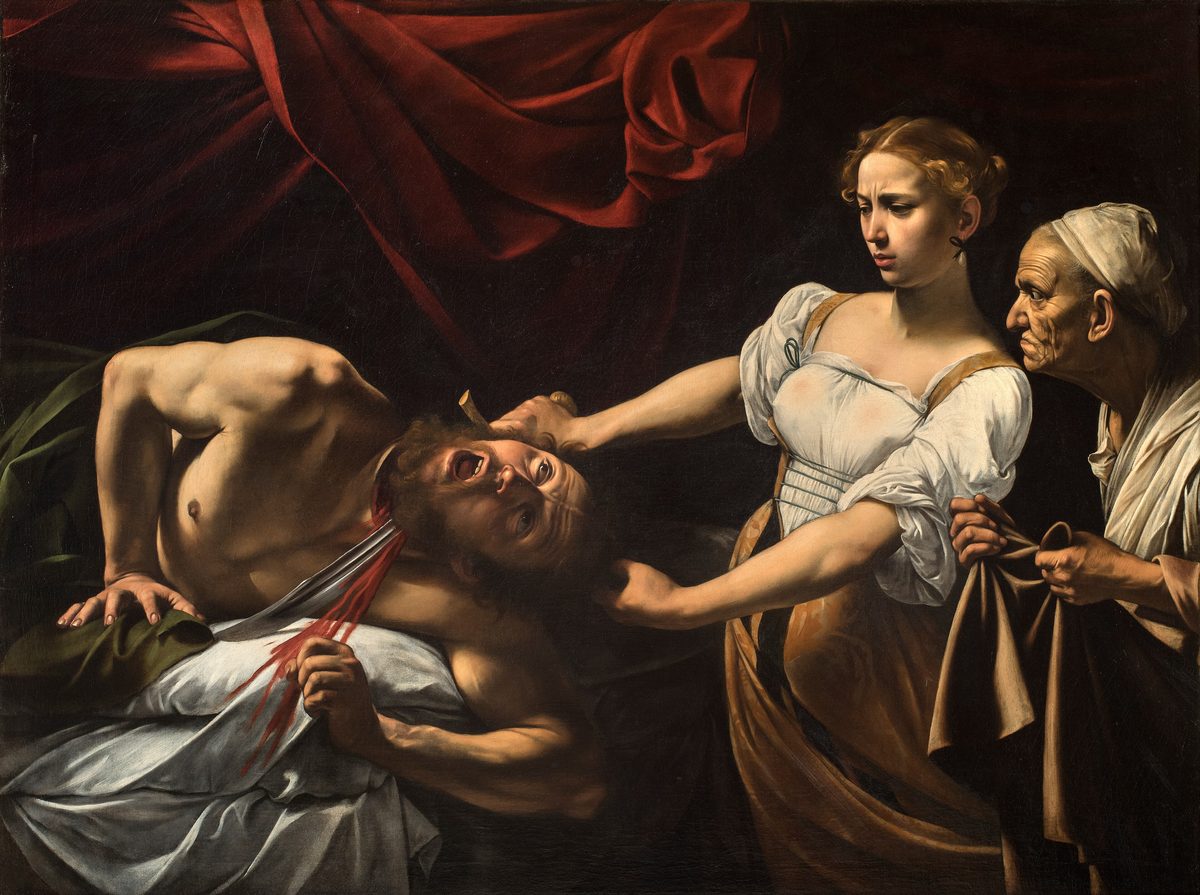
Judith Beheading Holofernes is an oil on canvas painting by the Italian Baroque artist Caravaggio, dated c. 1598-1599. Caravaggio was born in 1571 and died in 1610, and he worked in the years of the Counter-Reformation. The picture measures 145.0 x 195.0 cm and is in the collection of the Galleria Nazionale d'Arte Antica in Rome. It depicts the scene from the Book of Judith in which the widow Judith kills the Assyrian general Holofernes to save her city. Caravaggio was around twenty-seven or twenty-eight years old when he painted it.
What the picture shows
The canvas shows three figures against a near-black background, lit sharply from the left. On the left, a bearded man lies on a white-sheeted bed. He is half-naked, twisting his upper body toward the viewer; his mouth is open in a cry and his eyes are wide. At the right of center, a young woman in a white blouse with a laced bodice and a brown-gold skirt extends her arms. With her left hand she holds the man's hair; with her right she draws a sword through his neck. Red blood spurts in streaks from the wound onto the white sheet. Her face is frowning and she leans back slightly from the act. On the far right, an old woman with a deeply lined face and a white head cloth watches closely, holding a cloth bag open. A heavy dark red curtain is draped across the top of the picture. The man's left hand rests on green fabric at the lower left. The modelling of skin and textiles is smooth and detailed.
When and why it was painted
Caravaggio painted Judith Beheading Holofernes around 1598-1599, while he was working in Rome and building his reputation as a painter of religious and mythological scenes. He was in his late twenties. During this period he produced several dramatic compositions for private collectors. The Counter-Reformation encouraged art that made biblical events feel immediate and bodily, and the sharp light from the left and the attention to blood, skin and fabric fit that aim. The Book of Judith was read as a story of a faithful widow who defeats a tyrant. Caravaggio's approach to the scene, with the action pushed close to the picture plane, was part of the emerging Baroque style.
Seeing Judith Beheading Holofernes at home
A hand-painted copy should keep the original horizontal 4:3 format and its 145 x 195 cm scale. Look for the near-black background, the sharp light from the left, and the strong reds of the blood and curtain. The surface should be smooth in the skin and detailed in the textiles, with the white sheet and green fabric clearly distinguished. The copy should not flatten the contrast between light and shadow.