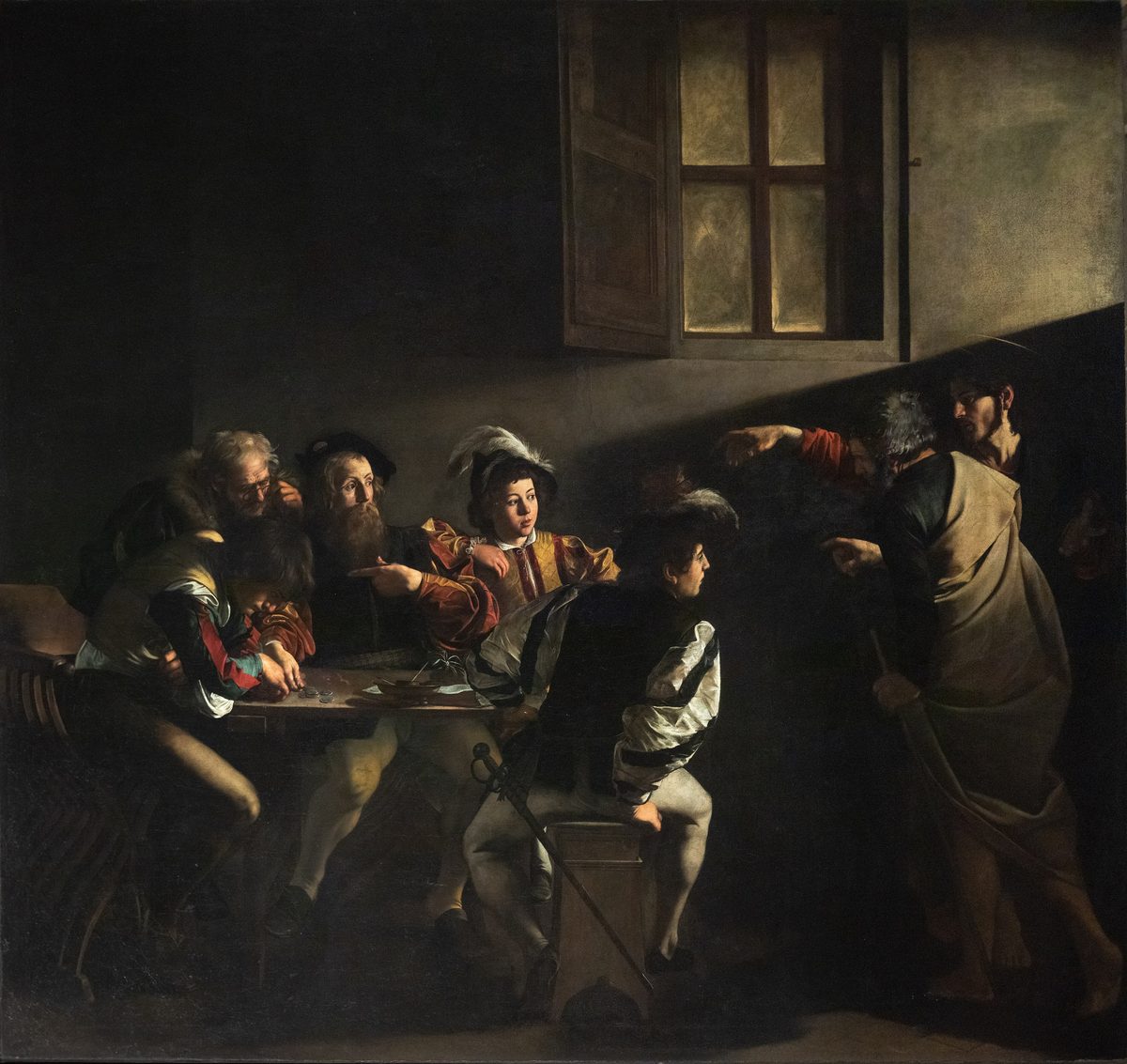
The Calling of Saint Matthew is a large oil-on-canvas painting by Caravaggio, the Italian Baroque artist, dated 1599–1600 and measuring 322 by 340 centimeters. It hangs in the Contarelli Chapel of San Luigi dei Francesi in Rome and has a nearly square format, slightly wider than high. In the picture, Christ enters from the right and points toward Matthew, who sits among tax collectors at a table on the left, showing the moment of his calling.
What the picture shows
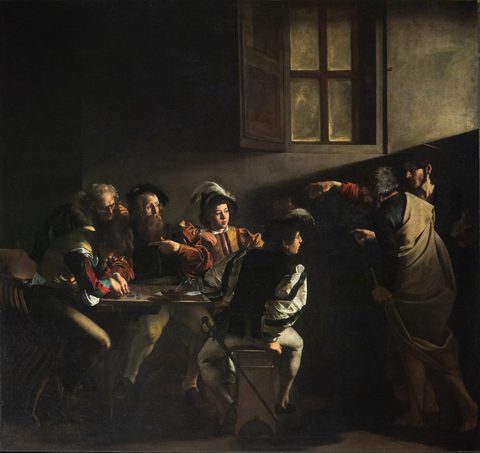
The picture is nearly square, slightly wider than high. In a shadowed interior, a plain grey wall meets a window on the upper right with a half-open shutter and cloudy panes. A beam of light enters from that direction and falls diagonally across the wall and the five men at the table on the left. They wear early-17th-century dress: slashed sleeves, plumed hats, swords. A bearded man in a dark hat points with his left hand toward himself or the man beside him. At the table's left end a young man bends over coins while an older man with spectacles peers down. A young man in a plumed hat and striped sleeves sits with his back to the viewer, a sword at his hip. On the right, two barefoot figures in simple robes enter. The one behind, with a thin halo, is apparently Christ; he extends his right arm toward the table. The man in front, in a green-brown cloak, also points. Deep shadow covers the lower half and left side, while dark browns and greys carry red, ochre, and white accents.
When and why The Calling of Saint Matthew was painted
Caravaggio painted The Calling of Saint Matthew in 1599–1600, when he was in his late twenties and working in Rome. It was one of his first public church commissions. The work belongs to the Counter-Reformation context in which biblical scenes were made direct and physically present. A beam of light cuts across a plain grey wall and falls on the tax collectors, while the barefoot Christ points in from the right. The men at the table wear early-17th-century slashed sleeves and plumed hats, placing the episode in the painter's own time. The contrast between the dark lower half and the lit figures guides attention without decoration. Its size, 322 by 340 centimeters, suits the side wall of the Contarelli Chapel, where it still hangs.
Seeing it at home
In a hand-painted copy, check that the canvas keeps the original's nearly square format, about 322 by 340 centimeters at full scale or proportionally smaller. The palette should stay close to dark browns and greys, with red, ochre, and white picked out under the diagonal light. The dark shadow across the lower half and left side should not be flattened. The pointing hands and the beam from the upper right should read clearly.