Edgar Degas Paintings: Dancers, Portraits, and Modern Paris
Edgar Degas (1834 to 1917) was a French painter closely tied to the Impressionist circle. He is known above all for his paintings of ballet dancers, but his subjects also include portraits, racehorses, cafe interiors, laundresses, and women at their bath. Degas paintings are now held by museums in New York, Washington, Paris, and London, and viewers still seek them out for their unusual angles, careful drawing, and unglamorous honesty about modern city life. He was born in Paris in 1834, trained at the École des Beaux-Arts, and died in Paris in 1917. His work matters today because it shows a city in motion: dancers stretch at the barre, a tired laundress carries a basket, a man watches a race through field glasses. The pictures feel immediate, as if you caught the moment through an open doorway.
Life and training
Edgar Degas was born Hilaire-Germain-Edgar De Gas in Paris on July 19, 1834. His father was a banker, and the family had relatives in Naples. He attended the Lycée Louis-le-Grand and then studied law for a short time before entering the studio of Louis Lamothe in 1855. Lamothe had trained with Ingres, and his teaching gave Degas a lasting respect for drawing. That same year Degas enrolled at the École des Beaux-Arts in Paris.
From 1856 to 1859, Degas lived in Italy. He spent time in Naples, Florence, and Rome, visiting family and studying the Old Masters. In Florence he began the large portrait The Bellelli Family, a picture of his aunt Laura, her husband, and their two daughters. He returned to Paris in 1859 and set up a studio. In the 1860s he exhibited at the Salon, making his debut in 1865 with a scene of a medieval war. He also painted portraits and historical subjects. A friendship with Édouard Manet drew him into the circle of young painters who met in Paris cafes.
Degas served in the artillery during the Franco-Prussian War of 1870 to 1871. An existing eye condition worsened during this period. In 1872 he traveled to New Orleans to visit his mother's family, and he stayed for several months. After returning to Paris, he helped organize the first Impressionist exhibition in 1874 and showed work in most of the group's later exhibitions. He preferred the term independent or realist, but he remained closely linked to the Impressionist movement.
In the late 1870s and 1880s, Degas turned more and more to ballet subjects, milliners, and women at their bath. He lived on the rue Victor Massé in Montmartre for many years. His eyesight continued to decline, and he used pastel more often because it allowed faster changes and stronger color. By the early 1900s he was nearly blind. He stopped working around 1912 and died in Paris on September 27, 1917.
Style and technique
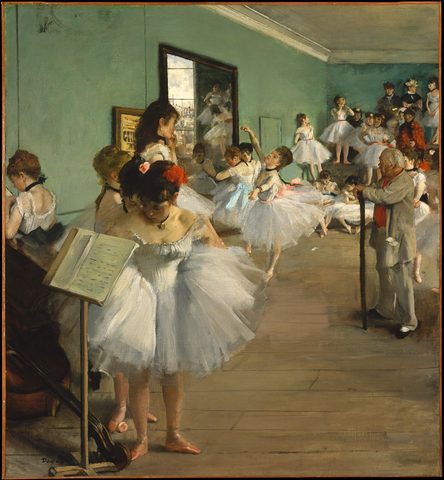
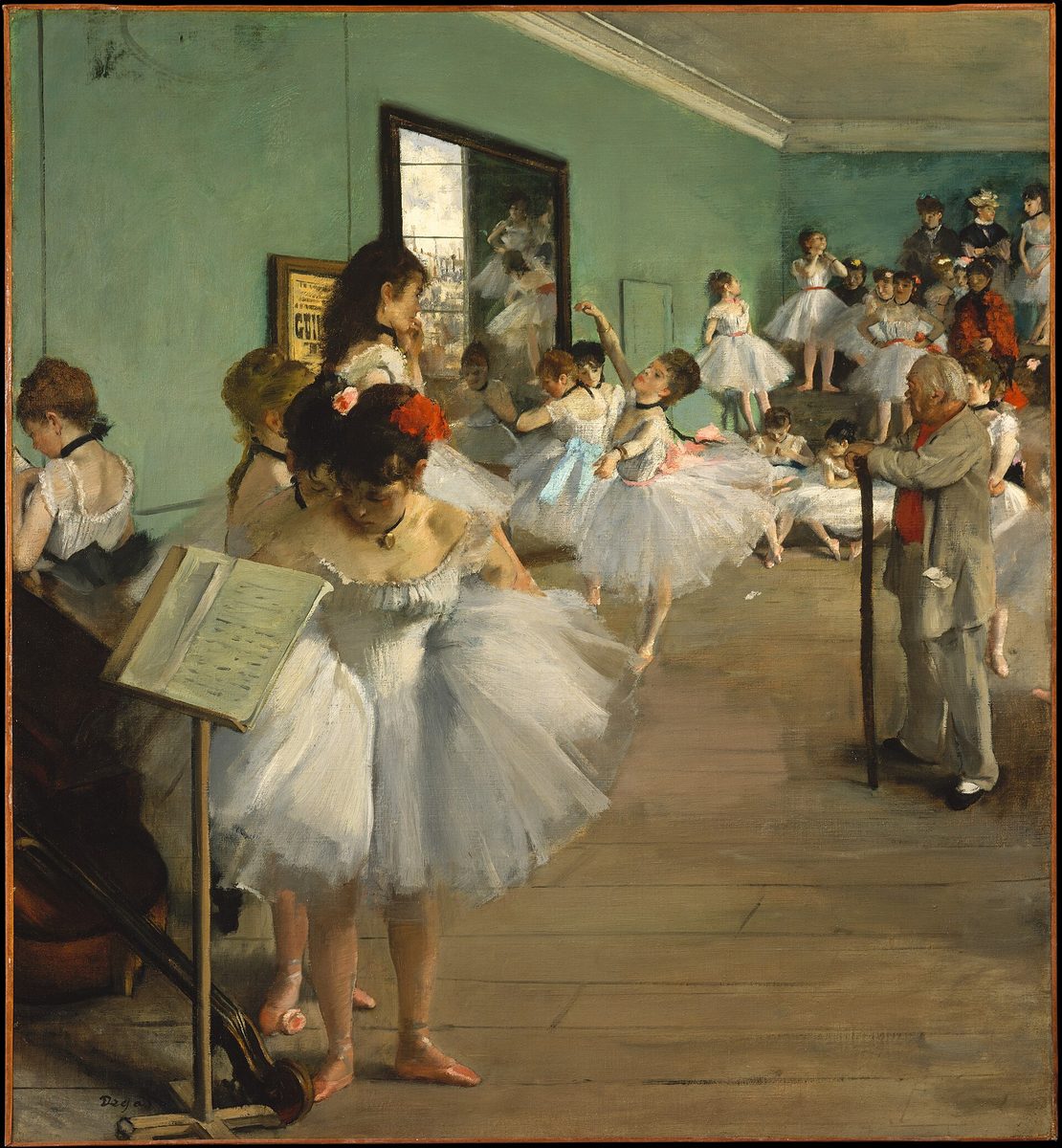
Degas admired the precise line of Ingres, whose work he studied in the Louvre, and the color of Delacroix. This early training gave his paintings a firm underlying drawing even when he worked quickly. In the 1860s his palette leaned toward gray and brown with black accents. By the 1870s he added stronger notes of green and pink, with occasional orange highlights, especially in stage light and practice rooms. The Dance Class, an oil on canvas from 1874, uses a long receding floor and a doorway at the back to place the viewer low and to one side.
His subjects came from modern Paris: ballet classes, horse races, cafes, milliners, laundresses, and women at their bath. He often cropped a figure at the edge of the canvas, as if the action continued outside the frame. Japanese woodblock prints influenced these asymmetrical compositions. Photography also mattered to him; he used unusual viewpoints and caught people in off-balance poses. He placed the vanishing point off center and tilted the floor upward, so the room seems to slide toward the viewer.
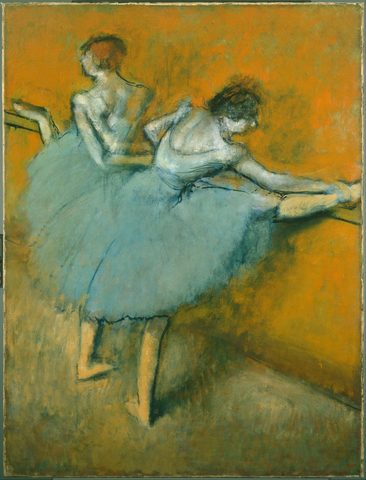
Degas changed his materials as his eyesight worsened. He combined ink, gouache, pastel, and charcoal on paper, and he built up pastel in tight crosshatching over monotypes. His late dance pictures, including Dancers at the Barre from 1900, use warmer, almost glowing color and looser strokes. Degas ballerina paintings are not stage portraits but records of effort: dancers adjust a slipper, rub a sore muscle, or grip a barre with one leg raised. His early portraits are tighter and more finished; late works are looser and more abstract.
Key paintings
The Dance Class (1874, oil on canvas, Metropolitan Museum of Art) shows a ballet studio with young dancers in white tutus. A ballet master stands in the center, resting on a stick,. The tilted floor and receding room make rehearsal, not performance, the subject. Degas based the scene on the old Paris Opéra on the rue Le Peletier.
Dancers at the Barre (1900, oil on canvas, The Phillips Collection) is a late work with two dancers in bright tutus. One stretches her leg on the barre; the other bends forward. The broad strokes show Degas pushing toward simpler, more abstract forms.
The Bellelli Family (begun 1858, oil on canvas, Musée d'Orsay) is an early portrait of Degas's aunt Laura, her husband, and their two daughters in a Florentine apartment. The father sits apart and turns his back, while the mother stands with one child. Degas worked on the canvas for nearly a decade, returning from Italy with studies and finishing it in Paris.
L'Absinthe (1875 to 1876, oil on canvas, Musée d'Orsay) shows a woman seated at a cafe table next to a man. A glass of absinthe sits in front of her. The couple sits off center, and the tables cut hard at the edge. The painting drew criticism for its plain, downbeat view of urban isolation, and it is now a well-known image of Parisian cafe life.
Miss La La at the Cirque Fernando (1879, oil on canvas, National Gallery, London) shows a mixed-race acrobat hanging from a rope high above the stage. The viewpoint from below makes the ceiling curve, and the picture records a real circus performer.
Where to see the originals
The Metropolitan Museum of Art in New York holds The Dance Class. Dancers at the Barre belongs to The Phillips Collection in Washington, D.C. For a broader Degas collection, visit the Musée d'Orsay in Paris, which owns L'Absinthe, The Bellelli Family, and many pastels. The National Gallery in London and the Art Institute of Chicago also hold Degas paintings and works on paper. Degas's bronze sculptures, cast after his death from wax and clay originals, are also in many of these institutions. Check each museum's website for current display status before you travel.