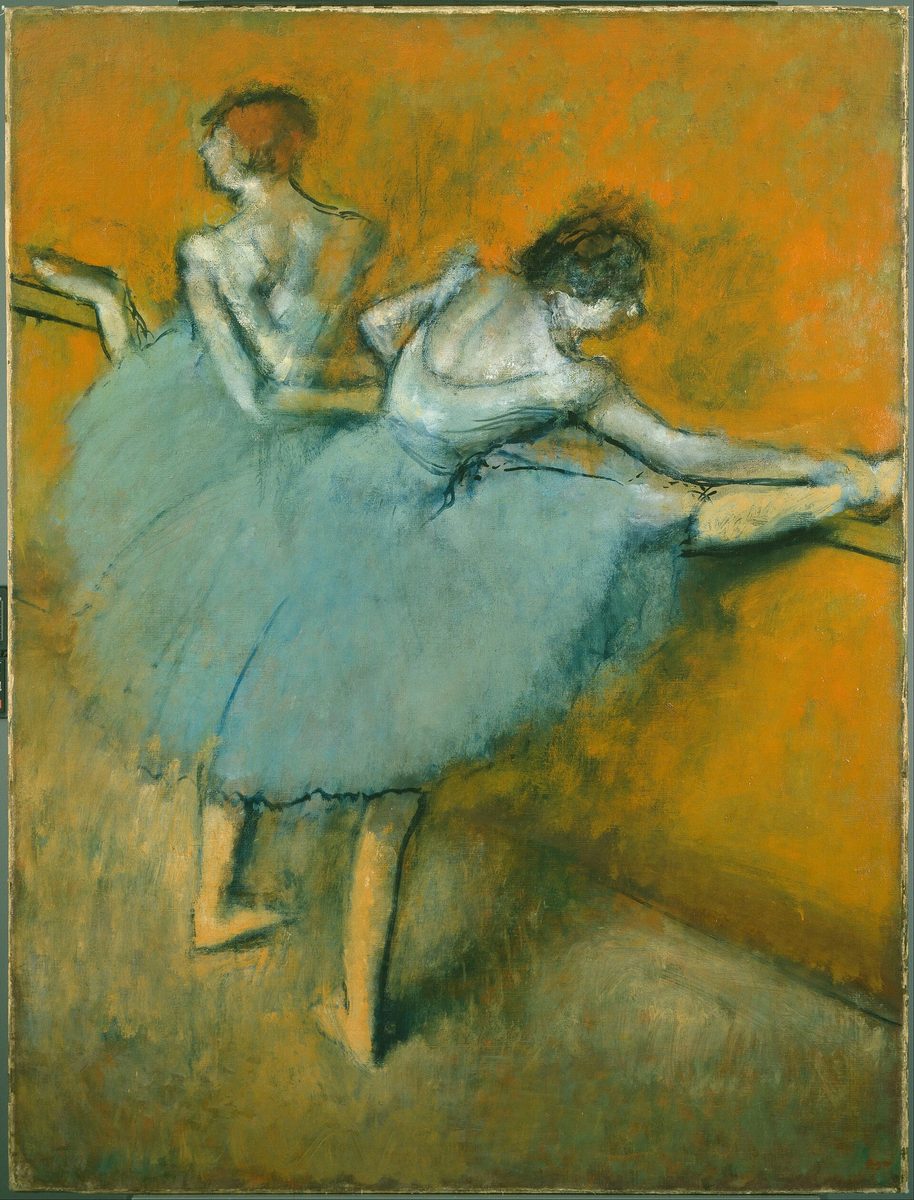
Dancers at the Barre by Edgar Degas is an oil on canvas painted in 1900. It measures 130.2 by 97.8 cm, hangs at The Phillips Collection in Washington, D.C., and is one of the artist's late treatments of ballet dancers. Degas was a French painter associated with Impressionism, but he worked mostly in the studio; this late canvas shows the heavily worked surface and restricted palette that mark his final years.
What the picture shows
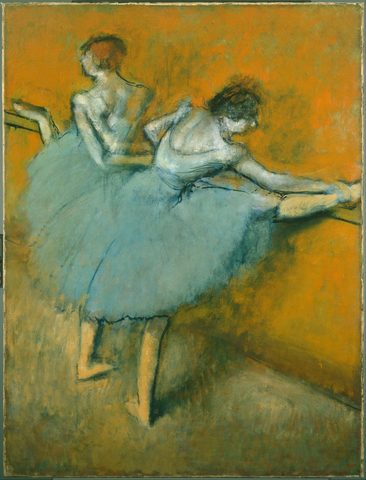
Stand in front of the canvas and you see two dancers in blue-turquoise tutus at a barre, seen from behind and slightly from above. The barre runs diagonally across the picture from the upper left toward the right. The dancer on the right has lifted her left leg onto the barre and bends forward over it, her arm stretched along her leg. The dancer on the left stands upright with one hand resting on the barre, looking to the left.
The background wall is a vivid orange, painted in loose, dense strokes. The floor is ochre-brown with green-grey shadows. Faces are barely indicated; arms and backs are outlined with dark lines. The paint surface is heavily worked and matt, with visible scrubbing and layered strokes. The palette stays limited to orange, turquoise, and flesh tones.
When and why it was painted
Degas was born in 1834, and by 1900 he was about 66. He had been drawing and painting ballet dancers since the 1870s, often reworking poses in his studio. In his late years, failing eyesight pushed him toward bolder forms and stronger color, and his surfaces became more heavily reworked. Dancers at the Barre is a late return to a familiar subject, now stripped to two figures, a diagonal barre, and a wall of dense orange strokes. Degas exhibited with the Impressionists from the 1870s onward, but he differed from painters like Monet by preferring interior subjects and artificial light. This canvas belongs to that late phase, where the painting's texture and color zones are as important as the pose itself.
Seeing it at home
If you commission a hand-painted copy, keep the original's vertical proportions in mind: 130.2 by 97.8 cm, about 3:4. Look for a heavily worked, matt surface with visible brushwork and layered strokes. A good copy reproduces the dull, scrubbed paint film rather than a glossy finish. The palette should stay limited to orange, turquoise, and flesh tones, with dark outlines on arms and backs. Avoid copies that smooth over the texture or brighten the colors.