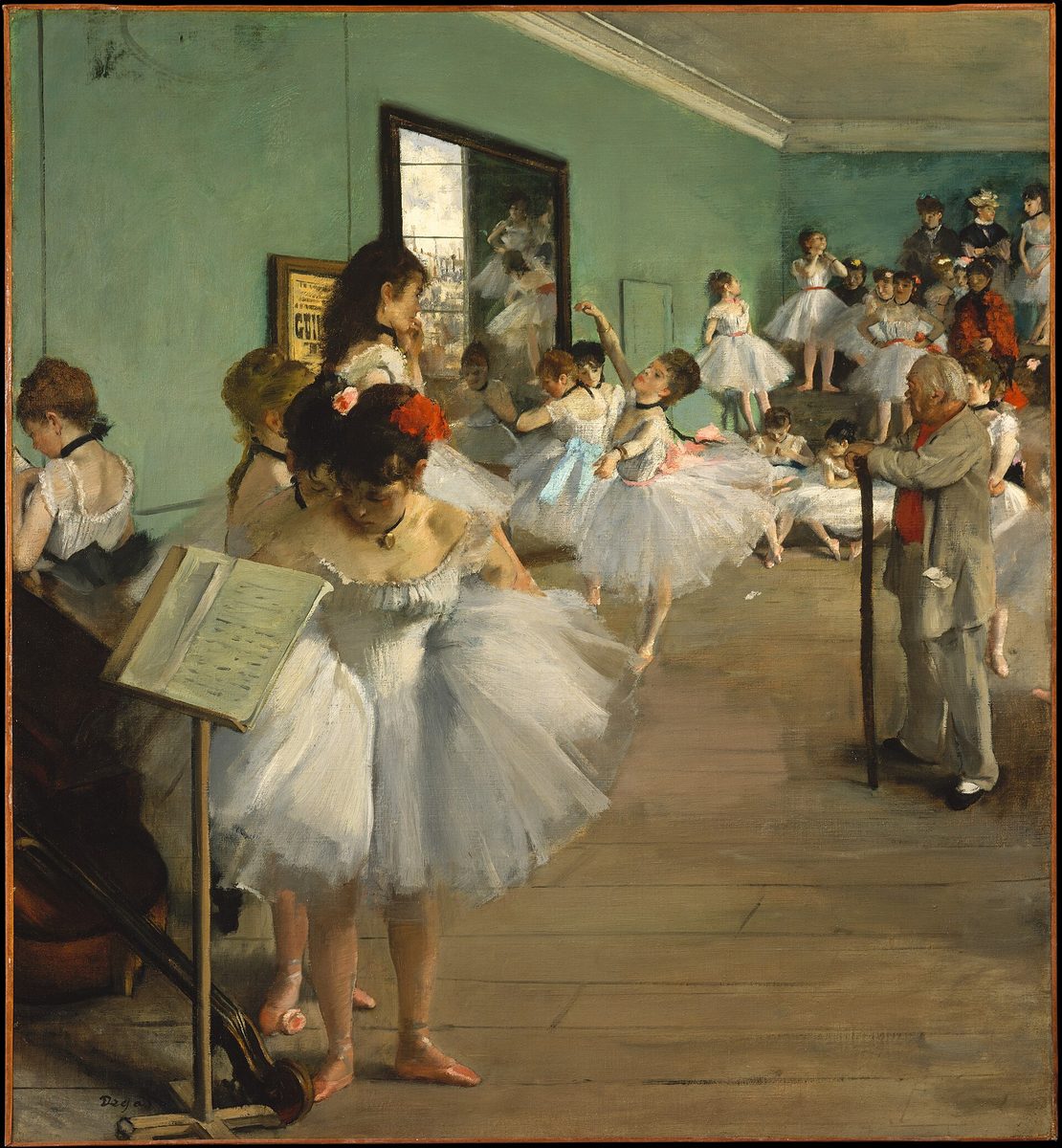
Edgar Degas painted The Dance Class in 1874 in oil on canvas. The canvas measures 83.5 by 77.2 cm and hangs in the Metropolitan Museum of Art, New York City. It shows a ballet rehearsal room with about twenty young dancers in white tutus and an old man leaning on a tall stick on the right.
What the picture shows
The room has pale green walls and a wooden floor that recedes diagonally to the back right. In the left foreground, a young dancer in a white tutu with a red flower in her hair stands with her head bowed, adjusting her dress. A music stand holds open sheet music; at lower left the neck and scroll of a double bass appear, with a piano at the left edge. On the right, an old man in a light grey suit leans on a tall stick. About twenty young dancers in white tutus with coloured sashes fill the middle ground; some practise poses, others rest. At the back, a group stands on a raised step, and behind them a few adult women in dark clothes and hats are visible. A tall mirror on the back wall reflects windows and dancers, and a framed poster hangs to its left. Several dancers sit on the piano at the left, one scratching her back. The palette is a cool green, white, grey and pale pink, the brushwork loose and sketchy; the canvas is signed 'Degas' at the lower left.
When and why The Dance Class was painted
Degas turned forty in 1874 and active in the Paris art world. That year he helped organize the first Impressionist exhibition, although his own aims were closer to realism and careful drawing than to open-air light. He began painting ballet subjects in the late 1860s, and by the 1870s classes and rehearsals had become one of his main themes. The Dance Class belongs to a group of pictures from this period that show young dancers not on stage but waiting, stretching or being corrected. Degas often framed such scenes from an oblique angle, letting the wooden floor run back to the right. This working rehearsal room, with its pale green walls and mirror, suited his interest in modern urban interiors and informal movement.
Seeing it at home
In a hand-painted copy, the original size of 83.5 by 77.2 cm matters because the composition is tightly cropped. The palette should stay cool: green, white, grey and pale pink, with the red flower and sashes as small accents. Loose, sketchy brushwork and the diagonal wooden floor are the details to check carefully. A copy should not feel glossy or overly finished.