El Greco Paintings: Visionary Works from Crete to Toledo
El Greco paintings combine Greek icon training, Venetian color, and Spanish religious intensity. Domenikos Theotokopoulos, called El Greco, was born in Crete in 1541 and died in Toledo in 1614. He worked as a painter, sculptor, and architect, but his oil paintings on canvas define his legacy. Today his work matters because it closed the gap between Byzantine flatness and Renaissance modeling, then pushed beyond both into a personal style of stretched figures, cool light, and restless drapery. Toledo and New York hold originals such as The Burial of the Count of Orgaz and View of Toledo. His paintings served churches and private patrons who wanted believable visions, not flat symbols.
Life and training
El Greco was born Domenikos Theotokopoulos in 1541 in Candia, the capital of Venetian-ruled Crete. As a young man he trained in the local tradition of Byzantine icon painting, learning to build images with gold leaf, flat forms, and strict symbolic rules. That early discipline never disappeared from his later work. Around 1567 he left Crete for Venice, then the center of oil painting in Italy. In Venice he studied the color of Titian and the dramatic compositions of Tintoretto, and he began to paint on canvas with layered oils instead of egg tempera on wood. By 1570 he had moved to Rome, where he saw Michelangelo's figures and the classical sculpture of the Vatican collections. In Rome he also saw Mannerist paintings, whose elongated proportions reinforced his own preference for tall, slim figures. He signed his early works in Greek, often as Domenikos Theotokopoulos, Cretan, a sign of pride in his origins. His time in Italy changed his sense of scale and anatomy, but he did not settle there.
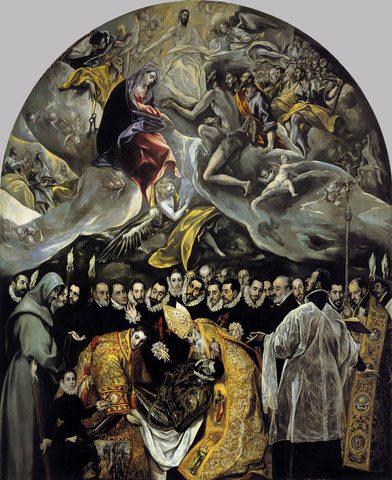
A turning point came in 1577, when he traveled to Spain. After a short stay in Madrid, he settled in Toledo, then the religious capital of Spain. He received two major commissions that secured his reputation: The Disrobing of Christ for the sacristy of Toledo Cathedral, begun in 1577, and The Burial of the Count of Orgaz for the Church of Santo Tomé, painted in 1586. The second painting shows a 14th-century local legend with donors, saints, and a row of contemporary Toledan nobles. In Toledo he worked as a painter, sculptor, and architect, designing altarpieces and frames as well as canvases. His one important royal commission, The Martyrdom of Saint Maurice, was painted around 1580 to 1582 for El Escorial but did not please Philip II. That rejection pushed him further into church and private patronage in Toledo. He remained in the city for the rest of his life, dying in 1614. His workshop continued after his death, run in part by his son Jorge Manuel Theotocopoulos, but his style was so personal that later followers often replicated only its surface oddities.
Style and technique
El Greco art is built on a few strong procedures. He usually painted on coarse canvas with a reddish-brown ground, then laid in forms with loose, rapid brushwork. His palette favors cool yellows and acid greens, along with gray-blues and deep reds, often lit by an uncertain gray-white light. Drapery folds are sharp and angular, not softly modeled. Faces are small on long bodies, and hands are thin with spread fingers. These choices come from his Byzantine training, his study of Tintoretto in Venice, and his own interest in making figures seem weightless. From icons he kept a sense of frontality and spiritual focus: figures often turn their faces toward the viewer even when their bodies move. Over time the figures grow taller, the space more crowded, and the lighting more electric. Early works such as The Disrobing of Christ still depend on clear stage space and carefully separated figures. Late works, including The Opening of the Fifth Seal from around 1608 to 1614, flatten the picture plane and let bodies twist against an unsteady horizon.
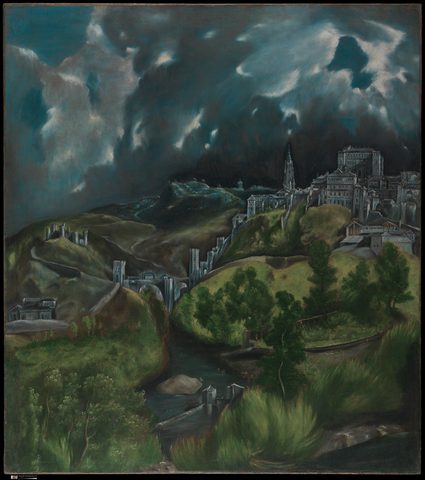
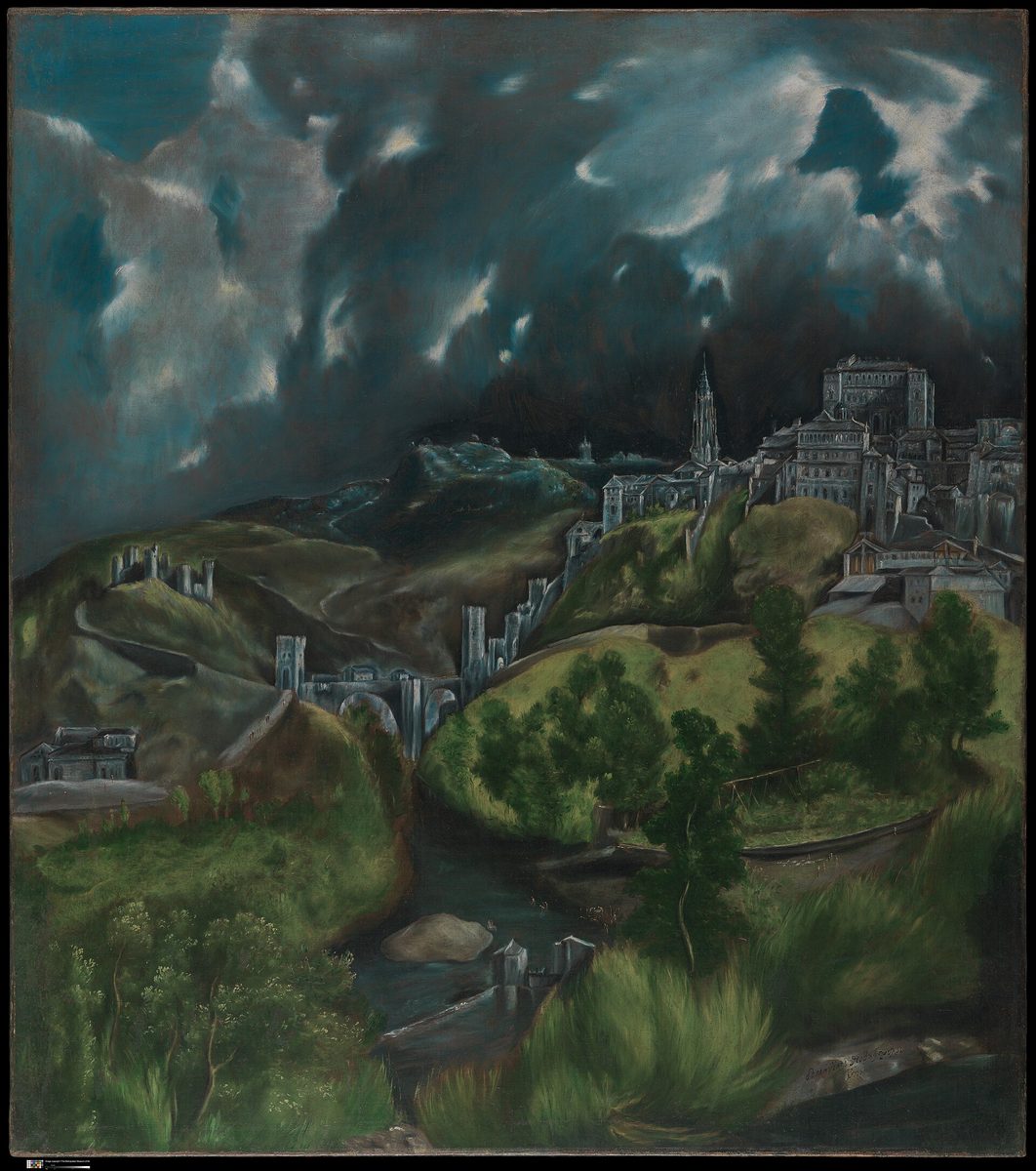
His subjects are mostly religious: saints, martyrs, the Virgin, the Crucifixion, and the Adoration of the Shepherds. He also painted portraits, character heads, and a few landscapes. View of Toledo from 1596 is his best-known landscape, and its green hills and storm-lit sky show the same unquiet energy as his sacred scenes. His technique did not aim at naturalistic finish. He often left brushstrokes visible, modified forms while the paint was wet, and used small highlights of lead white and yellow to make edges flicker. That physical handling gives El Greco paintings a texture that reproductions rarely capture.
Key El Greco Paintings
El Greco's best-known canvas is The Burial of the Count of Orgaz, painted in 1586 for the Church of Santo Tomé in Toledo. The lower half shows Saint Stephen and Saint Augustine lowering the armored count into his tomb while local noblemen in black watch. The upper half opens into a crowded heaven with Christ, Mary, and saints, painted in thinner, more luminous brushwork. The picture combines a group portrait, a miracle story, and an altarpiece in one 480-by-360-centimeter canvas, and it has never left its church. View of Toledo, from 1596, is the artist's best-known landscape. It shows the city on its hill under a bruised blue sky, with green banks and the Tagus river crossed by the Alcántara bridge. The Metropolitan Museum of Art in New York holds it today.
Other El Greco famous paintings include The Disrobing of Christ, painted for Toledo Cathedral around 1577 to 1579. It crowds the canvas with soldiers, onlookers, and a calm Christ in a red robe, about to be stripped before the Crucifixion. The Nobleman with his Hand on his Chest, from about 1580, is a half-length portrait of an unidentified Spanish gentleman, his fingers placed in a gesture of oath or sincerity. The Opening of the Fifth Seal, from 1608 to 1614, depicts martyrs receiving white garments, a scene from the Book of Revelation. These works show how El Greco's figures become taller and the color cooler while space gets more compressed as he aged, without losing the intense religious focus that ran through his entire career.
Where to see the originals
The Burial of the Count of Orgaz remains in the Church of Santo Tomé in Toledo, where El Greco painted it for the parish in 1586. View of Toledo is in the Metropolitan Museum of Art in New York City. The Disrobing of Christ hangs in the sacristy of Toledo Cathedral. The Prado in Madrid holds The Nobleman with his Hand on his Chest and several other El Greco paintings. The National Gallery in London and the Museo del Greco in Toledo also hold his work. Check current opening hours before visiting; some sites require timed entry or are closed on certain holy days.