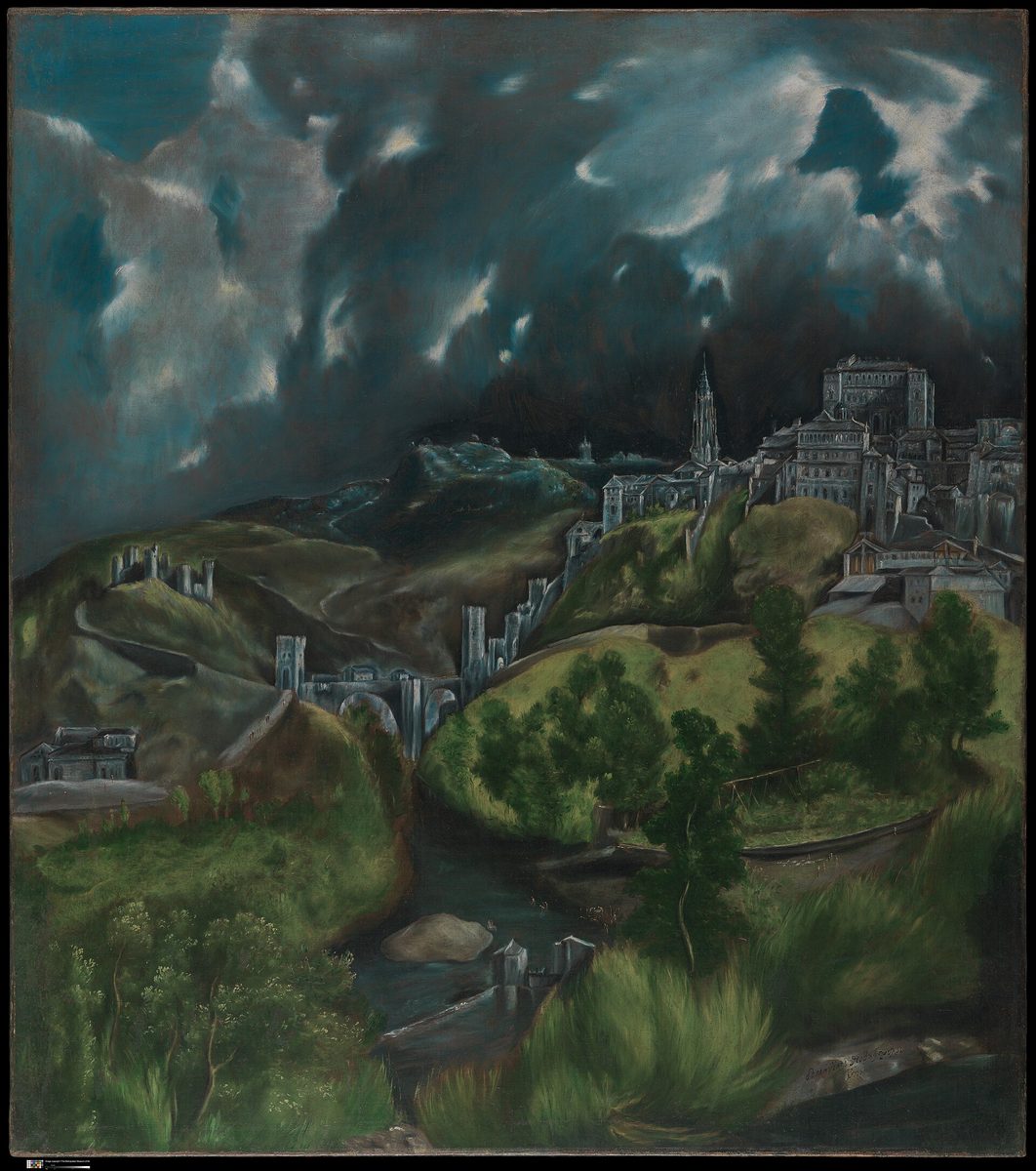
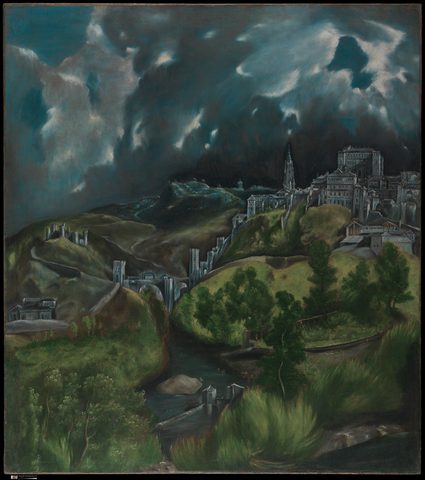
El Greco, born in 1541 and active in Spain until his death in 1614, was a Greek-born painter associated with the Spanish Renaissance and Mannerism. He painted View of Toledo in oil on canvas in the late 1590s; the work measures 121.3 x 108.6 cm and hangs in the Metropolitan Museum of Art in New York City. The scene shows the hilltop city of Toledo under a dark, stormy sky, with a tall cathedral tower, a large fortified building, and a bridge over the river.
What the picture shows in View of Toledo by El Greco
The composition is vertical, roughly 8:9. A hilltop town spreads across the upper right, its pale grey-white buildings set against a black-green sky. A tall pointed cathedral tower stands at the centre of the skyline, and a large square building with towers, probably a fortress or palace, sits to its right. On the middle left, a bridge with arches and towers crosses a river; a castle with towers sits on the hill to its left. The river runs from the bridge down through the lower centre, where small structures and a rock in the water appear at the bottom. The foreground is filled with bright green hills, bushes and trees. The dramatic sky has dark storm clouds with streaks of white, grey-blue and patches of turquoise. Long, fluid brushstrokes carry the cold palette of dark green, blue-black, grey and white. No human figures are clearly visible, though a few tiny marks along the road and on the river may be figures. A signature in Greek letters is visible in the lower right corner.
When and why it was painted
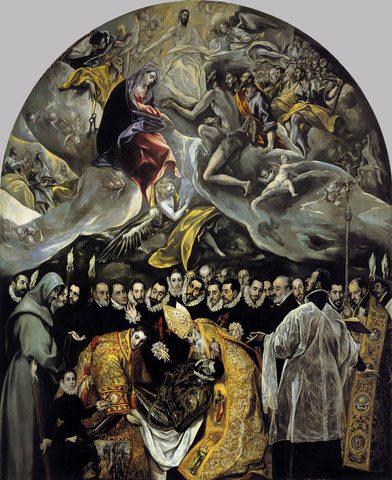
By the late 1590s El Greco had been living in Spain for about two decades, mostly in Toledo, where he worked for churches and private patrons. Born in 1541 on Crete, he trained in the Byzantine tradition before moving to Venice and Rome, then to Spain. His style there became associated with both the Spanish Renaissance and Mannerism, known for elongated forms, sharp contrasts, and expressive colour. View of Toledo belongs to this late phase. Unlike most of his religious commissions, this is a landscape, though it carries the same tense, stormy atmosphere he used in his sacred scenes. The painting does not record a specific event; it presents the city as a dense, dramatic silhouette, close in spirit to the visionary landscapes that interested Mannerist painters.
Seeing it at home
In a hand-painted copy of View of Toledo, keep the proportions close to the original 121.3 x 108.6 cm, a vertical format of roughly 8:9. Look for a surface that shows the long, fluid brushstrokes and the cold palette: dark green, blue-black, grey and white, with touches of turquoise in the stormy sky. The sky should feel heavy and the hills bright by contrast.