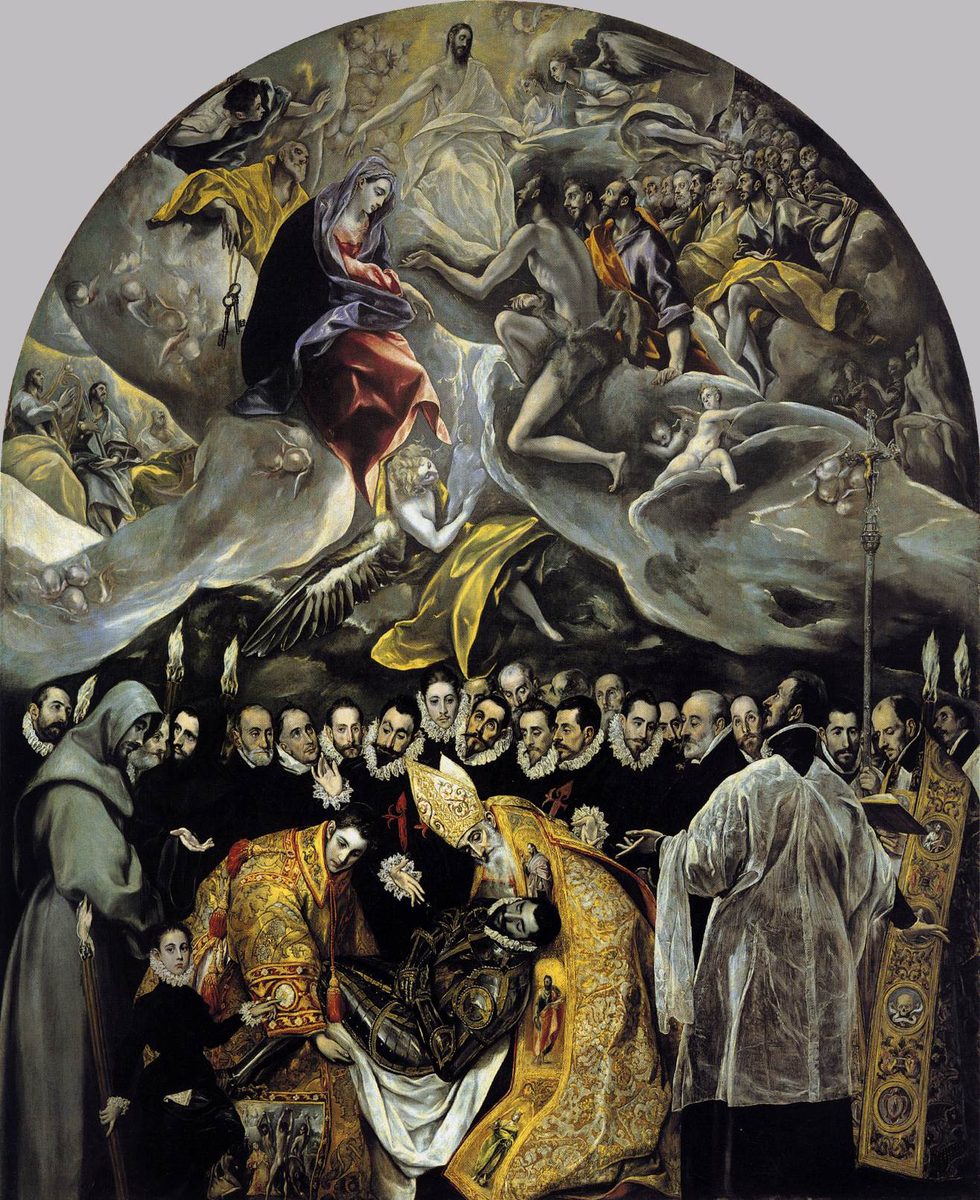
El Greco painted The Burial of the Count of Orgaz in 1586. The oil on canvas is 480 centimeters high and 360 centimeters wide, with a rounded, arched top. It hangs in the Church of Santo Tomé in Toledo, the church it was painted for. The picture is divided into two zones: an earthly burial scene below and a crowded heavenly scene above. Two richly dressed clergymen lower the dead man in dark armor as mourners in black surround them.
What The Burial of the Count of Orgaz by El Greco shows
Stand in front of the canvas and the eye moves upward from black, gold and white to silvery grey clouds. In the lower half, two clergymen in gold brocade vestments bend to lower a dead man in dark, polished armor. The older clergyman on the right wears a bishop's mitre; the younger one on the left is beardless. Behind them a tight row of about twenty men in black with white ruff collars look up or gesture. At the lower left a boy in black points toward the body; beside him stands a monk in a grey habit. On the right a priest in a sheer white surplice reads with his back to the viewer, and a processional cross rises behind him. Above, the Virgin in red and blue kneels on clouds, while a near-nude figure, apparently John the Baptist, kneels opposite. Christ in white sits at the top. A winged angel carries a small, translucent figure upward through a narrow passage in the clouds. Saints, angels and heads crowd the clouds; one figure on the left holds keys.
When and why it was painted
In 1586 El Greco had been working in Toledo for about nine years. He was born in Crete in 1541 and had trained in Venice and Rome before settling in Spain. The painting was made for the Church of Santo Tomé, where the Count of Orgaz was buried. It shows a local legend: when the count died, Saints Stephen and Augustine appeared to lower him into his tomb. El Greco treats this miracle as a two-zone composition, a format that suited his Mannerist interest in elongated figures and heightened spiritual feeling. The lower scene is rooted in black costumes and gold vestments; the upper scene opens into silvery clouds. This blend of Spanish Renaissance piety and Mannerist distortion was already visible in his Toledo altarpieces.
Seeing it at home
A hand-painted copy will usually be far smaller than the original size of 480 by 360 centimeters, so look for a painter who keeps the vertical, arched format and the clear split between the black-gold lower zone and the grey upper clouds. The faces and ruffs need careful edges; the subtle red and blue of the Virgin and the white of Christ should stay distinct. Ask about the surface texture: oil on canvas will let the brushwork show.