Johannes Vermeer Paintings: A Guide to the Dutch Master's Work
Johannes Vermeer was a Dutch painter born in Delft in 1632 and active there until his death in 1675. He produced a small body of work, about three dozen paintings, almost all of them quiet domestic scenes, portraits, or city views. Because so few Vermeer paintings survive, each one carries unusual weight. The two works in this catalogue, Girl with a Pearl Earring and The Milkmaid, show why his reputation rests on patient observation and controlled light. Today museums in The Hague and Amsterdam display these originals, and viewers still study the same details: a milkmaid pouring milk, a girl turning her head, paint layered in thin glazes. Vermeer was not prolific, yet his work has become central to how people understand the Dutch Golden Age. His treatment of daylight and his restrained color harmonies influenced later painters, and reproductions have made these images familiar far beyond museum walls.
Life and training
Johannes Vermeer was baptized in Delft on October 31, 1632. His father worked as an art dealer and innkeeper in Delft. The family lived in Delft throughout his childhood, and the city's canals, houses, and light appear in his later views. He spent nearly his entire life in Delft.
In 1653 Vermeer married Catharina Bolnes, a Catholic woman from Gouda. He probably converted to Catholicism before or after the marriage. The couple had fifteen children, though four died in infancy and eleven were still alive at his death. After the marriage they lived in the house of Catharina's mother, Maria Thins, on Oude Langendijk in Delft. That same year Vermeer joined the Guild of Saint Luke as a master painter. Guild membership meant he had already completed an apprenticeship, though no record names his teacher. He served several terms as a headman of the guild from 1662.
His earliest known paintings are larger biblical and mythological scenes with strong contrasts of light, close to the Utrecht Caravaggists. He soon turned to the domestic interiors for which he is known. Vermeer painted slowly and sold to a small circle of patrons in Delft. His most important patron was Pieter van Ruijven, a Delft collector who owned a large share of his work. Vermeer favored quiet subjects: women reading letters, pouring milk, or playing musical instruments. The Milkmaid dates from about 1660, when the artist was in his late twenties. Girl with a Pearl Earring was painted around 1665. His output was small, probably fewer than forty paintings in total, and only about three dozen are accepted today.
The last years were difficult. The French invasion of the Dutch Republic in 1672 damaged the art market. Vermeer's income fell, and he had to borrow money. He died in December 1675 and was buried in the Oude Kerk in Delft on December 15, 1675. The exact cause of his death is not recorded. His widow, Catharina, petitioned for bankruptcy the following year, and he left his wife and eleven children with debts.
Style and technique
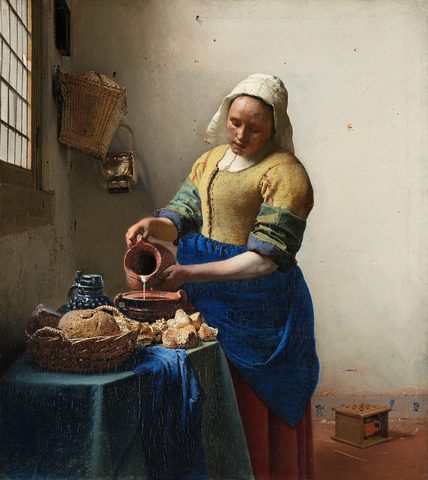
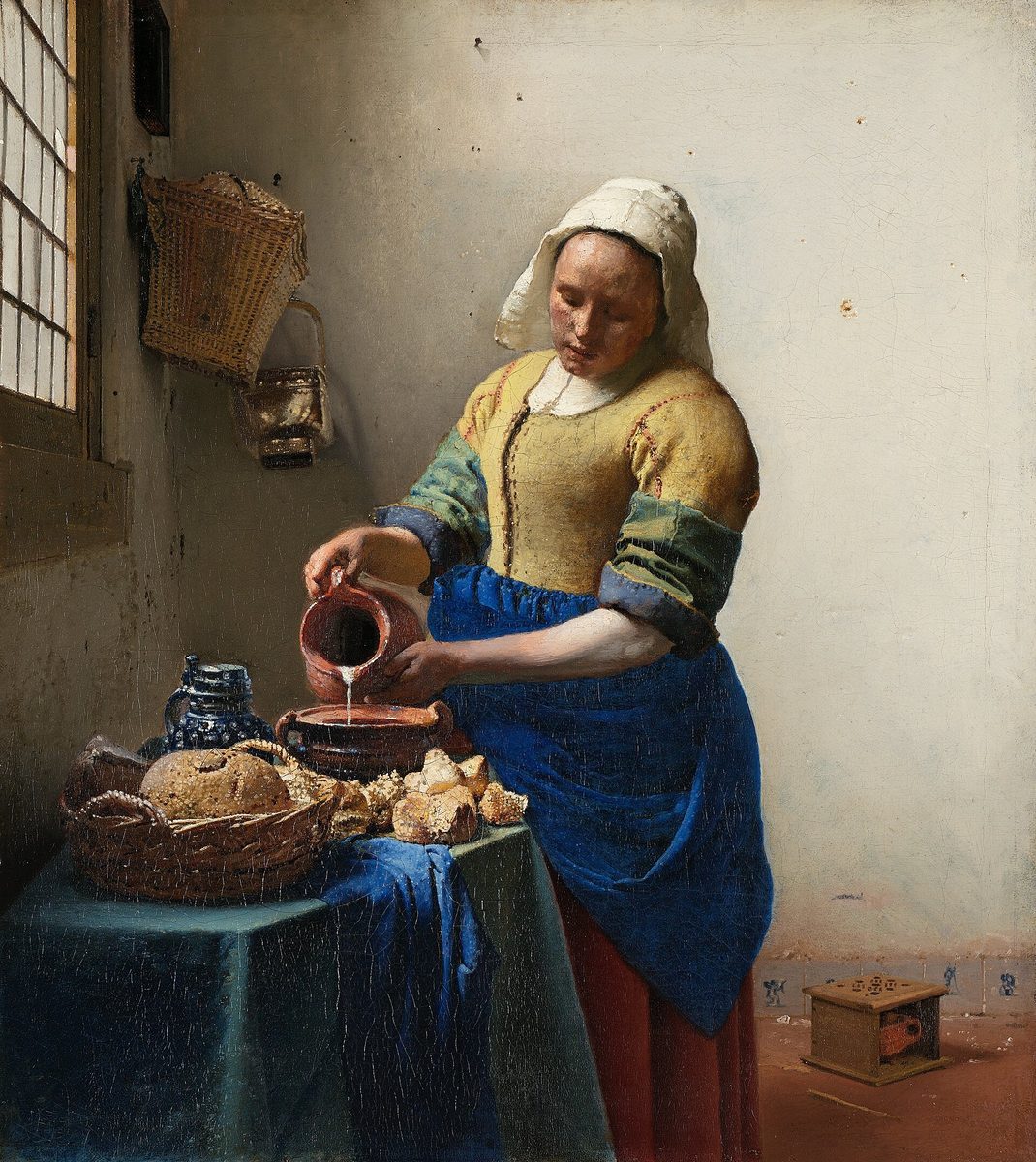
Vermeer's technique is precise and deliberate. He built up forms with thin layers of paint, often using expensive ultramarine made from lapis lazuli for blue areas. He applied small dots of thick paint, sometimes called pointillés, to catch light on bread, pearls, and metal. His compositions usually place a single figure near a window on the left, so daylight falls across a white wall. The Milkmaid, for example, uses this set-up: a woman stands beside a window, pouring milk from a jug, while a basket of bread and a blue cloth receive the light.
His palette favors cool whites, blues, yellows, and earth tones. He often kept backgrounds simple, with maps, framed pictures, or plaster walls. Brushwork is smooth in faces and fabrics, yet some details dissolve into soft focus. Over time his handling became more abstract in highlights and shadows, but the subjects remained domestic: women reading letters, holding balances, making lace, or playing instruments. His cityscape View of Delft shows the same restraint applied to architecture and water.
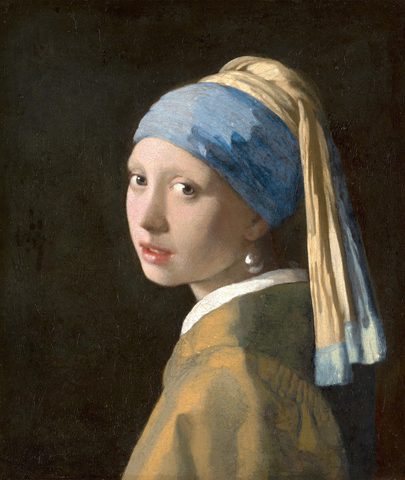
Influences came from the Utrecht Caravaggists in his early biblical subjects, but by the mid 1650s he had found his own quieter vein. He did not paint many formal portraits. Instead he painted unidentified figures in costume, as in Girl with a Pearl Earring, where the girl is not identified and wears a costume rather than everyday dress. Vermeer's real subject is often the behavior of light on surfaces.
No preparatory drawings by Vermeer survive, so his working method is reconstructed from the finished paintings. X-ray and infrared studies of some Vermeer paintings show changes made during painting. This lack of documentation makes his exact use of lenses or optical devices a matter of debate rather than established fact.
Key Vermeer Paintings
The Milkmaid (c. 1660) shows a kitchen maid pouring milk into a bowl. Light from a window falls on her apron, the bread basket, and the blue cloth. The painting is celebrated for its direct observation and thick paint on the bread crusts. It hangs in the Rijksmuseum in Amsterdam.
Girl with a Pearl Earring (c. 1665) is a tronie, a study of a head rather than a formal portrait. A young woman turns toward the viewer with a blue and yellow headscarf and a large pearl earring. The dark background and soft modeling make the pearl look luminous. It is in the Mauritshuis in The Hague.
View of Delft (c. 1660-1661) is one of the few outdoor scenes by Vermeer. It shows the city from the south, with the Schiedam and Rotterdam gates, the Nieuwe Kerk, and reflections in the water. Marcel Proust wrote about it in his novel. The Mauritshuis holds the painting.
The Art of Painting (c. 1666-1668) shows an artist in his studio painting a model dressed as Clio, the muse of history. A heavy curtain, a map, and a chandelier fill the room. The work may have been kept by Vermeer as a demonstration of his skill. It is in the Kunsthistorisches Museum in Vienna.
Woman Holding a Balance (c. 1664) shows a woman holding an empty balance over a table with coins and pearls while a painting of the Last Judgment hangs behind her. The empty balance has been read as a sign of moderation or judgment. The National Gallery of Art in Washington owns this small canvas.
Where to see the originals
The two paintings in this catalogue are easy to see. Girl with a Pearl Earring hangs in the Mauritshuis in The Hague, and The Milkmaid is in the Rijksmuseum in Amsterdam. Both museums specialize in Dutch Golden Age art. View of Delft is also in the Mauritshuis. Other major paintings by Vermeer are held by the Kunsthistorisches Museum in Vienna, the National Gallery of Art in Washington, the Städel Museum in Frankfurt, and the Frick Collection in New York.
Check museum opening hours before visiting, since these paintings are often in high demand and may require a timed ticket. The collections in The Hague and Amsterdam are located near train stations and are easily combined in one trip.