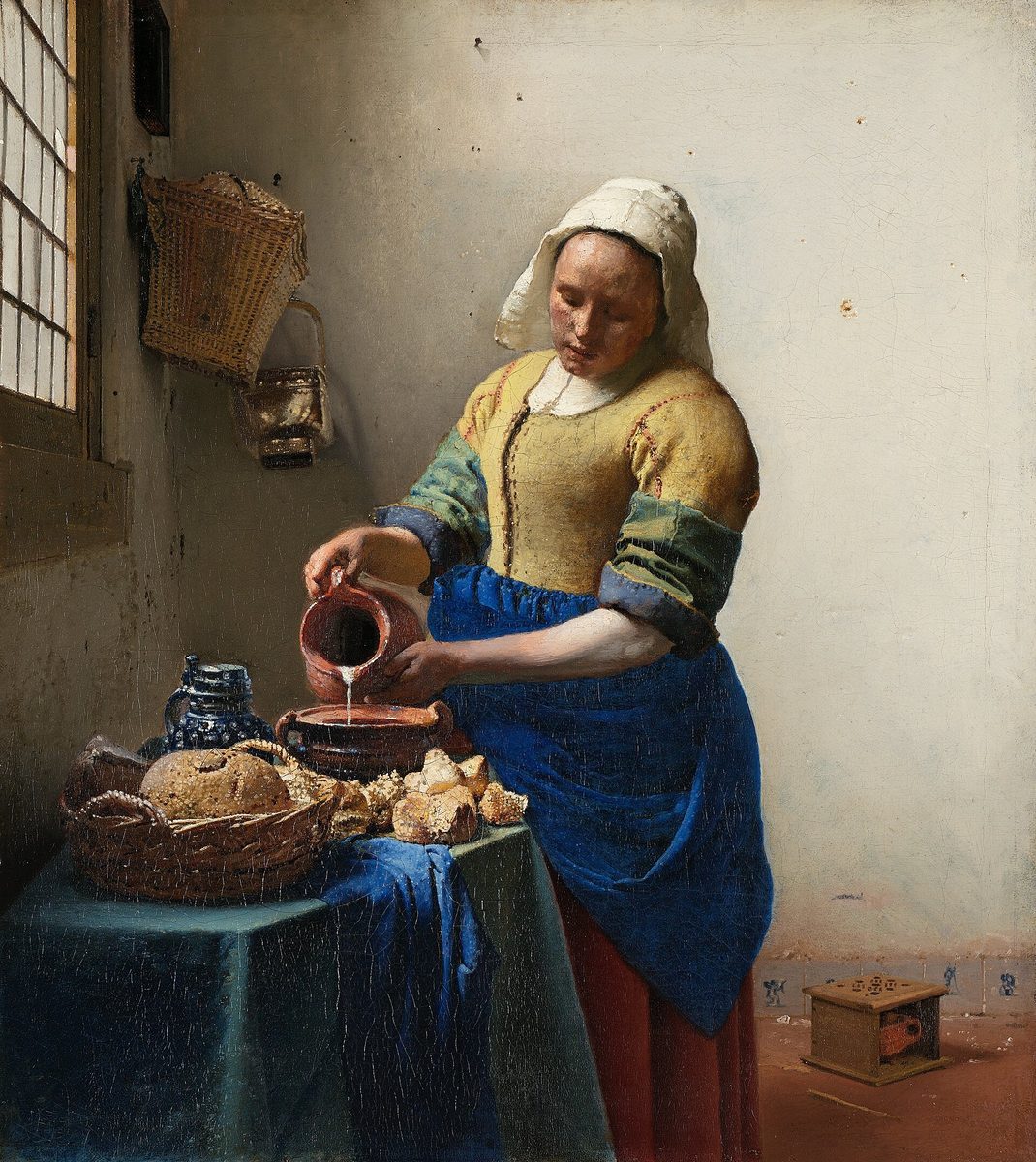
Johannes Vermeer painted The Milkmaid around 1660 in oil on canvas. The canvas is nearly square, 45.5 cm high and 41.0 cm wide, and belongs to the Rijksmuseum in Amsterdam. It shows a young woman in a kitchen corner pouring milk from a jug into a bowl, a scene built from a few carefully ordered objects. This Dutch Golden Age painting belongs to the same years as Vermeer's quiet single-figure interiors, where ordinary household tasks fill the center of the composition.
What The Milkmaid shows
In this near-square canvas, a young woman stands at a table in a kitchen corner. She pours a thin stream of milk from a red-brown earthenware jug into a two-handled bowl. Her head is bowed and her eyes lower toward the bowl. She wears a white linen cap, a yellow bodice with green rolled-up oversleeves, a blue apron, and a red skirt. On the table, a green cloth and a blue fabric hold a wicker basket of bread, broken bread rolls, and a blue stoneware jug. Light falls from a leaded-glass window at upper left; one pane appears broken. A wicker basket and a brass bucket hang from nails on the left wall. The back wall is plain off-white plaster with nail holes and marks. At lower right, a wooden foot warmer stands on the floor before a row of blue-and-white Delft tiles. The bread crusts are painted with small dots of light-colored paint.
When and why it was painted
By 1660 Vermeer was about 28 and living in Delft, where he painted small, focused views of domestic interiors. The Milkmaid is a servant scene rather than a portrait: the woman's bowed head and lowered eyes turn attention toward the task and the tabletop objects. At this time Dutch Golden Age painters often treated kitchens and pantries as subjects for still life, but Vermeer placed a single working woman at the center of the composition. The near-square format and low viewpoint bring the bread, jug, bowl and foot warmer close to the picture plane. Compared with his later music lessons and letter readers, this painting has a more physical surface, especially in the crusts and plaster.
Seeing it at home
A hand-painted copy should keep the near-square proportions of the original, 45.5 by 41.0 cm. Look for the muted, close-toned palette of white, yellow, blue, red, brown and green rather than bright hues. The surface matters most in the bread: the crusts are built with small light dots of paint, so ask for that broken texture in the copy.