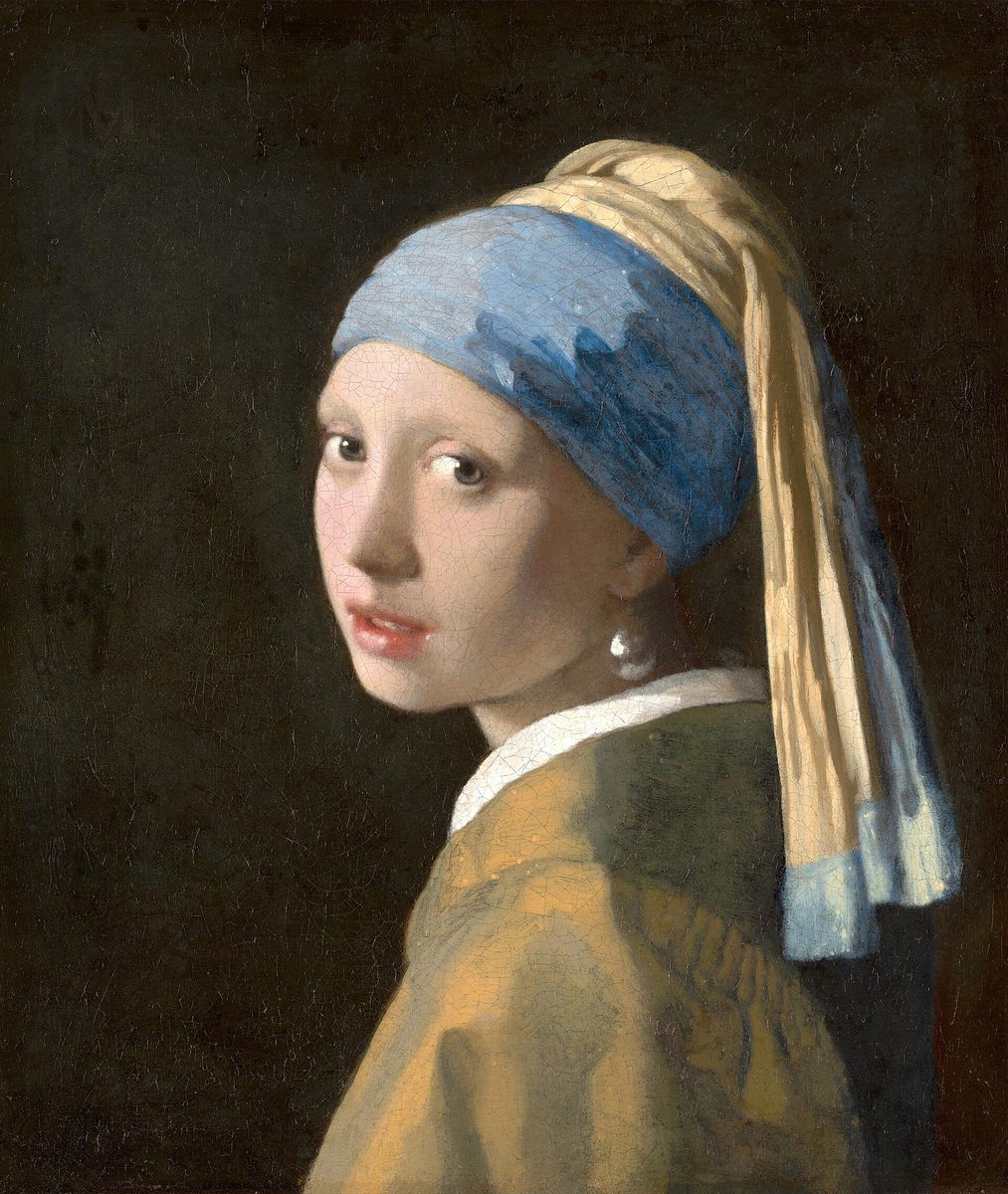
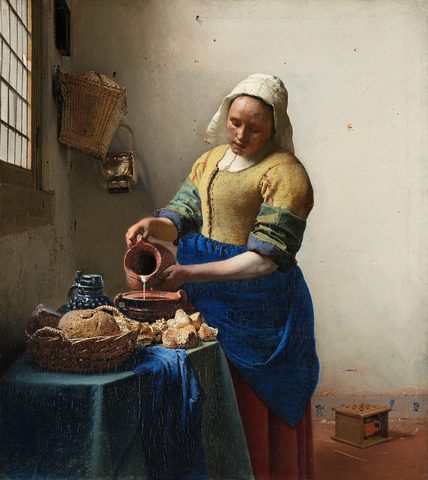
Johannes Vermeer painted the girl with pearl earring, also titled Girl with a Pearl Earring, around 1665 in oil on canvas. The canvas measures 44.5 by 39.0 cm and now hangs in the Mauritshuis in The Hague, where it is usually on view. Vermeer, born in 1632 and died in 1675, produced this picture in the last decade of his life, a period when he concentrated on domestic interiors, the fall of daylight and the sheen of fabric and skin.
What the picture shows
The format is vertical and close to square. A girl is shown from the chest up against a plain, very dark background. Her body is turned away to the right, and she looks back over her left shoulder at the viewer. Her lips are slightly parted, with a small highlight on the lower lip; her eyes are wide open with bright catch-lights. A blue turban wraps her head, and a yellow-ochre cloth falls from the top of it down her back. She wears a yellow-brown jacket with a broad white collar. A large pear-shaped pearl earring hangs from her left ear, lit with a white highlight and a reflection of the white collar. Light comes from the left, falling on her face, the turban, and the earring. The palette is reduced to ultramarine blue, yellow ochre, white, and near-black. Fine craquelure is visible across the whole surface, especially on the face.
When and why Vermeer painted girl with pearl earring
Vermeer was about 33 in 1665 and living in Delft, where he had been active as a painter for roughly a decade; he died ten years later, in 1675. He worked slowly and left a small oeuvre, mostly scenes of women in domestic interiors. Girl with a Pearl Earring is not a conventional portrait but a study of a face, a type called a tronie in Dutch art. The plain dark background and turban remove the figure from a specific room, focusing attention on the face, the collar, and the earring. The picture belongs to the Dutch Golden Age, a period of naturalistic light and texture, and to the broader Baroque painting movement; its dark ground and careful highlights reflect that interest. Vermeer used the same ultramarine blue and yellow ochre in other works of the 1660s.
Seeing it at home
In a hand-painted copy, check the size against the original: 44.5 by 39.0 cm, or an accurate proportional enlargement. The dark background should be layered, not flat black; the blue turban and white collar need visible brushwork. The palette should stay close to ultramarine blue, yellow ochre, white, and near-black. The pearl should read as a pear-shaped highlight with a reflection of the collar, not a simple white dot.