Rembrandt Paintings and the Dutch Golden Age
Rembrandt Harmenszoon van Rijn (1606-1669) was a Dutch painter and printmaker. He was born in Leiden, trained with local teachers, moved to Amsterdam, and worked there until his death. He painted portraits, self-portraits, biblical stories, mythological scenes, landscapes, and tronies, studies of a head in costume. Today his work matters because he turned oil paint into a record of attention: light catching a collar, a hand emerging from shadow, a face marked by age. Museums still give his canvases their own rooms, and the self-portraits are a direct, unsentimental record of a life. The Night Watch alone draws visitors to the Rijksmuseum in Amsterdam.
Life and training
Rembrandt Harmenszoon van Rijn was born in Leiden on 15 July 1606, the ninth child of a miller. In 1613 he enrolled at the Latin school, and in 1620 he registered at the University of Leiden, but he left after a few months to train as a painter. He studied with Jacob van Swanenburg in Leiden, where he learned the basics of panel painting and probably heard about Italian art. Around 1624 he spent six months with Pieter Lastman in Amsterdam, a history painter who taught him how to arrange a biblical or classical scene with clear action and strong lighting. By 1625 Rembrandt was back in Leiden as an independent master, sharing a studio with Jan Lievens. Constantijn Huygens, secretary to the Stadtholder, praised both young painters around 1629 and noted Rembrandt's power to convey emotion.
In 1631 Rembrandt moved to Amsterdam and lodged with the art dealer Hendrick van Uylenburgh. In 1632 he completed The Anatomy Lesson of Dr. Nicolaes Tulp, a group portrait that established his name in the city. He became Amsterdam's leading portraitist within a few years. In 1634 he married Saskia van Uylenburgh, Hendrick's cousin. The couple bought a large house on the Breestraat in 1639, now the Rembrandt House Museum. Their son Titus was born in 1641, after three earlier children died in infancy. Saskia died in 1642, the year The Night Watch was completed. Rembrandt's portrait practice declined in the 1640s, and his spending on prints, antiquities, and studio props outpaced his income.
In 1656 he applied for cessio bonorum, a form of bankruptcy, and his collections were sold. He moved to a smaller house on the Rozengracht and continued to paint, etch, and take pupils. Over his career his pupils included Gerrit Dou, Govert Flinck, and Carel Fabritius. Titus and Hendrickje Stoffels, Rembrandt's companion after Saskia's death, set up a business to protect him from creditors. Rembrandt outlived both. In the 1650s and 1660s he painted some of his largest religious works, including The Return of the Prodigal Son around 1668, and he received the commission for The Syndics of the Drapers' Guild in 1662. He died in Amsterdam on 4 October 1669 and was buried in the Westerkerk.
Style and technique
Rembrandt built his paintings with oil on canvas or panel, often in layers. Early works from the Leiden years are small and precise, with smooth finishes. In later Amsterdam paintings the brushwork becomes broader and the paint surface thicker. He used a palette of earth colors: ochre, umber, sienna, bone black, lead white, and a few red lakes. Blues and greens appear more often in his early work; by the 1650s browns and golds dominate.
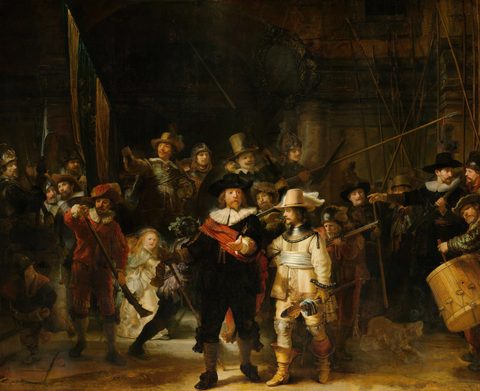
His light is the main structural tool. A figure or a hand catches a strong beam while the rest of the canvas sinks into translucent dark. In The Night Watch, the lieutenant's yellow coat and the captain's black suit are set against shadowed militia members; the girl in the middle distance glows under the same light. He layered thin glazes for shadows and built highlights with thick lead white, a technique sometimes called impasto. He sometimes scratched into wet paint with the back of his brush to define hair or the edge of a collar.
Rembrandt painted portraits, self-portraits, biblical stories, mythological scenes, landscapes, and tronies. He returned repeatedly to his own face, producing about forty painted self-portraits and many etchings. He often used members of his household as models, including his wife Saskia and later Hendrickje Stoffels. His subjects sit still or move slowly; the drama is in the arrangement of hands, eyes, and the weight of shadow.
His training with Pieter Lastman gave him a taste for history subjects with lively gestures; through Lastman and Utrecht followers he absorbed Caravaggio's strong light-dark contrasts. In the early 1630s his surfaces are polished and details are crisp; by the 1660s paint is dragged, scraped, and piled into ridges that catch actual light in a gallery.
He printed etchings with drypoint and burin, often reworking the plates to darken the lines. The physical surface of a late Rembrandt painting has a rough, almost sculptural quality. This handling became a signature of his late manner and influenced later painters who cared more about touch than smooth finish.
Key Rembrandt Paintings
Paintings by Rembrandt that anchor his reputation include The Anatomy Lesson of Dr. Nicolaes Tulp, The Night Watch, The Storm on the Sea of Galilee, and The Return of the Prodigal Son.
The Anatomy Lesson of Dr. Nicolaes Tulp (1632, Mauritshuis, The Hague) shows seven surgeons gathered around a corpse while Dr. Tulp demonstrates the flexor tendons of the left arm. Rembrandt was in his mid-twenties when he painted this group portrait for the Amsterdam Guild of Surgeons. The diagonal arrangement and focused light made his name in Amsterdam.
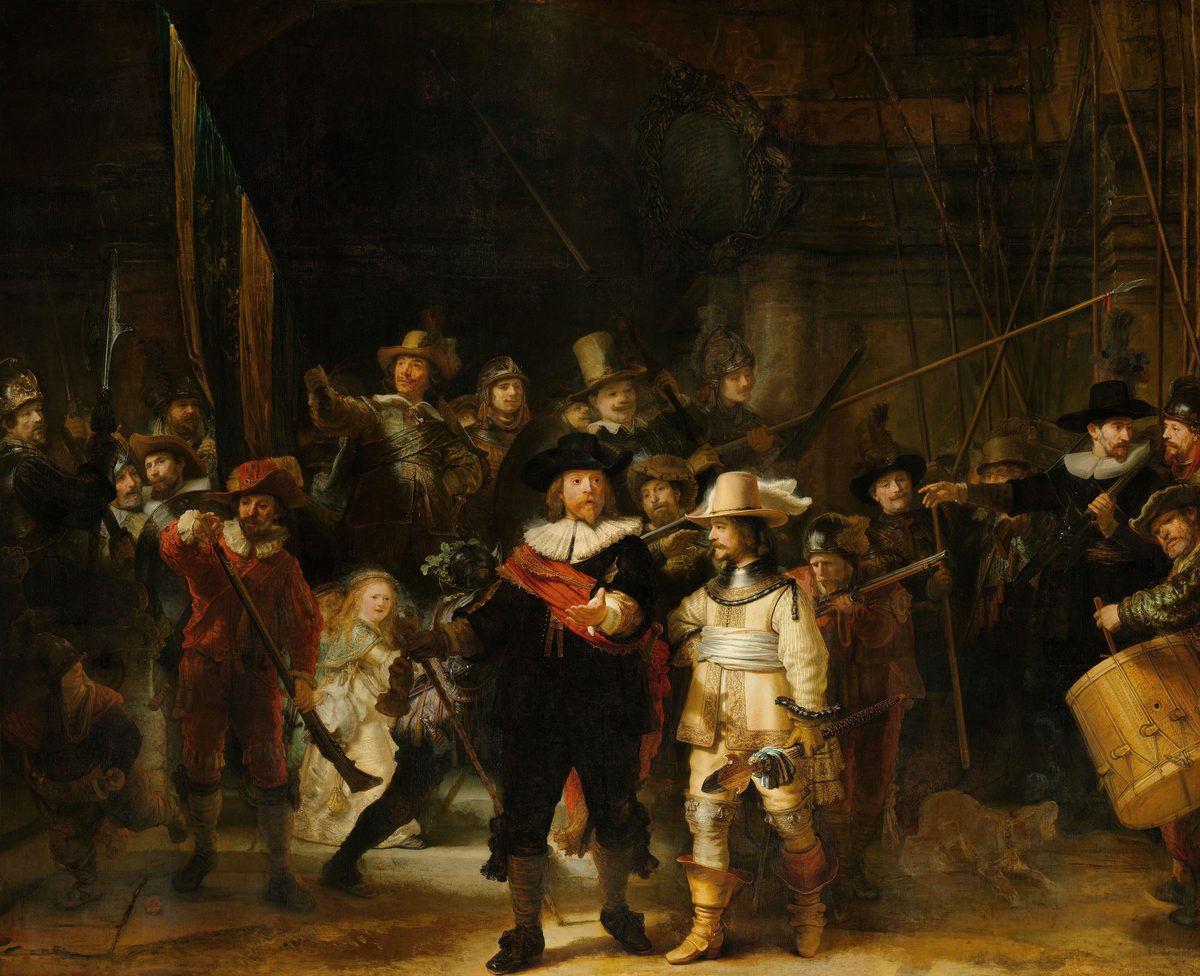
The Night Watch (1642, Rijksmuseum, Amsterdam) is a civic guard portrait that Rembrandt turned into a crowded, active scene. Captain Frans Banninck Cocq orders his company to march, while a drummer, a dog, and a girl in a pale dress move through the composition. The canvas measures 363 by 437 centimeters. Layers of old varnish darkened the paint surface and helped produce the popular title, even though the scene is set in daylight.
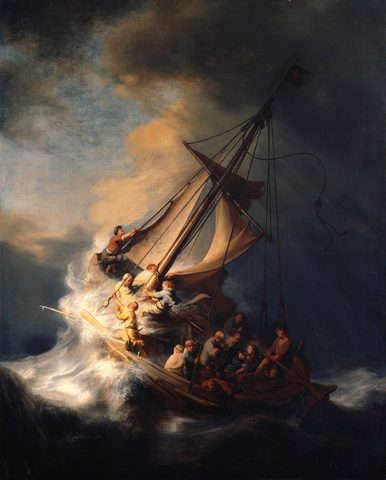
The Storm on the Sea of Galilee (1633) is Rembrandt's only painted seascape. The oil on canvas, 160 by 128 centimeters, shows the biblical storm with disciples struggling to control a fishing boat while Christ remains calm. It hung in the Isabella Stewart Gardner Museum in Boston until it was stolen in 1990 and has not been recovered.
The Return of the Prodigal Son (c. 1668, Hermitage Museum, Saint Petersburg) is one of his last large biblical scenes. The father's hands rest on the kneeling son's back, and the older brother stands at the right in shadow. The broad, rough handling of paint carries the emotional weight of the parable.
Self-Portrait with Two Circles (c. 1665-1669, Kenwood House, London) shows Rembrandt with his palette, brushes, and maulstick; the two circles on the wall behind him are its most debated detail.
Where to see the originals
The Night Watch is on permanent display in the Gallery of Honour at the Rijksmuseum in Amsterdam. The empty frame of The Storm on the Sea of Galilee still hangs at the Isabella Stewart Gardner Museum in Boston after the 1990 theft. The Anatomy Lesson of Dr. Nicolaes Tulp is at the Mauritshuis in The Hague. The Return of the Prodigal Son is in the Hermitage Museum in Saint Petersburg. Self-Portrait with Two Circles is at Kenwood House in London. Other major collections include the National Gallery in London, the Metropolitan Museum of Art in New York, the Gemäldegalerie in Berlin, and the Louvre in Paris.