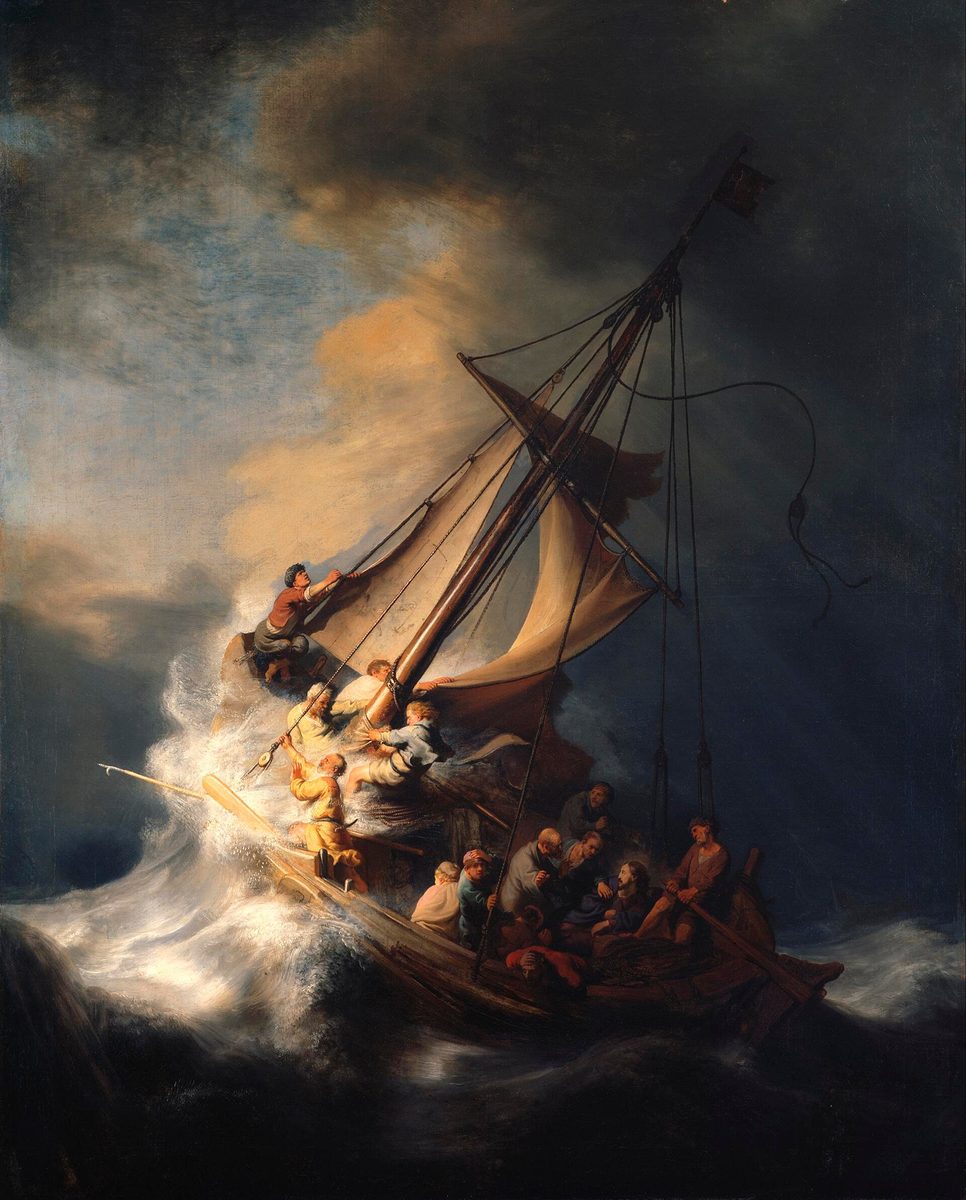
Rembrandt, born in 1606, painted The Storm on the Sea of Galilee in 1633 in oil paint on canvas, at the age of 27, and it is his only known painted seascape. The vertical canvas measures 160 x 128 cm, roughly four by five, and it belongs to the Isabella Stewart Gardner Museum in Boston. It was one of thirteen works stolen from the museum in 1990 and is still missing; the museum's empty frame remains on view.
What the picture shows
The first thing you notice is a small fishing boat with a single mast tilting steeply to the left, its bow rising on a huge breaking wave. White spray and foam burst over the bow, and dark green-black water fills the lower edge. The brown sail is torn and flapping; a rope hangs loose in a curve on the right. About fourteen men are on board: at the bow some haul ropes and grip the mast, one climbs the rigging, and at the stern a group sits closer together. Among them a figure with a faint halo, Christ, is being addressed by the others. One man leans over the right side, apparently sick, while another in a blue cap looks straight out at you. A man at the right holds the rudder, and a small flag flies at the masthead. Above, dark storm clouds cover most of the sky, broken on the left by a patch of light blue and golden light. Strong contrast lights the bow and sail, while the stern sinks into darkness.
When and why The Storm on the Sea of Galilee was painted
By 1633 Rembrandt had left Leiden and was living in Amsterdam, where he was gaining commissions for portraits and history paintings. He was 27. This is the only painted seascape he is known to have made, and it shows a biblical subject: the account of Christ calming a storm. The Dutch Golden Age valued dramatic natural observation and strong effects of light, and Rembrandt turns those skills to a stormy sea and a small boat. The scene gave him a chance to test how light falls on foam, rigging, faces, and torn canvas. The vertical format leaves room for the high wave and the small figures.
Seeing it at home
A hand-painted copy should keep the original's vertical 160 x 128 cm proportions, roughly four by five. Look for a surface built up with oil paint on canvas, not flat poster color. The copyist should preserve the strong contrast: light on the bow and sail against dark green-black water, with a small patch of blue and warm gold on the left. The brown sail should show torn, flapping edges.