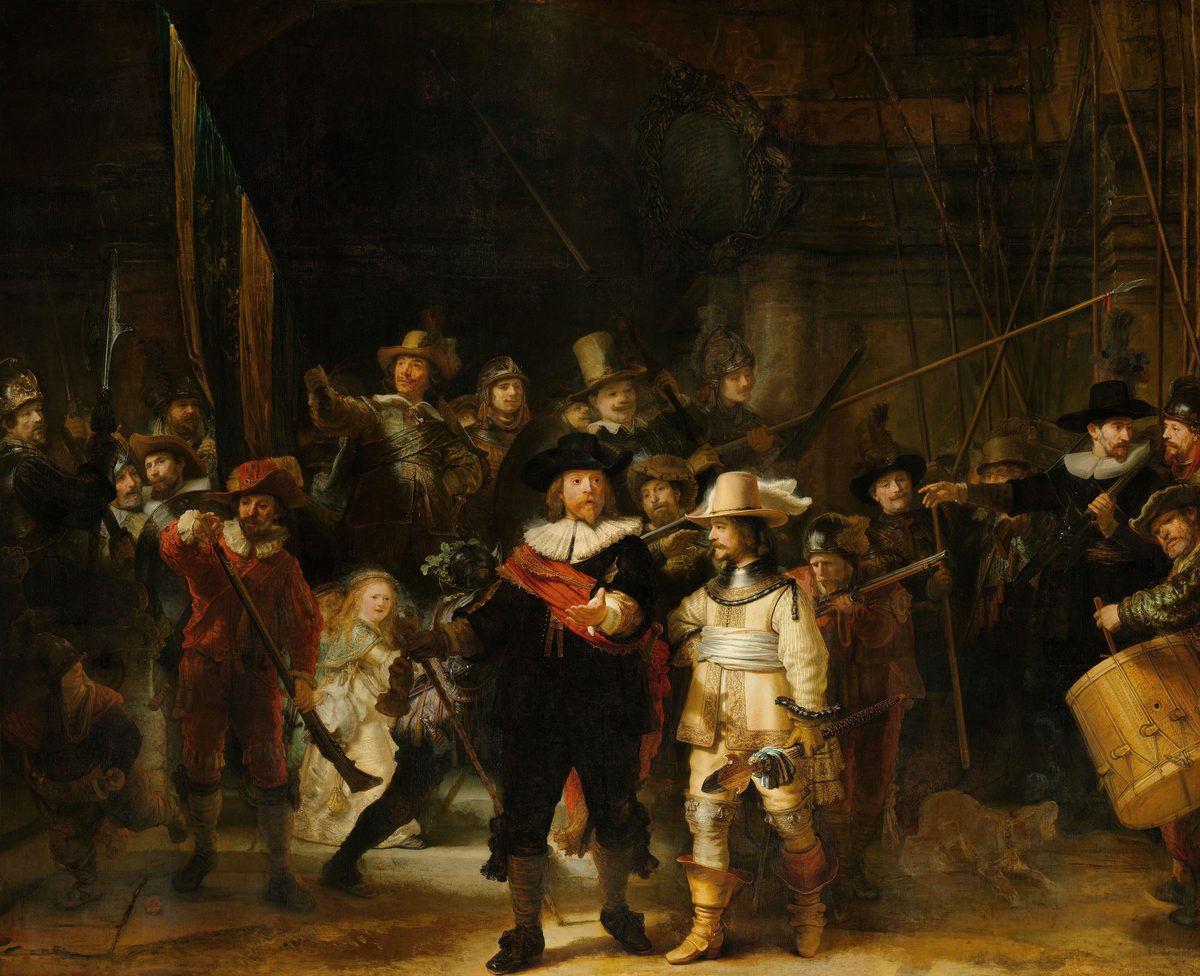
The Night Watch is an oil on canvas by Rembrandt, painted in 1642. It measures 363.0 by 437.0 centimeters, a horizontal canvas that gives the company of Amsterdam militiamen room to move forward out of a dark archway. The title is the popular name for a group portrait of one of Amsterdam's civic guard companies; the guardsmen carry muskets, pikes, and a banner. Rembrandt was a Dutch painter, born in 1606 and died in 1669. The painting hangs today in the Rijksmuseum in Amsterdam, where it is displayed with other Dutch Golden Age paintings.
What the picture shows
Standing in front of the canvas, you see more than twenty armed militiamen emerging from a dark archway toward the viewer. In the center foreground, a man in black with a wide black hat, white lace collar, and red sash strides forward, his left hand open and extended. Beside him, a man in a pale yellow-white buff coat and a hat with a white plume holds a decorated partisan. Left of center, a small brightly lit girl in a pale gold dress has a white bird hanging at her waist. On the far left, a man in red loads or handles a musket, while another figure in the middle raises a banner pole. On the right, a drummer beats a large drum and a small dog runs at his feet. Lances, pikes, and musket barrels cross diagonally in the upper right above a flag-bearer with a raised banner. Dark stone architecture, an arch, and a column sit behind the group. Strong contrast of light and dark puts the central pair and the girl in bright light while the rest fade into brown-black. The palette stays in black, ochre, gold, red, and brown, and the highlights are painted with thick, loose strokes.
When and why The Night Watch was painted
Rembrandt painted The Night Watch in 1642, when he was in his mid-thirties and well established in Amsterdam. He had moved to the city in 1631, and during the 1630s he built a reputation for portraits and large figure groups. The Night Watch belongs to a familiar Dutch Golden Age format: a civic guard company shown as if in action. It was first displayed in the Kloveniersdoelen, the Amsterdam headquarters of the civic guard company that commissioned it. In the same years Rembrandt was also painting individual portraits and biblical scenes. The painting's combination of direct observation, deep shadow, and visible brushwork fits the broad Dutch Golden Age interest in realistic detail. Its dark setting and dramatic lighting also reflect Rembrandt's own direction away from the smoother finish of his earlier Amsterdam portraits.
Seeing it at home
When you compare a hand-painted copy of The Night Watch with the original, the first thing to check is the horizontal format, close to six by five, not a square crop. The surface should show some thick paint in the lit areas, especially on the central figures and the girl's pale gold dress. A close palette of black, ochre, gold, red, and brown matters more than exact size, since most copies are smaller than the 363 by 437 centimeter original.