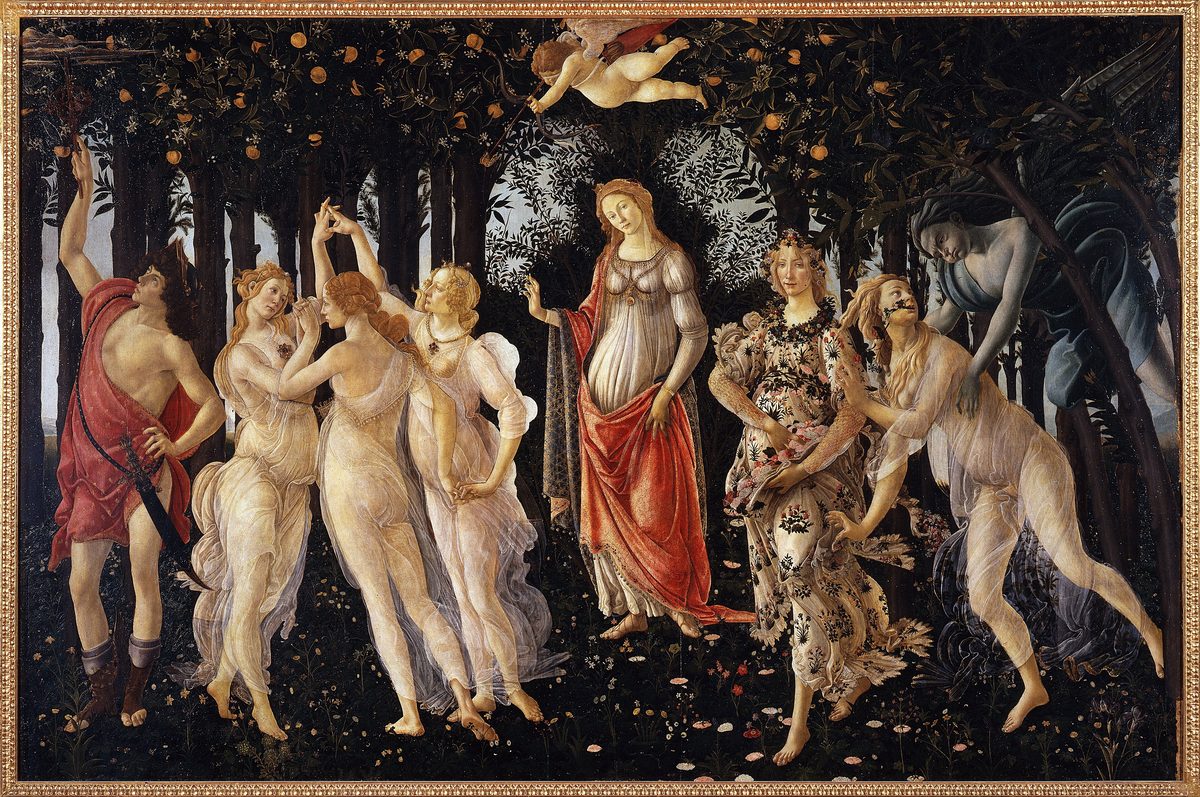
Sandro Botticelli painted Primavera between 1480 and 1485. The work is tempera on panel and measures 203.0 by 314.0 cm. It hangs in the Uffizi Gallery in Florence. The picture's eight figures stand in a dark grove of orange trees, but the panel is often read as a Florentine allegory rather than a simple meadow scene. The medium and scale match the large wall panels made for private Florentine rooms.
What the picture shows
Eight figures stand in a row in a dark grove of orange trees, with a winged child flying above. At the centre, a woman in a white dress with a red cloak raises her right hand; dark leaves form an arch behind her. Above her a blindfolded winged child aims a bow and arrow. On the left three young women in transparent white dresses dance in a circle, their fingers interlaced overhead. At the far left a young man in a red cloak with a sword raises a stick towards the leaves. On the right a blue-green winged male figure grips a fleeing young woman in a sheer dress; flowers come from her mouth. Next to her a woman in a flower-patterned dress strides forward, scattering flowers from her lap. The ground is a dark meadow with many small flowers; oranges hang among the dark foliage. Light comes from the gaps between the tree trunks. The colours are dark green-black, white, red, orange and pale flesh.
When and why Primavera Botticelli was painted
By the early 1480s Botticelli was in his mid-thirties and had already worked for the Medici, the leading family in Florence. In the same years he also worked in Rome, contributing frescoes to the walls of the Sistine Chapel. The Primavera Botticelli panel belongs to the same moment as his mythological commissions for private palaces, when Florentine patrons were mixing courtly poetry with classical subjects. The painting's combination of sinuous figures and close observation of plants, fruit, and fabric fits the Early Renaissance interest in natural detail. Botticelli worked in the Florentine School, where painters studied proportion, movement, and light, but his rhythm here is more decorative than scientific. The picture is often linked to the return of spring and to the cultural circle around Lorenzo de' Medici, though no single written programme survives.
Seeing it at home
A hand-painted copy should preserve the roughly two-to-three horizontal format of the 203 by 314 cm panel, so the ring of dancers and the winged figure at right are not cropped. Look for a matte surface that suggests tempera rather than glossy oil, and check the dark green-black foliage against the white, red, orange, and pale flesh passages. The scattered meadow flowers are a useful test of attention.